

Why Do Concrete Blocks Have Holes? (Added Strength Is Just One Reason)
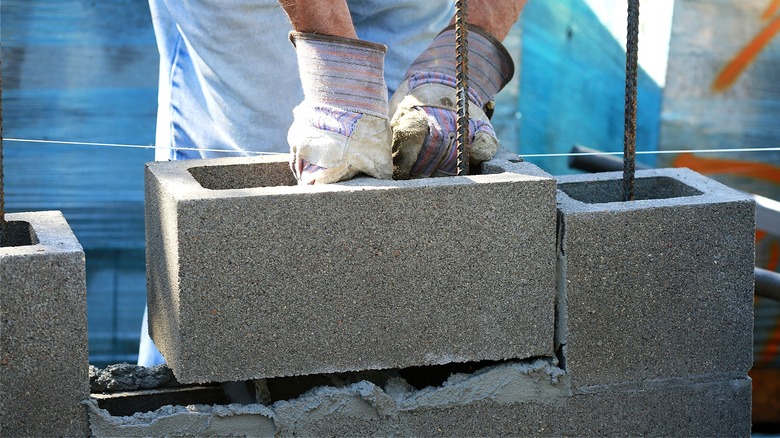
While working with concrete blocks on a project, you might have stopped to wonder why they're hollow. Concrete blocks are often designed with holes in the middle, with the most common designs featuring two hollow spots with a thin connective cement bar between the openings. Why? There are actually a few reasons why they come like this, including the fact that the holes make the blocks easier to haul.
Concrete blocks having holes is also related to strength and durability. Solid concrete blocks are technically stronger, but the holes in a concrete block allow users to adjust them to their needs. For instance, you can fill them with more concrete to make them as strong as solid blocks, or you can add reinforced bars through the holes for extra stability.
If all concrete blocks were solid from the start, they would 1) be much heavier and, consequently, more difficult to maneuver into position, and 2) they would lose their versatility, such as the option to add rebar. While some projects do call for solid blocks (such as foundations) others wouldn't be possible without the blocks being hollow. (See what makes concrete blocks different from cinder blocks.)
Other benefits that come with holes in concrete blocks
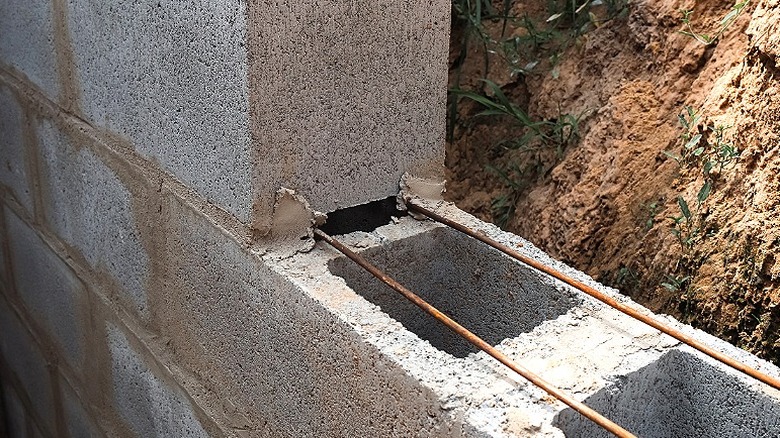
As mentioned, the holes make it so that the same concrete block can serve multiple purposes. For example, beyond rebar reinforcement, if you need to push something else through the block, like pipes or wires, there's a nice and easy space to fit cords and plumbing through. You won't have to do any frustrating drilling through the block, which can actually ruin its structural integrity, making it less durable.
Surprisingly, the holes also help to reduce sounds; it can make a room feel a little more insulated against noises in other rooms. The gaps also hold air that can help with temperature regulation.
Hollow concrete blocks leave space for creativity around the home as well. Because they are light enough for most people to handle but still durable, they make a great foundation for DIY projects, such as using the blocks as a bench or turning concrete blocks into wine racks for a fraction of the price, for those who like a more industrial look.
You can, of course, also use these versatile blocks outside of the home. For example, it's easy to build an epic succulent garden entirely from concrete blocks, with the cute plants filling in those hollow spaces.
A few things to consider with hollow concrete blocks
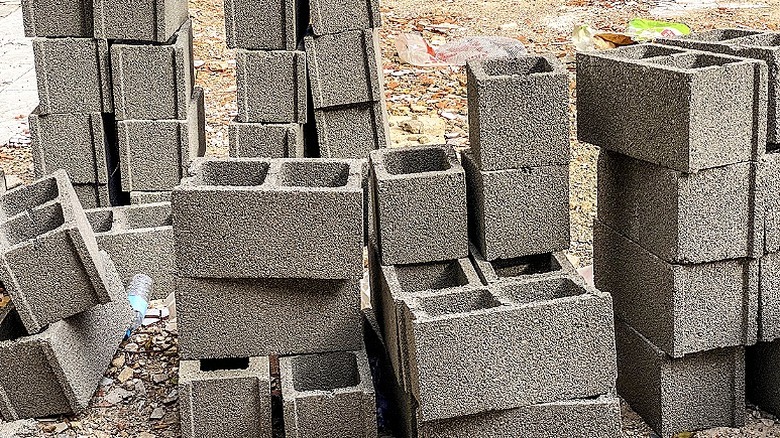
Though concrete blocks with holes in the center have a lot of benefits, there are also negatives to consider. For one, they tend not to be able to handle water very well. Since concrete is porous, the stones can expand and crack from temperature fluctuations. Solid blocks tend to be a little more stable than ones with holes in them.
Similarly, although hollow blocks do provide some insulation, filling them increases the benefits. However, that doesn't mean you have to use concrete. Sand, foam, and gravel are some examples of other options you can use to fill them and help insulate better.
When using concrete blocks for your own DIY designs, it's worth mentioning that not all of these hollow blocks are the same. Usually, they're broken into three groups: grade A, B, and C. A and B are a little thicker and are good for load-bearing structures. However, grade C is still useful when it comes to DIY projects or a small build that doesn't need to hold a lot of weight.
There are also different types of concrete blocks, depending on what you want to use them for, including ones that connect corners better, hold pillars, and have rounded edges for a smoother, more appealing visual.