

Ditch Concrete Blocks: How To Build A Retaining Wall From Rammed Earth
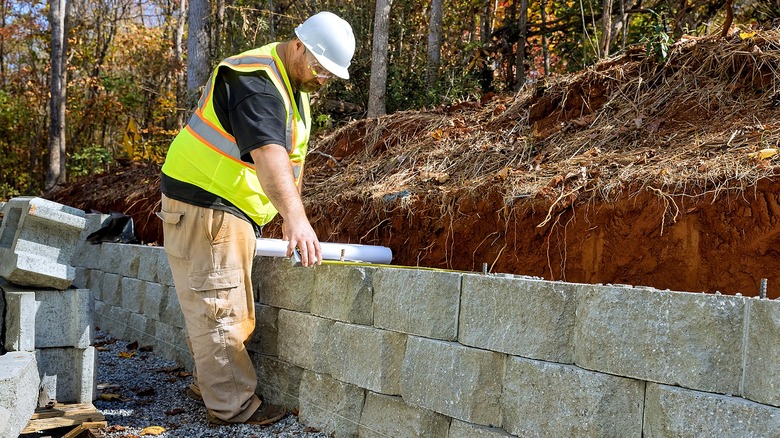
Concrete is almost a miracle substance; it's tough enough to use in construction, even for mighty dams. But the "almost" part of that sentence is a significant con to using the cement-based material. Concrete consumes a perplexing amount of energy to produce and relies on fossil fuels. While it'll leave you with a reliably solid retaining wall, its environmental impact is concerning. (Plus, concrete isn't particularly attractive.) To all this, we say it's time to say, "Goodbye, concrete," and hello to rammed earth, an eco-friendly alternative to highly polluting concrete.
Rammed earth is an ancient technique that compresses clay soil, gravel, sand, and water into one rock-hard substance, one that's arguably better looking than standard gray concrete. A retaining wall made from rammed earth will do a job comparable to concrete blocks while being nicer to look at, and much lighter on the planet.
The ingredients to DIY a rammed earth wall are affordable, while the process itself isn't highly complicated to grasp (although it is work-intensive). It's possible to construct your own rammed earth walls with little more than soil, water, a reinforced wooden form, and a few other tools. However, it's not fair to oversimplify the process. While the steps are somewhat basic, there are a lot of them.
For your own rammed earth retaining wall, you'll need generous amounts of clay soil, coarse sand, ⅜- to ½-inch rocks, water, and — yes, sorry — a bit of cement. As for the tools, you'll need an 8-inch-by-8-inch tamping tool, a pallet knife, a shovel and/or trowels to hand-mix the ingredients, and a form. You can build your own formwork with 1-inch-by-8-inch boards, plywood, two-by-fours, pipe clamps (and pipes), and a saw.
A few rammed earth considerations
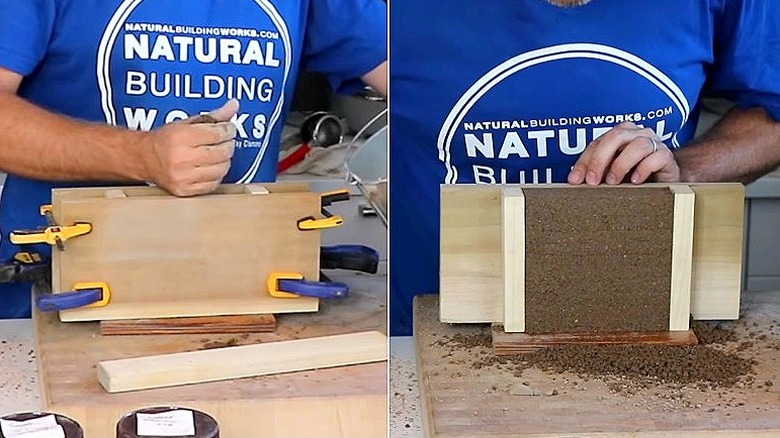
Before you go all in on building your new rammed earth retaining wall, there are some important considerations to know about, starting with cement. After digesting its ecological ills, you may want to opt out of cement for good; however, a small amount in your rammed earth mixture will help your work withstand the elements. Also, keep in mind that rammed earth also needs about at least one month to cure fully before it reaches peak strength. This long cure time may require you to add supports such as rebar.
If possible, arranging a short consultation with a professional could save you a lot of headache (as well as backache). They can also advise on how to prepare where the rammed earth wall will sit so that it will be securely anchored in place. Further, while you can use dirt from your own yard, you'll likely need to bring in additional earth from elsewhere. It's also probably wise to plan your build for the dryer time of year, given rammed earth's long cure time. Finally, you could start with a scaled-down version to practice the process (above right), following a tutorial like this one from Natural Building Works.
Stirring up the earthen mixture
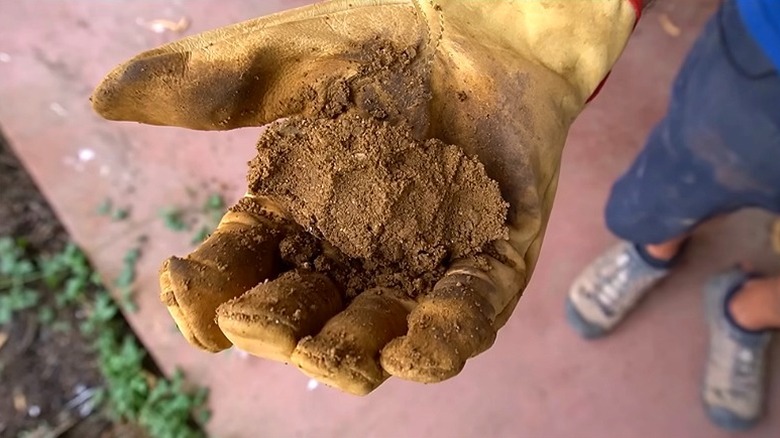
Mix up this old school building material with 3 parts clay soil, 2 parts course sand, and 1 part small rocks. Pour in enough dry cement to make up 3% to 7% of the mixture. (Be sure to wear protective gear, including safety gloves, eye protection, and a mask, while working with the dry cement.)
Combine the dry ingredients before slowly stirring in the water. Add water by sight and feel; the mixture should be damp with still some dry spots. It's ready when you squeeze a handful into a ball, and it should hold its shape.
To test, drop the ball from shoulder height onto a hard surface. The pile should peak at its center, while drier crumbles spray outward. If your rammed earth mixture doesn't pass these tests, mix in water until it does.
As for how much rammed earth you'll need for a retaining wall, it will depend on how tall your wall will be; i.e., 2 feet high, 3 feet high, 4 feet high. Know that as you build the wall up, each time you add rammed earth to the formwork, you will tamp it down to about half that. So, for example, if you add 4 inches to start, you won't be ready for the next layer until that first layer is a super-dense 2 inches high.
Building your rammed earth wall
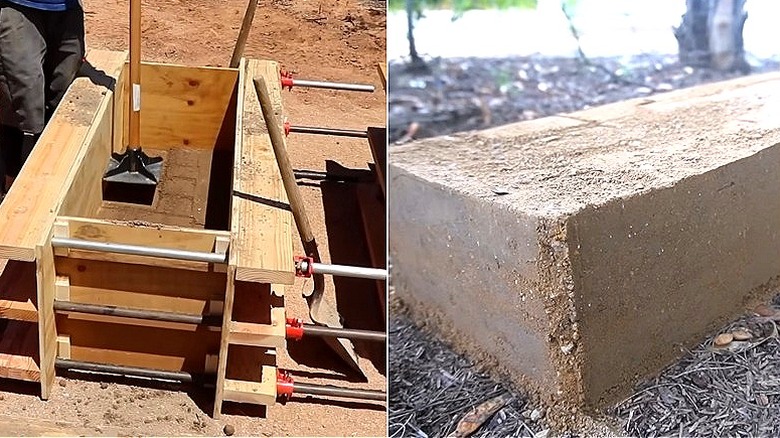
To build your formwork, you'll use the 1-inch-by-8-inch boards, plywood, two-by-fours, pipe clamps, and pipes. The pipes and pipe clamps are highly important as they will hold the formwork together as the rammed earth is added, and the pressure builds between the parallel sides and shorter ends. If the formwork isn't strong enough to withstand the pressure of compaction, it will blow apart.
Above, you can see what a formwork will look like (left image). For the retaining wall's thickness, adjust this with the size of your end boards. For example, using 1-inch-by-8-inch boards, the wall will be 8 inches thick. For pipe clamps, an example would be one like this from Pony (Lowe's, $28.48), which is designed to hold a ¾-inch pipe and has a clamping force of 1,200 pounds.
The mold is also what makes building with rammed earth eco-friendly as the pieces are used over again. After the rammed earth cures, you undo the formwork to reveal the final piece. Then you start the process over again, using the same supplies.
To build the rammed earth wall, begin by scooping about 2 inches of the earthen mixture into the form, smoothing the top with a pallet knife, and packing down the surface evenly with your tamping tool; you should lose about 1 inch of height after tamping. Again, every time you tamp down the mixture, you'll lose about half of what you newly add.
Continue this process until you reach the desired height for your wall. Let your wall dry and cure before removing the wood form; how long this should take is another question for your professional, as it may vary according to your area's climate.