

13 Leafy Greens You Can Harvest All Summer Long (And 2 You'll Only Pick Once)
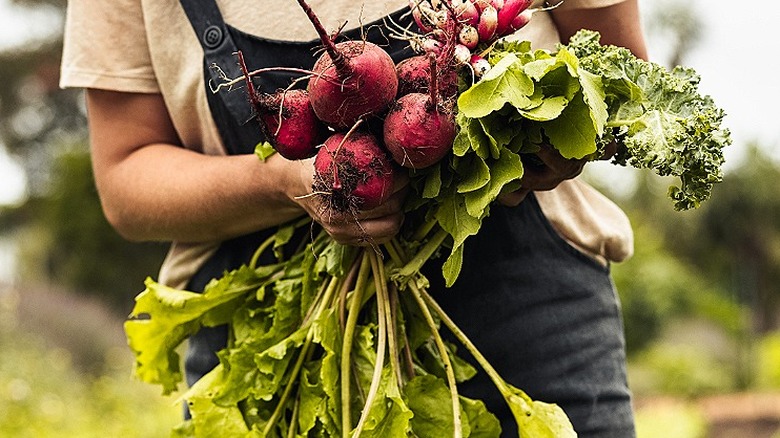
If you're new to vegetable gardening, it may surprise you to learn that many types of greens don't need to be picked all at once. In fact, these types of lettuces and green leafy vegetables are known as "cut and come again," because the main plant continues to produce new leaves after you remove several. If you leave the central part of the plant intact, you can harvest these greens all summer long.
Many varieties of lettuce (Lactuca sativa) can be picked throughout their growing season. Loose-leaf and loose-headed types can be harvested more than once, as opposed to the "crisphead" greens, which are harvested in one go once they mature. Similarly, many cooking greens — plus greens that can be enjoyed either fresh or cooked — are also of the cut-and-come-again variety. As with lettuce, it's helpful to know which are which.
In general, all types of leafy greens are among the essential garden vegetables worth growing. Depending on your needs, it's often helpful to grow both cut-and-come-again vegetables and tight-headed greens in the garden. Each boast their own advantages. For example, you can easily make individual salads when you like by snipping just a handful of leaves from your growing loose-leaf or loose-head lettuces. At the same time, it's also helpful to have heads of crispy iceberg lettuce or cabbage set in the fridge for when you need them.
Loose-leaf lettuces create a never-ending salad bowl
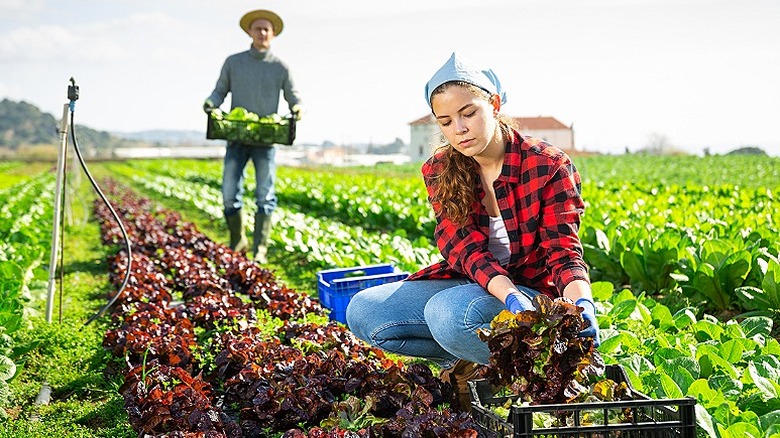
For an endless supply of lettuce, try the clever harvesting method of the cut-and-come-again trick. The main thing to watch out for is that you're using it on the right kind of lettuce. Often considered the easiest salad green to grow, loose-leaf lettuces don't form any type of head at all. Instead, the outer leaves can be harvested once they reach 3 or 4 inches in length. It's preferable to cut from the base, near the soil, so that your lettuce continues to reward you with a harvest as long as possible.
Typically, you will sow loose-leaf lettuce seeds in mid-spring, when the ground is warm enough. Depending on the variety, the leaves will be ready to pick between 40 and 50 days after sowing. The lettuce tends to "bolt" in the summer heat, and may become unusable at the height of summer. But you can begin another round of this cool-weather crop in late fall.
Green loose-leaf lettuce types include 'Black Seeded Simpson' and 'Salad Bowl,' both of which produce harvestable baby leaves in as little as 35 days. If you prefer red loose-leaf lettuce, or like to mix them with your greens, consider 'Red Sails.' It can take almost 50 days to mature, but is also slower to bolt in the heat. Other red loose-leaf types include 'Red Oak Leaf,' the darker 'Merlot,' and the frilly 'Red Velvet.'
Loose-headed lettuces allow for continual harvests
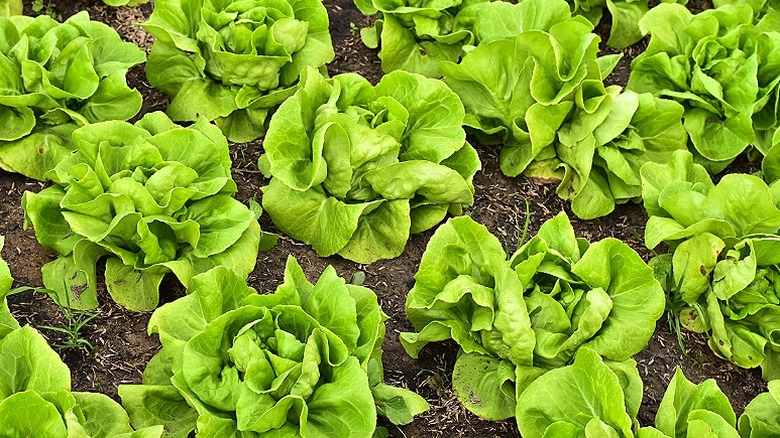
Loose-headed lettuces can be harvested for their entire head, but they also work as cut-and-come-again greens. This type, which includes butterhead and Romaine lettuces, form something of a middle ground between loosey-goosey leaf lettuces, and tight-headed greens like iceberg. They're also better at handling the heat (especially Romaine), making them good "bridge" plants for the cool-season lettuces.
Butterhead lettuces, as their name suggests, provide the most tender of leaves in the "head" category of lettuces. They're also known as bibb or Boston lettuce. When harvesting just the outer leaves, remove each leaf close to the soil line (about 2 inches above), and harvest no more than half of each butterhead lettuce at a time. It takes around 60 to 75 days for most butterhead types to mature. Among the varieties of butterhead lettuce are buttercrunch and red Boston.
Romaine lettuces grow upright, and are also head lettuces. Their shelf life is somewhat between that of iceberg and butterhead types. These are also known as cos lettuces. Their upright-growing form leads to firmer, broader leaves. It's not hard to master how to start growing Romaine lettuce in your garden. If you grow them to harvest as a heading lettuce, they mature in 70 to 75 days. But you can begin to pick them much earlier if you're using the strategic cut-and-come-again method.
Many cooking greens also yield summerlong nutrients
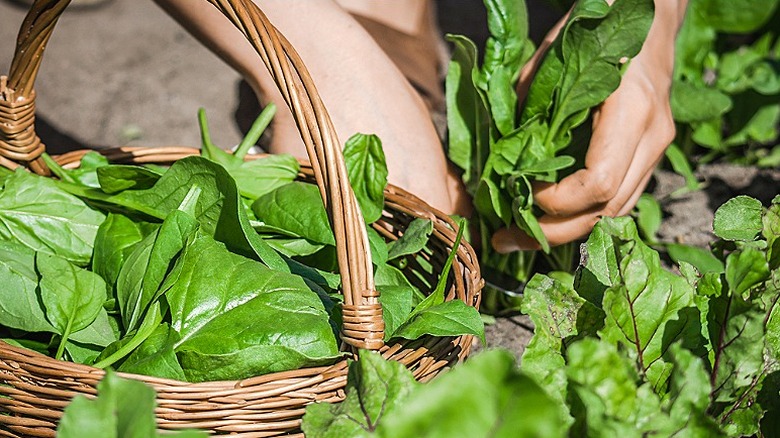
Like many lettuces, some cooking greens, like collards, grow in a (loose) rosette pattern that lend themselves to the cut-and-come-again harvest method. Most of these are primarily used for cooking, but some, like spinach (Spinacia oleracea) and Swiss chard (Beta vulgaris var. cicla), have tender "baby" leaves that can also be tossed into fresh salads.
Spinach grows best in the spring and fall, and prefers partial shade. Both the stems and leaves of Swiss chard, meanwhile, are edible, and produce all summer. Break the individual leafy stems about 1 inch from the soil line when harvesting the outer leaves.
Kale (Brassica oleracea, var. acephala) is among the cool-weather crops to harvest in the fall for the best flavor. Note that outer kale leaves need to be snapped, cut, or twisted off. Do this when they're roughly 8 to 10 inches long.
Fast-growing mustard greens (Brassica juncea) are at the height of their flavor before they reach full size. Snip outer leaves when they're about 6 to 8 inches in length. Like spinach, mustard greens are at their best during the cooler months, and will probably need a re-sowing in the fall.
Collards (Brassica oleracea var. viridis) handle the heat a bit better than mustard greens. They also produce larger leaves (up to 1 foot), and you can begin harvesting the outer leaves once they reach 6 inches long. Though, if you want less tender leaves, wait until 10 to 12 inches.
Double-duty veggies provide both edible roots and leafy greens
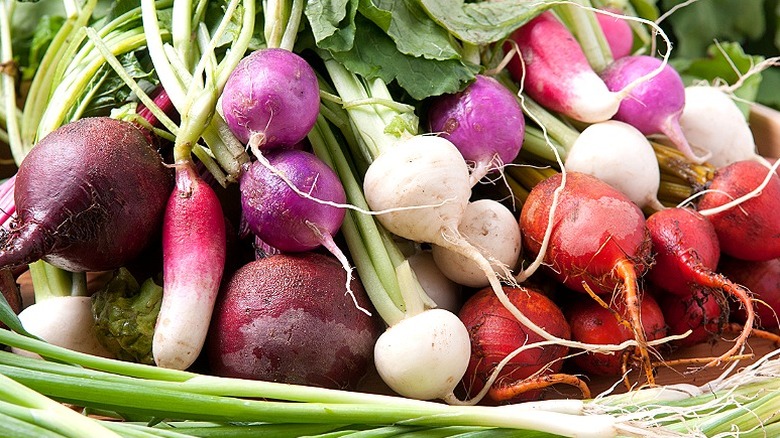
While supermarkets usually stock vegetables like beets and turnips for their roots, some gardeners grow them for their leafy greens, or as a double-duty vegetable. When growing vegetables that grow underground as dual-purpose plants, you can harvest some of the outer leaves for cooking, then the root itself at the end of the growing season.
The first "greens" of the season — although one unlikely to fill the greens pot by themselves — are radishes (Raphanus sativus) and their cousins, daikons (R. raphanistrum subsp. sativus). Use the tops of both vegetables fresh to add a spicy note to your salads, or cook them as you might spinach. The easiest way to make use of radishes and daikons is to keep re-seeding the plants, so that you can pull up the whole plant and use the roots and greens separately.
When growing turnips (Brassica rapa var. rapifera) and beets (Beta vulgaris var. crassa) for both their roots and leaves, space them about 18 inches apart so that the below-soil part of the plant has room to develop. Sparingly harvest the leaves when they're about 4 to 5 inches in length. If you're only interested in turnip and beet tops, space them closer together.
And don't forget rutabagas (Brassica napus var. napobrassica), another root vegetable whose leaves can be grown as greens, too. Even if you don't harvest it during the season, make use of the tops after picking the root.
Head lettuces and greens can only be harvested once
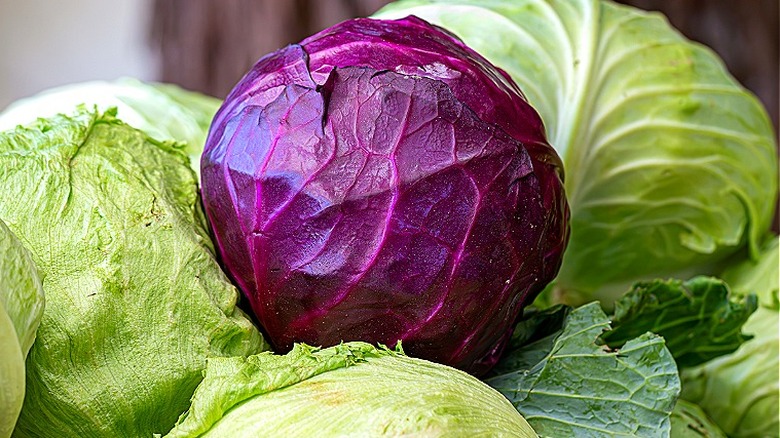
Leafy greens which form a tight head are harvested only once in a growing season. Harvest time comes when the head has matured, at which point the entire plant is removed from the soil. While they don't let you "come again" throughout the summer, these types of greens do provide a large amount of fresh leaves all at once.
Iceberg is perhaps the most well-known lettuce. It's also known as "crisphead" lettuce, and is considered among the more challenging types to grow. Icebergs may have waned in popularity over the years as a preference for darker colors have come into vogue, but they lend undeniable crispness to a salad or a sandwich. One advantage of iceberg lettuce is that it can last up to three weeks in the refrigerator after picking. (A less-crisp subcategory of crisphead is the frillier 'Batvia' type.)
Cabbage (Brassica oleracea var. capitata) is the other leafy green which grows as a head. As with iceberg lettuce, because the outer leaves of cabbage grow so tightly around the rest of the head, it's impractical to harvest outer leaves through the season. Depending on the variety, cabbages can take between 55 and 100 days to mature. At this time, the entire head is chopped off at the soil line.