

Landscape Fabric Vs Weed Barrier: What's The Difference?
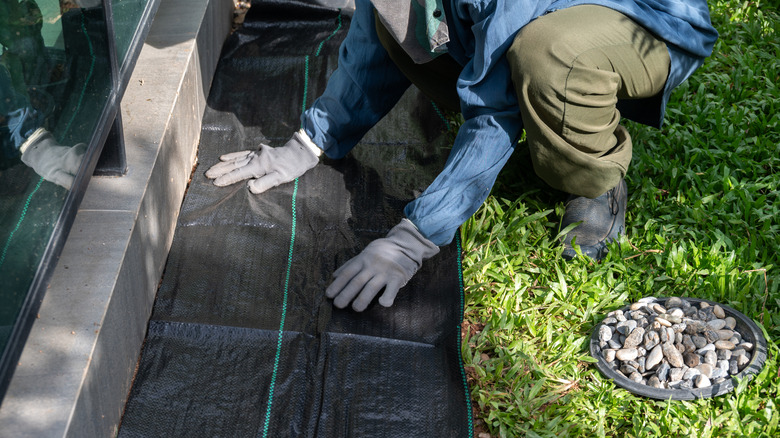
Whether you're buying paint or replacing your garden hose with an co-friendly alternative, shopping for home and garden products can often feel overwhelming. These purchasing decisions don't always matter that much, but sometimes when you choose the wrong product, there's more at stake than simple aesthetics. If you're standing in the aisle looking at landscape fabrics and weed barriers, it's important to know the labels aren't just for marketing. While these two terms are often used interchangeably, there is a difference between landscape fabric and weed barriers. Landscape fabric is actually a type of weed barrier, but more to the point, it's also included on another list: geotextile materials.
Technically, a weed barrier can be anything you put on the ground to prevent weeds from growing. This includes landscape fabric, but it also includes alternative materials that prevent weeds, such as mulch, cardboard, bark, fabric, and even old carpet. Synthetic and plastic mulches might also be considered weed barriers.
The geotextile category is also made up of synthetic materials, but these products differ from the those in the weed barrier category. Synthetic geotextile materials started being used in the late 1950s for civil engineering. While they can also block weed growth, they're designed to perform other important functions, such as filtering soil for drainage and stabilization. Mulches, cardboard, and other weed-blocking materials are not geotextiles. But landscape fabric is both a weed barrier and a geotextile, which is part of what makes the nomenclature so confusing.
How weed barriers and landscape fabrics are used differently
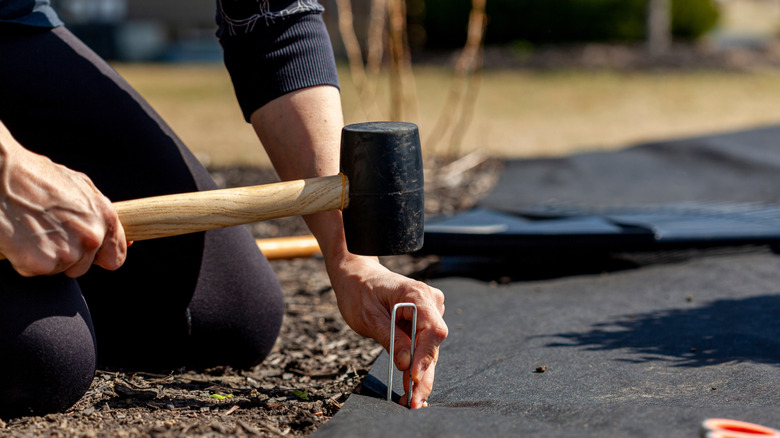
Landscape fabric and other weed barriers can both block weeds effectively, so the choice between them comes down to what else your project needs. Drainage is a major factor. Woven landscape fabric suppresses weeds, but the fine particles of dirt eventually clog it and slow water from passing through. Non-woven landscape fabric is built for filtration and lets water move freely. Loose weed barriers like mulch, tree bark, or gravel allow water to pass. However, compared to landscaping fabric, biodegradable mulches will break down, and gravel will eventually sink into the soil without any fabric underneath. For perennial and shrub plantings, organic mulches are a good choice because they can be reapplied and they feed the soil over time.
Location also matters. Landscape fabric works best in high-traffic areas like paths. When it's used in flower beds, your plant roots could weave themselves into the fabric. This means you'll be ripping and tearing roots out when you eventually have to remove the fabric. If there's direct sun exposure, unprotected landscape fabric can degrade in as little as a year. Unlike gravel or mulch, it already lacks aesthetic appeal when it's not covered, but it looks even worse as it deteriorates.
At the end of the day, you may be choosing between a loose weed barrier and landscaping fabric based on price. A bulk order of mulch, for example, costs $30 to $135 per cubic yard, which works out to roughly $0.28 to $1.25 per square foot at an average depth of 3 inches. A landscaping fabric like Sta-Green 50-foot by 3-foot Basic Weed Barrier from Lowe's only costs about $0.10 per square foot, so you may be able to cover more ground at a lower cost.