

The Affordable Product That Efficiently Fills Hairline Cracks In Concrete Retaining Walls
We may receive a commission on purchases made from links.
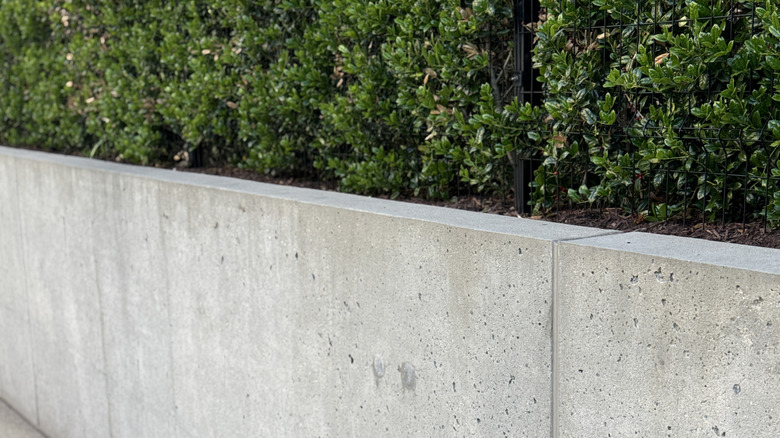
There have been a lot of product innovations when it comes to paints, epoxy coatings, and sealers. Some of them are quite expensive, and with all the choices available, it's easy to purchase a product that's not quite right for your project. The good news is that if you're looking for an affordable product to fix hairline cracks in concrete retaining walls, elastomeric paint is a far better solution than standard exterior paint.
Originally introduced in the 1950s, elastomeric paint was first used as a roof coating. Over the years, the product has become a popular choice for a variety of exterior home improvement projects. Elastomeric is a blend of "elastic" and "polymer," which is a good way to describe how this film can stretch up to 300% more than regular paint. The long molecule chains in this coating allow it to expand and contract, making it perfect for bridging the hairline cracks in retaining walls and other masonry surfaces.
Retaining walls are one of the top uses for elastomeric paint, since they're subject to forces like hydrostatic pressure and moisture on one side and wind and weather on the other. Behr's 1-gallon Elastomeric Masonry, Stucco and Brick Exterior Paint can withstand up to 98 mph wind-driven rain, lasting about 10 to 15 years when applied correctly. One gallon can cover approximately 75 to 125 square feet of retaining wall.
How to apply elastomeric paint to a retaining wall
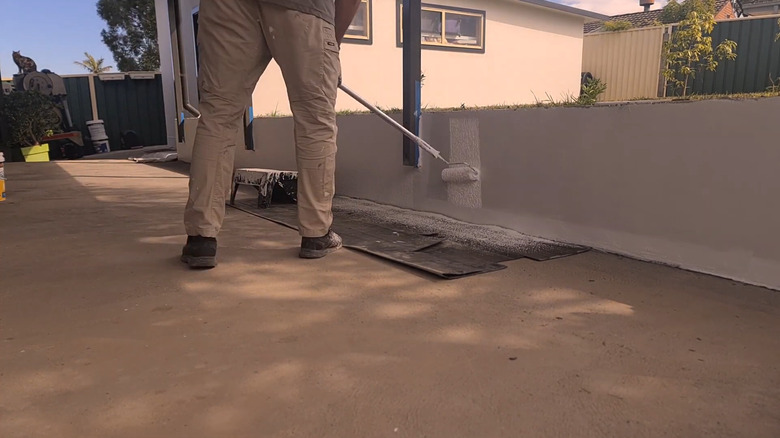
Just like with epoxy coatings for refinishing your patio, surface preparation is a critical step when you're applying elastomeric paint. The make-or-break step is powerwashing to remove dirt, chalk, and mildew, as well as old peeling paint if the concrete has been painted before. For dirt and grease, using a masonry cleaner like Krud Kutter Original Concentrated Cleaner/Degreaser does the job.
While elastomeric paint is fine for hairline cracks, you should check your wall for anything wider than ¹⁄₁₆ inch. For these, the best approach depends on the size and cause of the crack. Larger surface cracks can be patched with a sealant like an elastomeric concrete patching compound. Different products have different cure times, so follow the directions on the package to ensure it hardens and cures before you paint. Any new concrete projects should be allowed to cure for at least 30 days before painting or sealing.
Behr's elastomeric paint should be applied without thinning, using two coats. Like all your outdoor projects, the best time to paint a retaining wall with elastomeric paint is on a dry day when the temperature is between 50 and 90 degrees Fahrenheit. Avoid any rainy or wet stretches — even excessive dew can impact adhesion and curing.