

How To Sharpen Hard-To-Reach Edges Using A Handy Tool
We may receive a commission on purchases made from links.
Sharpening your tools regularly is one of the best ways to keep them in good shape, maintain your safety, and ensure your work runs smoothly. In many cases, this is as simple as running a standard file along the edge to bring the dull angle back to a precise point, but you won't always be so lucky.
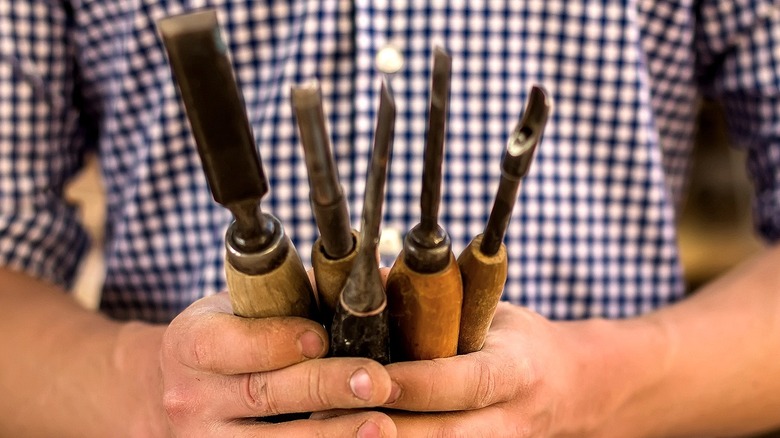
Oddly shaped tools, like those with concave or curved blades, can present major challenges when it comes to sharpening. As a result, these tools are often cast to the side — either condemned to a life of dullness after the first handful of uses, or tossed out in favor of their sharper replacements. With the right sharpener, however, this doesn't have to be the case.
Slip stones are sharpening tools designed specifically to reach those difficult-to-access edges. They're made of the same materials as other sharpening stones – ceramic, natural stone, and aluminum oxide are a few options – but their shape is what sets them apart. Rather than looking like a simple block, slip stones have curved or narrow edges that can fit within the radius of tools like concave knives, v-tools, gouges, chisels, and bevels.
If you've invested in tools to start woodworking at home, it's a good idea to pick up a slip stone to keep the interior of these specialized blades sharp and ready to deliver a precise finish. Regular flat whetstones can be used to sharpen the exposed exterior edges, but a slip stone will finish the job and help you tackle those inaccessible nooks and crannies that might otherwise be forgotten.
How to use a slip stone for sharpening
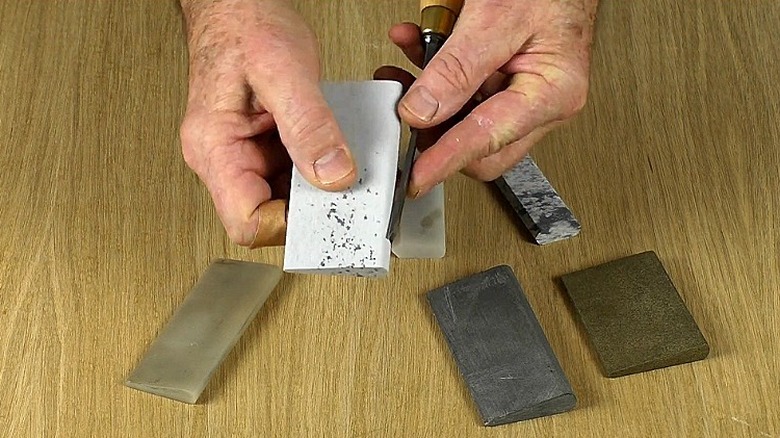
Before you get to sharpening, you'll want to make sure you've chosen a product that will work with the tool you have. Slip stones come in different grits, materials, and sizes. As a rule of thumb, coarser grits (around 220) can be used to smooth out large imperfections and nicks, while smoother grits (1,000 to 3,000) are for run-of-the-mill blade sharpening.
Size is also a big factor here — choose a slip stone with an edge that fits the edge of your tool's blade as closely as possible. This Taytools Genuine Hard (Fine) Arkansas Novaculite Slip Stone, for example, has a ⅜-inch rounded edge, making it the perfect size and shape for a ⅜-inch or larger gouge.
Once you've bought your sharpening stone, begin by sharpening the exterior of the blade with a normal, block-shaped whetstone. Start with a coarse grit. Follow up with a coarse grit slip stone on the interior of the blade — simply move the tool along the curved surface until you're satisfied that the blade has been shaped to your liking. From there, you'll want to repeat the process — exterior with whetstone, then interior with slip stone — but with a finer grit. This will finish things off and help you achieve a truly sharp edge.
While investing in a slip stone collection for your tools may seem like a hassle, they're incredibly valuable to have on hand if you're a frequent woodworker (and for beginners, they're among the tools worth investing in to start woodworking at home, too). Sharper blades mean less effort, as well as safer conditions and more precise cuts. What's more, having the ability to keep your tools in good shape at home can save you plenty on repurchases and professional sharpening services.