

Why Homeowners Are Ditching Sprinklers And What They're Using Instead
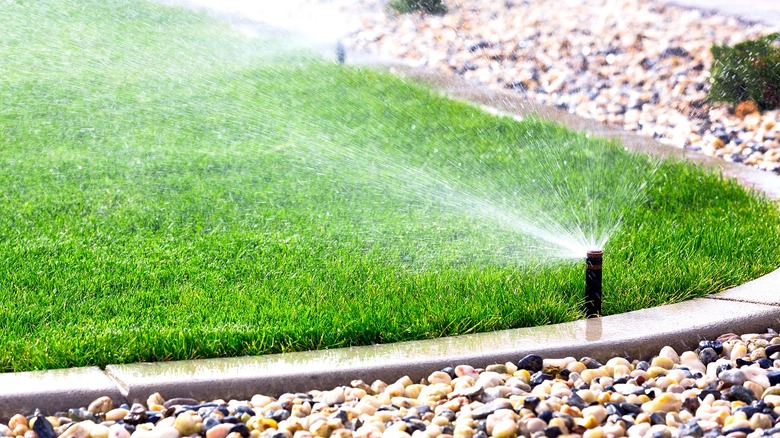
Walking through the neighborhood on a summer evening used to feel a bit like a water show, with oscillating sprinklers (the kind you jumped over as a kid) gently cascading water across a lawn. Or you might have become used to the tik-tik-tik-ssshhh of an impact sprinkler providing a background beat to your stroll. But if lately you've had to dodge fewer sprinkler showers on your walk and started to wonder why homeowners aren't using sprinklers as often anymore, you're not the only one to notice the shift. More homeowners these days are switching to another watering technique: drip irrigation.
Like sprinklers, this is an easy way to automate your plant watering. In case you're unfamiliar with drip irrigation versus sprinklers, here's how the former works: Small permeable hoses distribute water at the base of your plants. Usually, these hoses are buried under a shallow layer of mulch or earth. Connected to the hose is a dripper — aka, an emitter – that trickles out water to the surrounding area. Another name for drip irrigation is trickle irrigation.
Installing drip irrigation is usually considered a DIY project. It requires basic supplies, and a little pre-planning regarding where to put the hoses and emitters, but it doesn't need advanced plumbing or landscaping know-how.
Drip irrigation can reduce your water usage
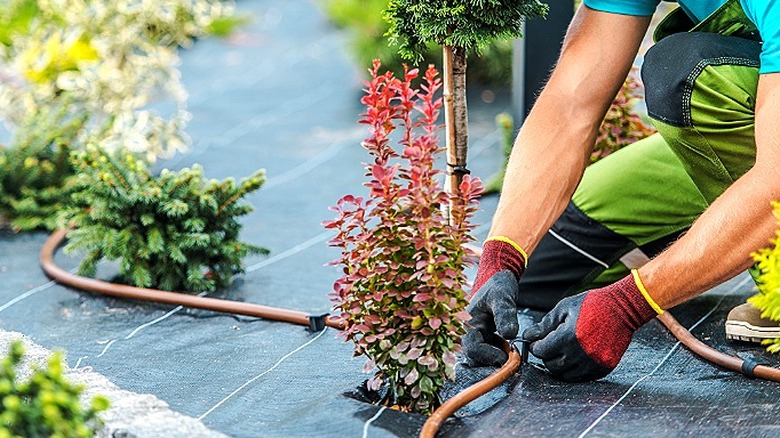
Aside from saving you the time and effort it takes to water the yard and garden with a watering can or hose, drip irrigation offers other benefits — namely, it saves water and distributes that water more evenly. Consider that not all the water broadcast through a sprinkler reaches the ground. You lose some water to wind drift loss and evaporation.
On the other hand, drip irrigation delivers a trickle of water right where you intend it to go via a network of hoses that you install. According to Colorado State University, "Drip irrigation exceeds 90 percent efficiency whereas sprinkler systems are 50 to 70 percent efficient." Further, while sprinklers tend to soak some areas of a yard more than others — depending on the angle — drip irrigation setups give a uniform saturation wherever the hose reaches.
Some of the most common scenarios for using drip irrigation include cultivated areas of your yard, like a flower or vegetable garden or around landscaped trees and shrubs. Just be sure to keep a close eye on areas of your yard where you use drip irrigation; because the water emitters are frequently concealed, it can be hard to spot a clogged water line.
Inspect the drip-irrigation area regularly to ensure that water is flowing freely and that you have sufficient coverage for the plants in the area. If you notice that your plants are looking dehydrated, you need to be prepared to do a little digging to uncover the problem spot.