

The 5 Best And Most Reliable Materials For A Workbench Top
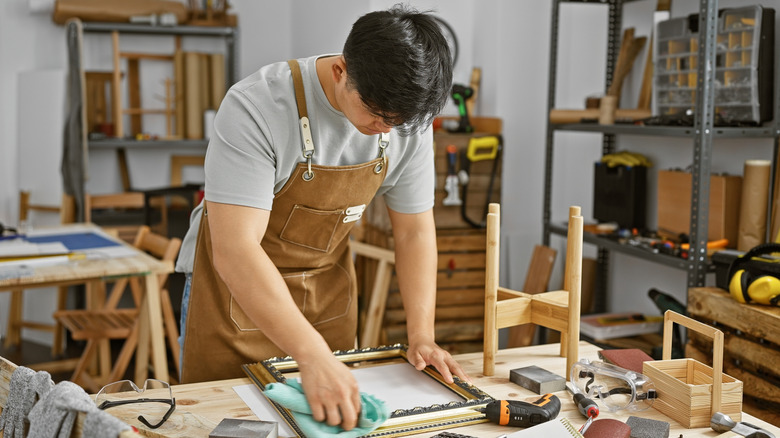
There are plenty of useful articles about which tools to invest in to start woodworking at home, but you won't get far without a decent workbench. It needs to be sturdy, and the worktop itself has to be flat. It's bound to get marked and have chunks taken out of it eventually, but the surface has to be level or your accuracy will suffer. I've been a carpenter and remodeler for over 25 years, and I've built a few benches in my time. Today we're going to look at what I think are the best materials to give you a reliable surface to work on.
There's nothing to stop you getting some 4x4s and 2x6 pine boards from your local hardware store and nailing a rudimentary bench together. It will serve a purpose. Pine is soft though, so it's easy to damage and tends to warp with changes in humidity. There are those who would argue that for simple beginner woodworking projects, that kind of surface is adequate. I disagree. A poor workbench top makes it difficult to make pieces well, and if you're put off from the get-go, you're more likely to give up.
You don't have to spend a fortune on a good workbench top. Some of my suggestions aren't cheap, but other materials are very affordable and widely available. Let's get to it.
Solid Hardwood
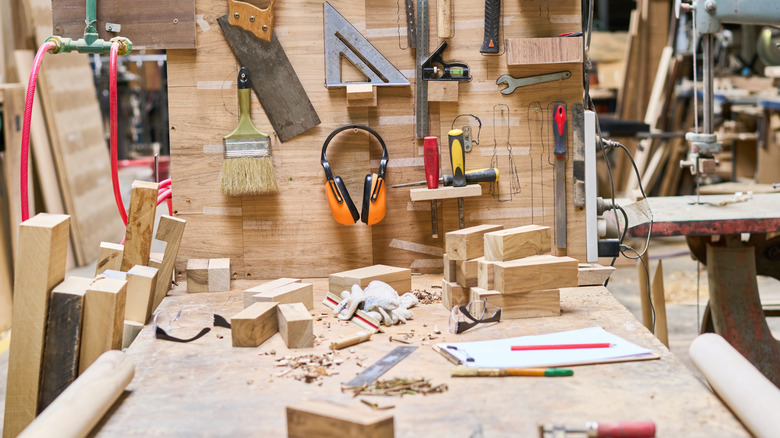
If you buy a budget workbench for a few hundred bucks, it will probably come with a rubberwood worktop. Despite the name, rubberwood is botanically a hardwood. It has medium density and is quite tough, making it a decent choice for DIY use.
However, premium workbenches use either solid beech (often European, which is harder than American) or hard maple. Both are close-grained woods and when properly prepared, they are very stable and hard-wearing. This is the workbench that can last a lifetime, but the big drawbacks for that quality are price and availability. A high-quality solid hardwood bench is a beautiful, artisan-made thing, but it can cost thousands of dollars.
The top itself will typically be three to four inches thick. If you're trying to save money and buy just that, rather than the whole bench, it's not the kind of thing you'll find at a big box or hardware store. Your choices are either to locate a craftsperson who will make one for you or visit a lumberyard, buy the wood, and make your own. I appreciate that neither of these is practical for most people, but for the serious woodworking enthusiast or professional, it is the best workbench material available.
Butcher's Block
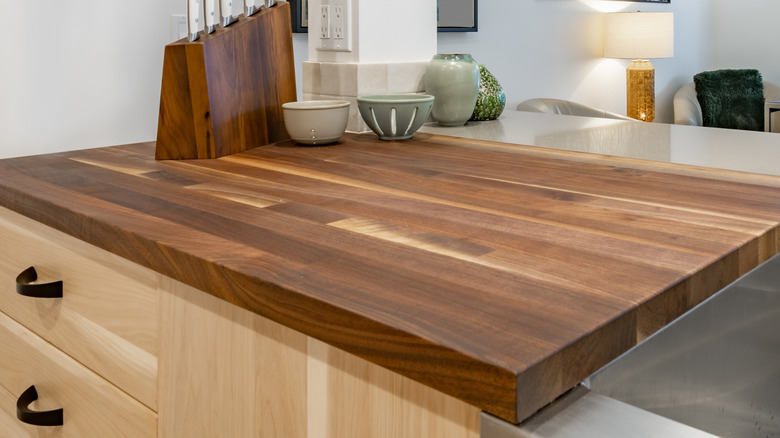
If you want the benefits of hardwood but in a workbench top that is more affordable and more readily available, look for what's called butcher's block. This is something that you can find at your local big box store, but you need to be careful to only buy solid wood. It is also available as a laminate, which is basically a printed skin wrapped around a composite core. You don't want that at all.
Real butcher's blocks are made from small pieces of hardwood glued together and then machined flat. Originally they had the end grain uppermost, providing an almost self-healing surface for the knives and axes used by butchers. The downside was that blood and meat juices would also penetrate the wood over time. Modern versions usually have the blocks set horizontally.
You will often find them sold as kitchen countertops, but they are equally good for a workbench. Rubberwood is again one of the wood species offered, as are birch and walnut. However, acacia is the hardest of those woods generally available, and that's what I would buy.
MDF (Medium Density Fiberboard) or Plywood
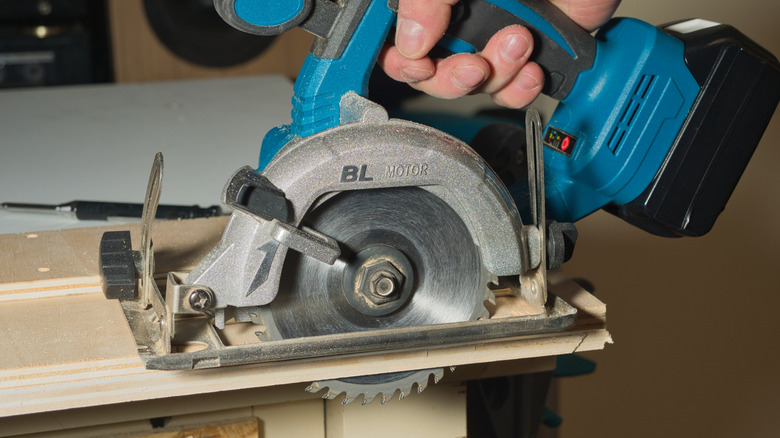
Although these two materials are somewhat different, I've gone for a twofer because both are used for what we call sacrificial workbench tops. They are relatively low-cost (MDF is normally cheaper) and are available as 8x4 sheets from hardware stores. Maximum thickness is usually ¾ inch, and that's what I get. Cut the sheet to the size you need and simply screw it to your bench. When it gets too beat up, just replace the old sheet with a new one.
I prefer plywood, which is made from thin sheets (veneers) of wood glued together in layers, with each one at a 90 degree angle to the last. This offers a lot of strength and stability. Plywood splinters are surprisingly painful, so be careful when you lift a board, and be sure to sand the edges of the worktop thoroughly once in place. MDF is made from wood particles and resin glue compressed together. It's easy to work with, doesn't produce splinters, and stays flat, but is very dusty when you cut it. Personally, I prefer not to use it, but it is the most budget-friendly way to produce a stable workbench top.
HDPE (High Density Polyethylene)

If you're looking for a scientific or classroom-type workbench top, one that's resistant to all kinds of chemicals and easy to keep clean, you have two choices: stainless steel or HDPE. I'm not including stainless steel here because it's very expensive and needs to be installed by a pro. It's fine for a high-end kitchen maybe, but I can't imagine using it in a workshop.
HDPE is also pretty pricey at $250 or more for an 8x4 sheet a ¼-inch thick, but for some it will be worth it. It shrugs off just about any liquid, including things like petrol and even acids, making it a breeze to wipe down when you're finished. It can be a great surface for hobby and craft work and is very durable under most circumstances. That said, it will melt above 230 degrees Fahrenheit. So if you were making candles, for example, you wouldn't want to put a hot pan of wax onto it straight from the stove. You should also avoid naked flames (although that's true of any wooden workbench too).
If you'd like a workbench top that's a bit brighter than usual, in addition to black or white, HDPE also comes in a range of vibrant colors. Like many plastics, it is petroleum-based, so it might be something to steer clear of if you are keen to create a more sustainable home. That said, I understand it is relatively straightforward to recycle it.