

How To Identify A Snapping Turtle In Your Yard
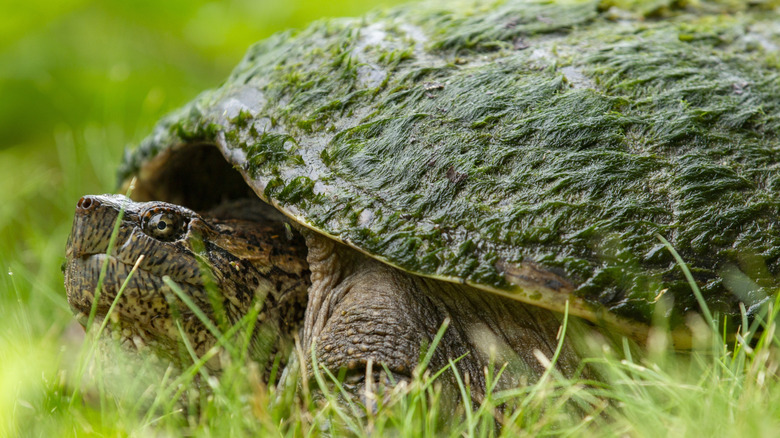
Turtles are some of the oldest reptiles in the world — and to some reptile enthusiasts, they might be the cutest. They've evolved over the last million or so years to live on land, in water, or sometimes both. Spotting turtles in your yard can be great for homeowners, but when you cross paths with one that hisses at you like you're the intruder, you might feel differently. That grumpy turtle could be a common snapping turtle (Chelydra serpentina), which are known for having sassy attitudes when they feel threatened. But on the off-hand chance it isn't spewing anger in your direction, how can you figure out whether it's a snapping turtle for sure? There are a few things to look at for a quick identification without getting up close and personal.
Not every turtle strolling through your yard is a snapping turtle, however. In fact, the majority are probably just regular turtles, like box turtle, which are easy to identify by their rounded shells and smaller heads. Snapping turtles have a prehistoric, Godzilla-like vibe, but some other tell-tale signs can help you spot the differences. The good news is that snapping turtles are hard to miss, and will most likely be one of two species: a common snapping turtle or an alligator snapping turtle. Common snapping turtles (Chelydra serpentina) can reach between 8 and 14 inches long and weigh between 10 and 35 pounds, while alligator snapping turtles (Macrochelys temminckii) grow much larger, topping the scales at between 35 and 175 pounds. They're a lot bigger than, say, a common box turtle, which averages only 6 inches long. A regular turtle and snapping turtle are two very different beasts, and it's important to know how to tell one from the other before going anywhere near it.
Snapping turtles are large and formidable, but mostly harmless
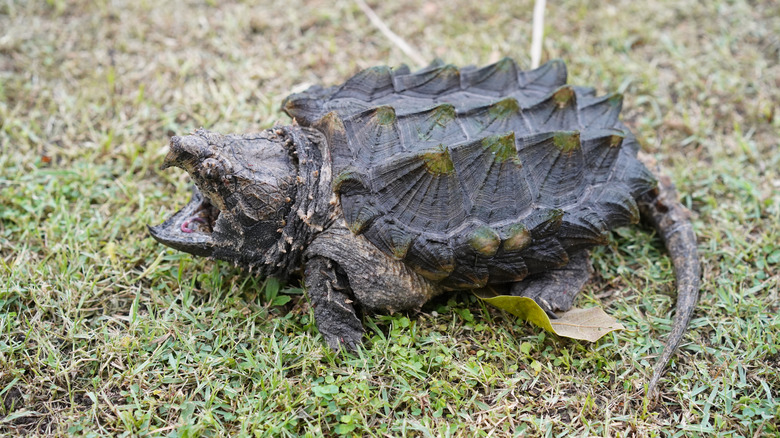
Start by looking at the shell. Box turtles have a smooth, dome-like shell, giving them a cutesy appearance. Snapping turtles don't. Their shells are flatter, and alligator snapping turtles have big ridges. They could be covered in mud or algae, which only exaggerates their rugged look. Next, one of the most obvious clues is the head. Snapping turtles have oversized heads and powerful, hooked jaws that look like beaks. Their necks are extra long to stretch far beyond their shell. Most other yard turtles look dainty by comparison. The tail is another giveaway. A snapping turtle's tail is unusually long and thick. A typical turtle will have a much shorter, less prominent tail.
One of the most likely times you may encounter a snapping turtle in your yard is during mating season, which lasts from April to November but peaks around June or July. Males usually stay near water, but a female turtle may choose your yard as a safe place to lay her eggs. What should you do if you find a turtle nesting in your yard? If it's a snapping turtle, don't pick it up and stay away from the head. They have the jaw strength to take off a finger if given the chance. If you stumble upon eggs in your garden and they look like little ping-pong balls in a carefully constructed hole in the soil, they likely belong to a snapping turtle. The best thing to do is leave them alone until they hatch in about 80 to 90 days, since these ancient creatures play an important role in the ecosystem. Given time, snapping turtles will return back to the water, but you can call a local wildlife rescue service if necessary.