

The Clover Variety That'll Fill Your Yard With Low-Maintenance Pink And White Flowers

Do you have spots in your yard that are looking dull and brown? Are you interested in swapping some of your lawn for something more low-maintenance, and doing away with all the watering and mowing that is often needed for grass? If so, then you aren't alone. One great way to make your yard more visually interesting, easier to maintain, and more beneficial for the local ecosystem is by adopting clover.
When picturing clover, you might imagine a generic green bed of leaves with simple white flowers. However, that isn't always the case. There is actually a stunning pink and white clover variety that is not only a perennial but also incredibly low-maintenance. This variety is called strawberry clover, also known by its scientific name Trifolium fragiferum. It covers the ground with thick, creeping stems called stolons that can smother weeds, and it is great for attracting more birds to your yard.
In addition, it can withstand a variety of soil types — such as salty soil or even clay — so you likely won't have to do too much to your soil in order to help strawberry clover thrive. It does well in cool climates but can also tolerate hotter temperatures than other clover types, so it is typically described as doing well in Hardiness Zone 4 all the way up to Zone 9. Strawberry clover typically flowers from May to June, meaning your lush green carpet will have a beautiful pink accent throughout a good portion of the summer. So, let's take a moment to explore how to grow strawberry clover so that you can create a low-maintenance lawn yourself.
Growing strawberry clover in your yard
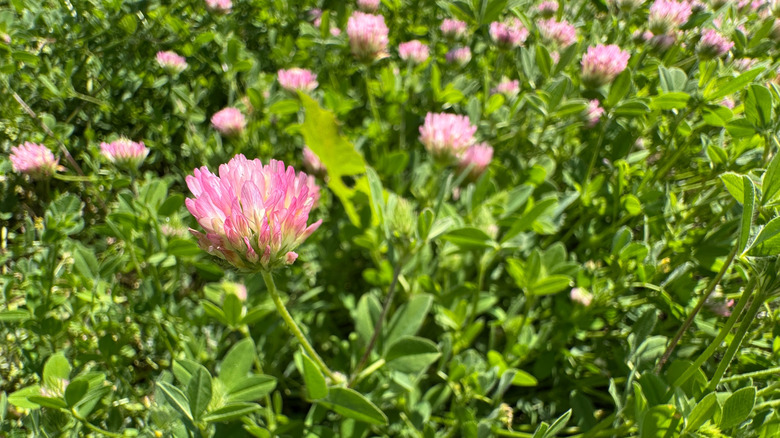
To create a thick, stunning bed of strawberry clover and ensure that it flowers well throughout the summer, it is important to be aware of its growing requirements, though these are relatively simple because it's such a low-maintenance option.
First, it is generally best to plant strawberry clover seeds after the final frost in early spring, though you can also plant them at the beginning of fall if you have missed that window. While this clover variety can tolerate some shade, it generally grows best in areas where it gets full sun. Make sure to plant the seeds at a relatively shallow depth — about 1/8 of an inch — as they are small and will need to be able to reach the surface. Then, make sure to water the seeds regularly to ensure the soil remains moist while they get established.
Luckily, strawberry clover is able to withstand a high degree of flooding, so you won't have to worry about it too much during spells of excessive precipitation. However, this plant grows best when it is situated in well-drained soil, so having some gravel or sand mixed in could help to ensure that its growth isn't stunted by perpetual wetness. If you are using the strawberry clover as an easy grass alternative rather than to just fill out some empty areas or borders, you can also mow it once or twice a year after it is established to keep it at a good height. If you want a bit more variation in your landscape, you could also try growing strawberry clover alongside other varieties for even more visual interest in your yard.