

How Much Weight Can Standard Cinder Blocks Hold?

Standard cinder blocks, those 8x8x16 inch concrete units that look like a thick, rectangular figure 8, are a popular choice for the foundations and basement walls of residential buildings, garages, schools, and warehouses. Despite their fame, most of the ones you see aren't technically cinder blocks — they are Concrete Masonry Units (CMUs). The original name comes from a time when industrial ash (cinders) was mixed with cement to produce lightweight building blocks. They were easy to work with but not strong enough for modern building techniques, so the ash was replaced by harder aggregates, typically gravel or crushed stone. Today's CMUs are not the same as cinder blocks, but the name has stuck regardless. ASTM International, who set standards for the construction industry (among other things), say that a standard CMU must have a compressive strength of 2,000 pounds per square inch (psi).
True cinder blocks can still be found at masonry suppliers and are a cost-effective material for retaining walls. However, it's CMUs that are far more common on construction sites. Because of the hollows, the surface area of a standard cinder block is about 64 square inches. So in theory each one can support a weight of 128,000 pounds, which is pretty impressive. However, while firm statistics are hard to come by, safety margins suggest that in real-world use, loads seldom exceed 500 psi or 32,000 pounds per block.
A lot depends on the block, and whether it is reinforced
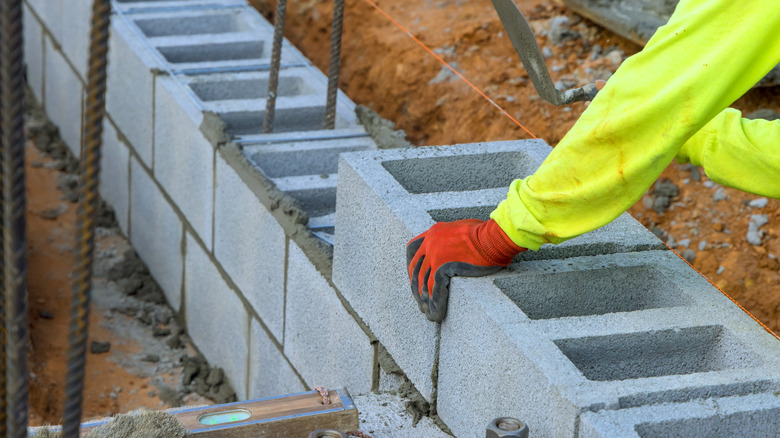
It's worth pointing out that the ASTM figure is a minimum standard, and many CMUs exceed it. Some can support up to 4,000 psi. They can also be reinforced for even greater strength, adding rebar or filling the hollows with poured concrete. When this is still not sufficient, solid blocks may be used. There are more than a dozen types of hollow and solid construction units, each with different purposes and load ratings. So before you start a project, it's worth checking the difference between concrete and cinder blocks and understanding which best meets your needs.
Although standard CMUs have tremendous load-bearing capacity and are very durable, it is unusual for them to be used in tall office or apartment buildings. This is not because they lack strength, but rather because they are heavy and have high labor demands. It's faster to pour concrete or use precast panels, and that has a major impact on building costs.
For the DIYer, cinder blocks are a useful and versatile material for building retaining walls or an extra garage, and there are even some unexpected ways you can use them around the home and yard. They are affordable, tough, relatively easy to work with, and offer a lifespan of up to 100 years.