

The Rare Pyrex Dish That Introduced A New Technique For Tempered Glassware
We may receive a commission on purchases made from links.
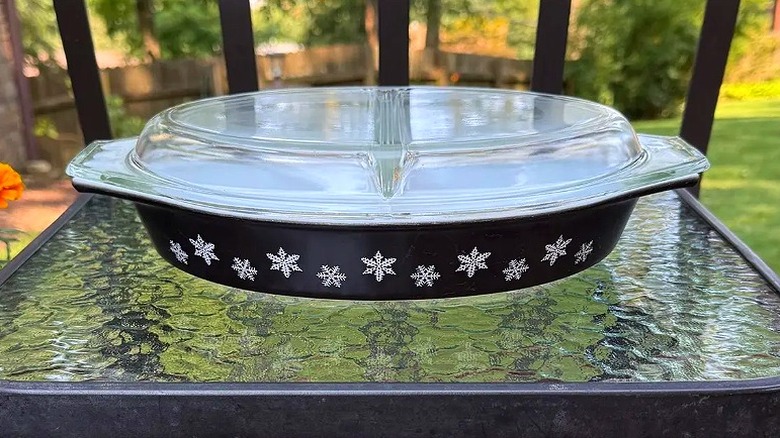
Although Pyrex had an entire line of bakeware, when you say "vintage Pyrex," many people think of the oldest Pyrex bowl sets, like a colorful stack of nesting bowls. But collectors today love to hunt for Pyrex patterns as well. For example, the first two patterns ever to appear on Pyrex opalware were Snowflake and Pink Daisy (1956). Today, if you see one of these patterned dishes at the thrift store or antique mall, they could be worth more than you realize — especially if you find a Black Snowflake casserole dish with its clear glass lid.
The Snowflake and Pink Daisy Pyrex patterns debuted in 1956, over a decade after Pyrex had first produced its colorful plain opalware bowl sets. Snowflake and Pink Daisy were originally marketed as "Decorator Casseroles," and came in different shapes, including oval, oblong, and the Cinderella divided casserole dishes. The clear covers, meanwhile, could be used as a trivet or as a serving dish itself. The Black Snowflake design, called charcoal by collectors, featured a white pattern screen-printed onto a black background (that was then made permanent through firing.).
The charcoal version of Snowflake is the least common of three color combinations, with the two others both being turquoise and white (one the inverse of the other in pattern and background). As for how much Black Snowflake goes for today, condition is key, of course. For example, in 2026, a 2-quart space saver without its lid sold for $40, while the same rectangular style of dish with an intact lid brought about $95. And a 1 ½-quart divided casserole with its lid sold for $30, while a 2 ½-quart oval in its original box went for $125.
More on the 1950s Black Snowflake Pyrex dishes
You don't have to be a collector to have fun looking for valuable glass items from thrift stores, but it does help to know what you're looking for. First off, a bit on this new screen-printing technique. Note that while Snowflake and Pink Daisy were the first Pyrex patterns, Pyrex Desert Dawn dishes weren't solid color either. But Desert Dawn, debuting one year earlier in 1955, featured a spattering effect, not a pattern.
With the screen-printing process, though, Corning Glass Works could apply a design onto its Pyrex products. One wrinkle, however, was that the protruding handles on the dishes got in the way of the screen-printing, which is why you don't see the pattern wrap all the way around. There's a "break," where the handles are.
Also, for Black Snowflake, the matte finish was intentional; if you find one thrifting, that's how it should look. It isn't a sign of damage or anything abnormal. Another feature to note, is that some of the Black Snowflake dishes came with both a metal cover and a glass lid, so sometimes you'll see them with both.
The Black Snowflake Pyrex design was produced until 1960, while the two other versions had slightly longer runs: the turquoise-on-white design was produced until 1963; the white-on-turquoise pattern, which became part of the Turquoise collection, ran until 1967. Also, don't confuse these early Snowflake dishes with the Snowflake Blue ones from a decade later; those are part of a valuable '70s vintage Pyrex collection called the Compatibles.