

Goodbye Boring Display Shelves: The Vintage Living Room Trend That You'll Want In 2026
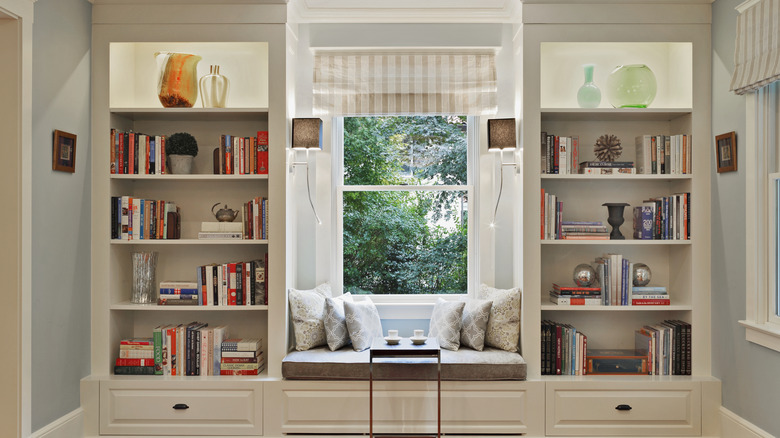
Traditional display shelves, whether open or with glass-paneled doors, are a common sight in homes. They give you an opportunity to display your favorite accessories with style, and double as a convenient storage solution. That being said, for something a bit more unique to give your statement pieces the center stage they deserve, turning to a vintage living room trend will help. Speaking exclusively with House Digest, Craig Gritzen, the founder and principal designer at Curated Style Collective, suggests investing in display pedestals. He tells us, "Display pedestals are making a comeback in design-forward home interiors. I don't think they are everywhere yet, but home interior design is trending more collected and inspiration is being pulled from art galleries."
He credits their comeback to a shift in the home decor being displayed in 2026. Currently, homeowners are more interested in putting up pieces that feel personal rather than something that looks pretty but holds no sentimental value. Our expert concurs, "I'm seeing more homes where owners are less concerned about filling a space with decor and more interested in highlighting special objects that are beautiful or connected to a personal story." And this is where these late 19th century favorites come into the picture. Gritzen says, "Pedestals do an excellent job displaying objects, especially since their added height creates a focal point for the object displayed on it. I think they are regaining popularity because they quietly state this object is of importance to the owner, which promotes connection in a home." Wondering how to style them? Our interior design expert shares a few tips.
Things to consider when styling a display pedestal in your home
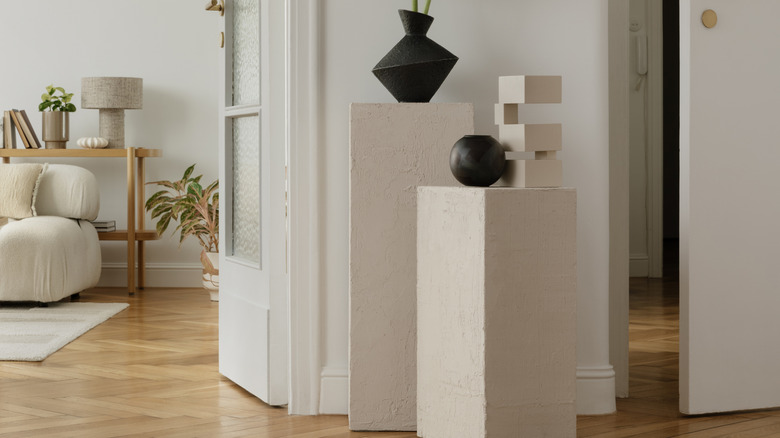
There are multiple ways a pedestal can be the decorative piece your home needs – but only if you style it right. Exclusively sharing with House Digest a list of things you should consider, Gritzen says, "Before purchasing a pedestal, first identify the object that you would like to display. This helps you determine the right pedestal to safely display the object." For instance, to make dramatic indoor plants (think bird of paradise or red African milk tree) the center of attention, a wood pedestal will look great. You can even opt for a natural stone base (or an imitation version) if your planter is luxurious. Shedding light on different kinds of materials, Gritzen explains, "A stone pedestal would feel visually heavy and anchoring, while a lucite pedestal would disappear into the surrounding architecture." Scale is an important consideration, too. Our expert says, "The pedestal needs to be large enough to support the object, but not too large and visually heavy."
Gritzen adds, "Width, height, and weight are also important considerations. The pedestal should be wide and heavy enough to support the object while high enough to not let the object get lost in the surrounding furnishings." The other thing to focus on is safety. Though pedestals are generally heavy and won't topple over with a slight touch, the items on top might. So it's a good idea to secure them if you have mischievous children or pets at home suggests Gritzen, particularly if they're in a small or narrow walkway. He elaborates, "The pedestal could be discreetly anchored to the wall or floor along with fragile objects secured with museum or mounting putty."
Mistakes to avoid when putting display pedestals in your home
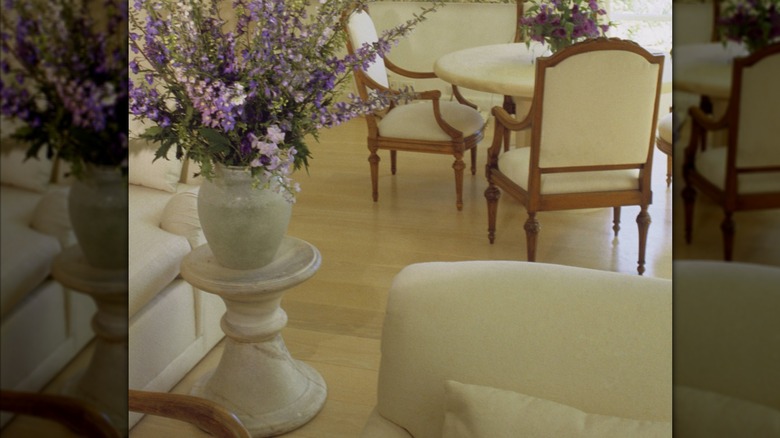
Highlighting the most common errors, Gritzen notes, "The biggest mistake is getting the placement or the proportions of the pedestal wrong." The former is vital to ensure your chosen display object gets the attention it deserves, shares our expert. He says, "If they are placed too close to furnishings, they blend in too much. Pedestals work best when they have space to breathe. Try placing them at the end of a hallway, framed between windows, or in a corner that feels empty but is too small for an accent chair." The key is to not sequester them, as they need space to truly shine and not lead to a cluttered visual.
Similarly, proportion is a crucial element. Gritzen tells House Digest, "If the pedestal is too narrow it could be unstable. If it's too bulky, it will be visually heavy and compete with the object for attention." So, style them with care. And in case you find a lovely Victorian era pedestal you simply must have in your home, feel free to display them in their own right, suggests Gritzen. You don't have to stick to a plain white column. Experiment with different materials and designs for your pedestal, like glass, high-gloss lacquered wood, tile, and glazed ceramics, to find the right showstopper. He reasons, "They still elevate objects in the same way while adding to the character of the space or complementing the object they are displaying." For a unique touch, you can even DIY a gorgeous pedestal stand. Gritzen's final piece of advice? "Use them sparingly ... to avoid the space feeling like a gallery instead of a home," he concludes.