

Sharpen Garden Tools Quickly With A Lawn Mower Staple
We may receive a commission on purchases made from links.
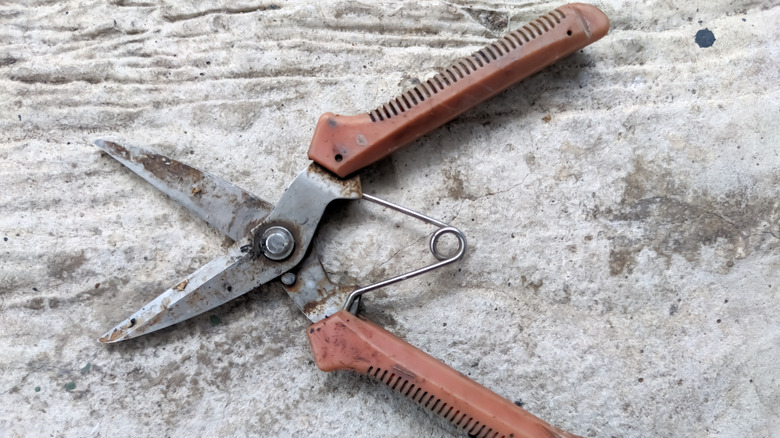
Imagine heading out to work in the garden, and as you begin using your pruning shears, you notice they aren't clipping as efficiently as they normally would. You go to use your sharpening stone, only to realize that you lent it to a neighbor — who's had it for longer than anticipated. Well, if you're in a pinch and the blade on one of your most essential garden tools has become as dull as a butter knife, try using an angle grinder to sharpen it instead.
In a video, an expert with Norton Abrasives EMEA briefly explains how the angle grinder, the same tool often used for sharpening dull lawn mower blades, can also be used to sharpen everyday gardening tools, including axes and shears. For example, you can carefully run the grinder along both sides of an axe's blade, and in a matter of seconds, put a fresh edge on it that'll have it chopping like new again. If you spend a lot of time gardening, you know that some garden tools should be sharpened regularly to prevent hand fatigue and make cleaner cuts. This method is worth considering if you'd rather spend your time gardening than wrestling with dull tools.
If you don't already have an angle grinder, don't fret. They aren't as expensive as you may think. Plus, it's almost guaranteed that you'll find additional uses for it around the house. Angle grinders from top hardware brands such as Ryobi or DEWALT typically cost around $60. For example, the DEWALT 4-1/2 -Inch Angle Grinder is available on Amazon at this price. If you're on a budget, there are wallet-friendly options too, like the WEN 7-Amp Grinder and Hammerhead 6-Amp Grinder, priced at $26 and $35, respectively.
Tips for using an angle grinder to sharpen garden tools
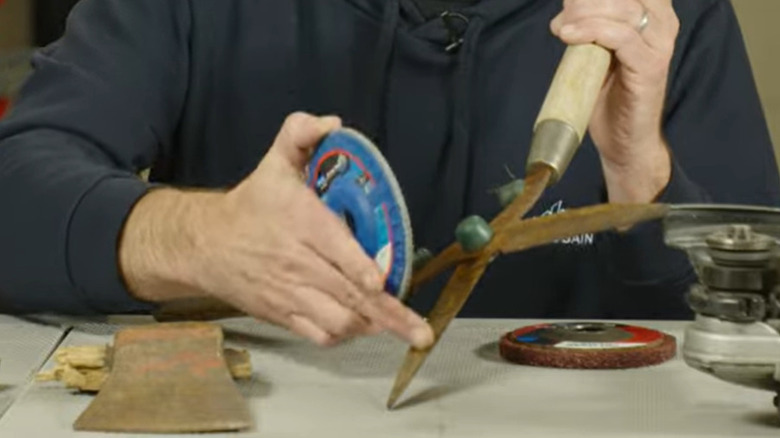
The reason an angle grinder can work well as a blade sharpener lies in a convenient combination of features: a fast-spinning abrasive disc and a handheld design. This combo can minimize the number of passes needed to sharpen an edge, resulting in less manual work than you'd typically put in tools like sharpening stones or metal files. When using a grinder as a sharpener, it's best to use a flat disc with a fine grit, such as 120-grit. If you're purchasing the grinder's disc separately, ensure it matches your grinder's size. For DIY applications, the most commonly used grinder size is typically 4.5 inches.
The process for sharpening various gardening tools with a grinder is fairly simple. First, hold your gardening tool in one hand, secure the grinder at a slight angle, and run passes along both sides of the blade. If you have a bench clamp to secure the gardening tool, even better. Angle the grinder so the spinning disc is roughly at 20 to 25 degrees against the blade. Then, run the grinder along the blade for one or two passes and examine the edge. Repeat this step on the other side of the blade. Check the edges after each couple of passes to prevent removing too much metal and accidentally reshaping the blade.
The key to sharpening a blade with an angle grinder is avoiding an overly aggressive approach. In other words, don't apply too much pressure to the blade, as this can create undulation, over-sharpening, and even dents. Keep a steady hand while making the passes, as it'll help ensure your final result is a straight, even edge from end to end.