

What To Do If You Spot A Tick Crawling In Your Bed

Ticks are never a welcome sight, but spotting one crawling around in your bed rather than in its expected environment of a patch of tall grass can be a true shock. On the rare occasion that they do end up indoors, ticks are most likely to lurk on pets or in hidden areas like the cracks under baseboards, so a sudden sighting on your blanket may leave you alarmed and wondering what to do. Luckily, there's no reason to panic. Tick infestations don't typically occur inside, so if you're sure that's what you've spotted, it's likely an isolated incident. By confirming that what you see is indeed a tick, removing the bug, and taking steps to prevent future sightings, you can nip this problem in the bud.
Because ticks don't often find their way into beds, it's very important to consider whether or not what you're actually seeing is a bedbug. They're both biting pests with similar shapes and no wings, so identification at a glance can be tricky. If the tick has recently fed, however, the difference in size between these two species will become much clearer. Ticks balloon with blood after hitching a ride on their host, while bedbugs simply take on a darker color. If the bug you see is somewhat large, alone, and has eight legs, there's a good chance it's a tick. If not, you might want to start looking into how to get rid of bedbugs instead.
How to treat your space after finding a tick in your bed
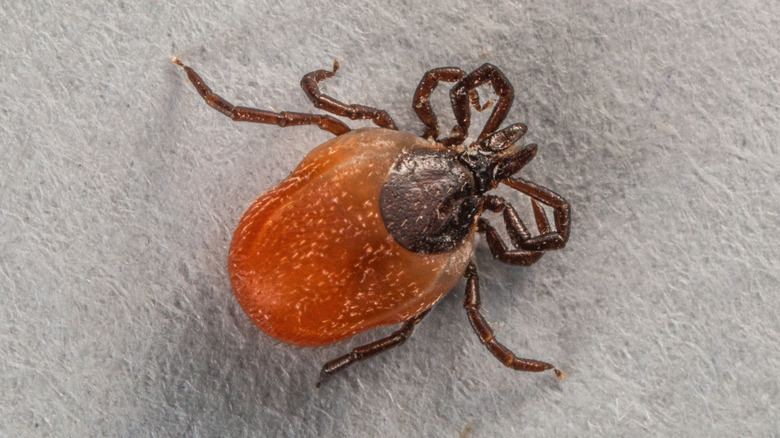
If you're sure that what you're facing is a tick, it's time to remove it. If it's loose on your bed, vacuuming it up is a good option. Seal the bag and throw it out once the job is done. Next, inspect yourself and your pets. If one of you has suffered the unfortunate fate of a tick attaching to your skin, remove it with fine-tipped tweezers, making sure to do so slowly and without twisting. Once it's removed, kill it by drowning it in alcohol, flushing it down the toilet, or placing it in a sealed container. Make sure to clean the wound and inspect the rest of your or your pet's body to make sure there aren't any additional hitchhikers.
From there, your next steps should be cleaning and prevention. Wash your bedding (and any pet beds) on high heat to kill off any additional pests. An all-over vacuum and inspection of nooks and crannies where ticks might like to hide is also a good idea. As stated, ticks don't typically find homes indoors, so if you're seeing them pop up in your house, it's likely that they've hitched a ride on you, a family member, or a pet. Make sure your pets are up to date on their flea and tick prevention, use an Environmental Protection Agency-registered pest repellent if you're heading out on a hike, and consider investing in permethrin-treated gear. Lawn care is also very important — long grass and leaf piles create ideal habitats for ticks, so make sure to clean up and mow as needed. You can even add plants that keep ticks out of the yard to your landscaping for more protection, but this should be treated as an add-on rather than a cure-all.