

Not Lavender, Not Euphorbia: The Tough Perennial To Grow In Gravel Garden Beds For Endless Blooms

Looking for stunning garden gravel ideas to transform your outdoor space? You can't go wrong by including a water-wise, flowering plant such as gaura (Oenothera lindheimeri), a long-blooming perennial that's native to Texas, Louisiana, and Mexico. This pink- or white-flowering "tough cookie" will thrive in hot, dry conditions, while also providing you with ornamental blooms that last from early summer to deep frost.
What's more, gaura is available in several cultivars, allowing you a range of options in terms of bloom color and height. The common plant, also known as Lindheimer's beeblossom, is a shrubby perennial that grows 3 to 5 feet tall and up to 2 feet wide. Its petals are whitish-pink, and grow on long stems that seem to "float" above its sage-like foliage. Gaura is perennial in USDA hardiness zones 5 to 9.
Choose one or more varieties of this long-blooming native plant to brighten your garden. Gaura cultivars include heavily-flowering, compact types such as the 'Ballerina' series, with hues of white, soft pink, or hot pink that grow no taller than 18 inches but spread about 3 feet. If you like variegated foliage, consider 'Corrie's Gold,' with yellow-tipped leaves and pink-margined, white blooms, or 'Passionate Pink,' with tri-colored leaves and pink flowers. 'Siskiyou Pink' has bright pink blooms and is one of the medium-tall cultivars, while 'Dauphine' is extra-tall, growing up to 7 feet. Keep in mind that plant hardiness zones do vary among the cultivars, making it important to double-check before selecting them for your own gravel beds.
Give flowering gaura plants a sunny gravel bed in order to thrive
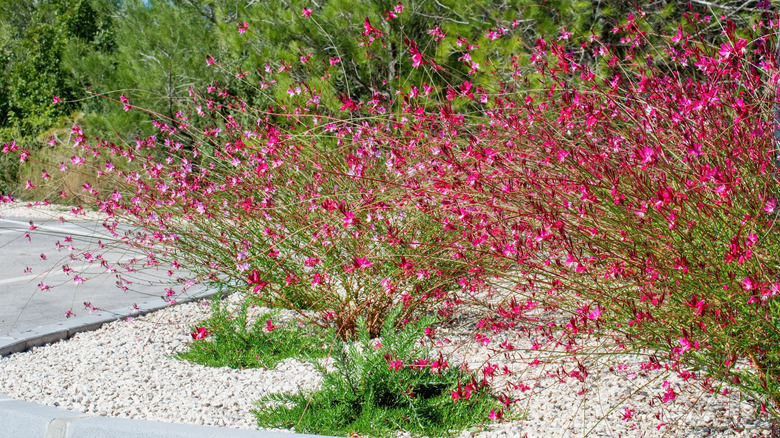
Gaura grows best in full sun. Because it is at risk of root rot in poorly-draining soil, gaura is a great candidate for planting in gravel beds. If your existing beds are clay or hardpan, remove the top layer of soil, and replace it with a 4- to 5-inch layer of pea gravel. Set the gaura seedlings directly in the gravel. Consider adding companion plants that are also drought-tolerant and known to thrive in gravel beds. Options include such ornamentals as 'Red Rocks' beardtongue (Penstemon x mexicali 'Red Rocks') and coneflower (Echinacea paradoxa).
It's important to not just dump gaura and other plants in gravel without follow-up care. In the beginning, the roots do need moisture in order to establish themselves. Water at least once a day, perhaps more often in extreme heat. These special measures allow the plants to reach into the soil level and take firm root. Later, of course, these drought-resistant plants will thrive without much water.
In fact, once they are well-settled, gaura is a water-wise plant that only needs occasional watering. Experimenting can help you determine the best moisture level that encourages extra flowering — without the scraggly growth and drop-off of blossoms that come from too much water. Light pruning also adds to continual and heavier blooms. The best time to cut all of the flower spikes back is in the fall, while early spring is optimal for old foliage removal.