

Do You Sharpen Both Sides Of Lawn Mower Blades?
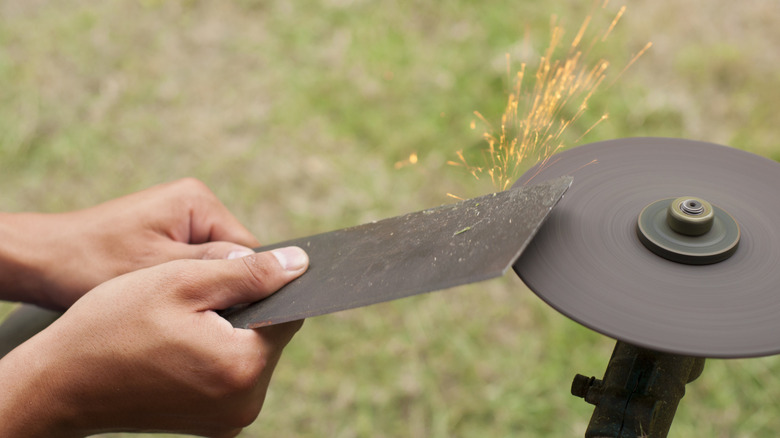
If you are seeing warning signs that indicate your lawn mower blades need sharpening, including grass that looks torn or uneven grass heights after mowing, you might think about sharpening your own blades. Although you could hire a mower repair company or take the blades to a hardware store for sharpening, most homeowners can do the job in 30 minutes (or so) with the right tools.
It can be a challenge to remove the blades and reattach them safely, but you might find determining exactly where to do the sharpening to be the most challenging. When sharpening your mower blades, you only need to work on one side of the blade. You should only work on the side that has the beveled angle, rather than both the top and bottom. The flat bottom and trailing edges should generally be left alone to preserve the blade's intended shape and balance. Removing unnecessary metal from the wrong areas can throw the blade out of balance and make it more difficult to rebalance the lawn mower blades after sharpening them. Additionally, removing metal from the wrong section of the blade could weaken the metal and leave it susceptible to cracks or damage while mowing.
This recommendation can sound confusing because a mower blade has a cutting edge near each end. However, both are leading edges as the blade spins, so you're sharpening the same type of beveled edge at each end rather than sharpening both faces of the blade.
How to know what part of the blade to sharpen
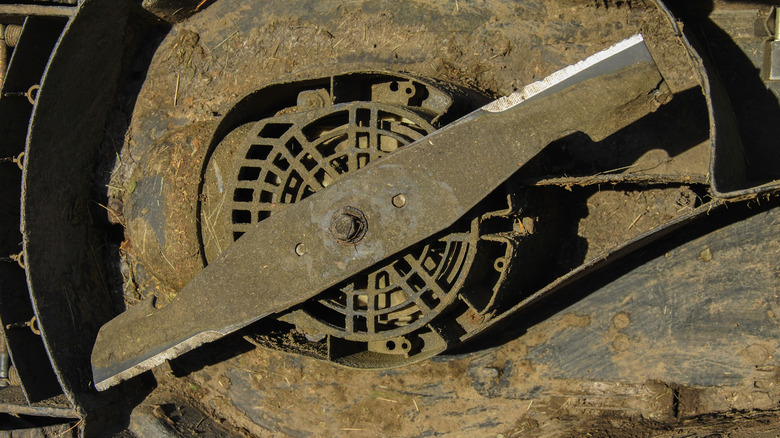
When trying to figure out which part of the mower blade to sharpen, you can use a few clues to find the leading (or front) edge. This part needs to be sharpened because, as the blade spins, the front edge makes initial contact with the grass and cuts it. The back (or trailing) edge doesn't perform the primary cutting action and shouldn't be sharpened.
When looking at the blade, the cutting edges should be obvious, as they will have bevels while the rest of the metal is flat. The two cutting edges will be near opposite ends of the blade and typically measure only a few inches in length. These outer sections do most of the cutting because they travel farther and faster than points closer to the blade's center during each rotation. This combination of blade tip speed and force means the ends cut most or all of the grass before the middle passes over it, even though the entire unit spins at the same RPM.
As another clue, you can study how the blade spins under the deck. Many mowers spin the blade clockwise when you're looking at the mower deck from the top. (Some riding mowers may spin one or more blades counterclockwise.) By understanding how it spins, you can visualize which edge is the front edge that needs sharpening.
Use caution when removing the blade's metal while sharpening
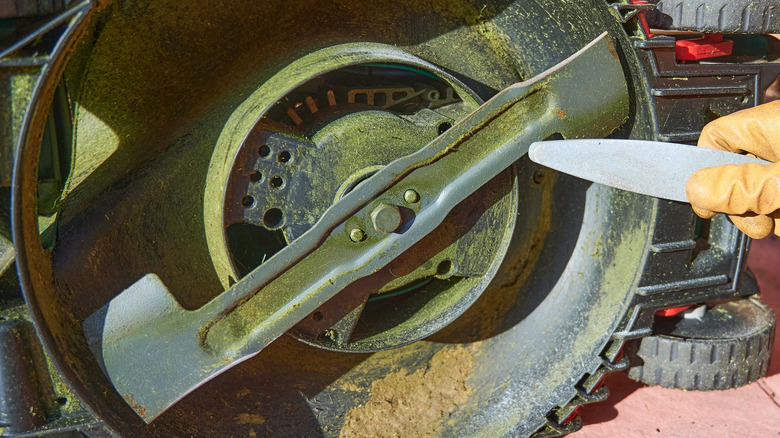
When sharpening a lawn mower blade, you'll be grinding metal from the cutting edge until it's sharp enough to cleanly cut the grass instead of tearing it (like a dull edge does). When doing DIY sharpening, you should try to match the original angle of the blade when it was new. Many blades have a 30-degree angle when new, but some use an angle up to 45 degrees.
When you finish, the edge should be roughly as sharp as a butter knife rather than razor-thin. Only use gentle strokes and limited pressure when sharpening the cutting edge. Using smooth motions and moving in the same direction each time should reduce the chance of taking off too much metal. Try to remove roughly the same amount of metal from both cutting edges, then check the blade's balance before reinstalling it. An unbalanced blade can cause excessive vibration during operation.
If the metal is bent, worn, or severely nicked, replacement is a better option than sharpening. The average lifespan of lawn mower blades is usually two or three years with proper maintenance, but if you cut grass in areas with numerous rocks or use your mower more often than average, you may need to do a replacement sooner.