

The Oldest Mason Jar Is Also One Of The Most Valuable To Find Secondhand
We may receive a commission on purchases made from links.
Mason jars aren't normally seen as something valuable. In fact, they're frequently recycled once they're empty or used in the yard and garden to become the base for cute decor. Nowadays, you can pick up a new 12-pack of 32 Ounce Glass Mason Jars with Lids and Bands for less than $20, but things start to look much different when you dig a bit more into the collector's scene. Exceptionally rare jars have been able to fetch upward of $20,000 on the resale market – a mind-boggling figure when you consider the fact that they were once seen as a commonplace item. While the jar we're focusing on today won't provide you enough to buy a new car, it can act as an interesting slice of history and provide you with a nice little profit if you decide to sell.
The oldest Mason jars were created in the 19th century and embossed with a logo that reads "Mason's Patent Nov. 30, 1858." They look a little bit different than what we're used to today — rather than being made of classic clear glass, they have a light, teal-green color. The shape is also a shift, with a rounded base and curved sides that narrow slightly toward the mouth. These jars are the first iteration of those we're more familiar with currently, and this design was produced for about 75 years — if you find one today that's genuine, it's between 93 and 168 years old.
How to tell if your Mason jar is genuine — and how much it might be worth
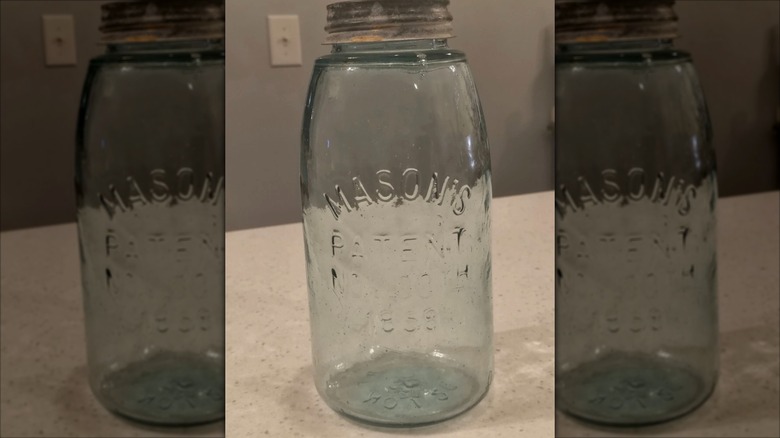
When it comes time to authenticate your latest thrift find, things can, unfortunately, get a bit complicated. Any jars embossed with a "Mason's Patent Nov. 30, 1858" are likely to be old and genuine, but not every jar that contains this text was produced by Mason himself. Two decades after he got his patent, other companies were able to swoop in and reproduce the idea. If your jar just contains this text and no other logos, it's by Mason. If it has a logo that says Ball or a graphic including the letters B, B, G, M, and C, it's produced by Ball. If it has an iron cross graphic, it's by Hero Glassworks. All of these jars can sell secondhand, but if you're looking for the true original, you need a clean logo.
While they are old, original Mason jars are still somewhat common. You can find listings that vary greatly in price, ranging from $20 all the way up to $160, but valuation typically sits on the lower end of this range. If you're unsure if the jar you found is a true antique, look out for minor imperfections like air bubbles and rough seams.
Over the years, Ball became a much larger producer of these jars than Mason, so there's a high chance you'll stumble across pieces with a Ball logo while you're out and about. Ball changed its logo and branding many times over the years, so it's actually fairly easy to date and appraise jars you find. Check out this guide to the value of vintage Mason jars by year for a simple reference point — you could make a pretty penny on the resale market.