

12 Air Conditioner Cleaning Dos & Don'ts You Need To Know This Summer
We may receive a commission on purchases made from links.
Of all the seasons, summer is the one in which you most want your air conditioning to work well. And while cleaning your air conditioning unit should be a priority task in the spring to ensure it's in fine fettle for the hot season, that doesn't mean you shouldn't still keep on top of it during the summer. In fact, it's arguably one of the most important times of the year to do it. Pollen counts increase as the weather warms; dust and dirt from the garden makes its way indoors as you to-and-fro from the yard; doors and windows are often left open to let the summer air in. All of this puts an awful lot of stress on your AC unit, which in turn means some seasonal TLC is usually required.
In order to help you keep your AC system clean this summer, we've compiled a handy list of dos and don'ts to bear in mind as you do it. Some you may already know or be doing already, while others can help you get on top of sneaky bacterial build-up that can impact your family's health. We'll cover the kinds of cleaning tools and products you should use, along with those you should absolutely avoid. And while this is a guide for those of you who prefer to do things yourself, we'll also highlight some times at which you may be better off hiring a professional.
Switch it off before you do anything else

The first thing to do, regardless of how or which part of your air conditioning system you're cleaning, is to switch the system off. This will ensure that you don't accidentally shock yourself when you're cleaning the internal components. It will also safeguard you from any moving parts. Don't forget, air conditioning systems are often designed to come on based on certain environmental parameters, like temperature — especially if you have yours set to "auto" mode. If it happens to get wind of a mercurial spike while your hands are inside, it could well switch on and catch you out.
The reason it's included in this guide to summer AC cleaning is that this is the season when you're most liable to forget. If it's baking hot outside, and your air conditioning is all that's keeping you and your family cool, then you'll want to avoid as much downtime as you possibly can. That, in turn, can lead to rushing and skipping important steps, in a bid to get the system fired up again quickly. Instead, whenever you need to clean your AC system, make a point of switching it off. More than that, cut the power at the primary breaker panel. If you're unsure where to find this, then you can also switch it off at your home's main circuit breaker box, to ensure that the power supply is cut. And if you need help remembering to do it, you can always pop a post-it note near the unit to remind you whenever you come to clean.
Replace your air filter regularly
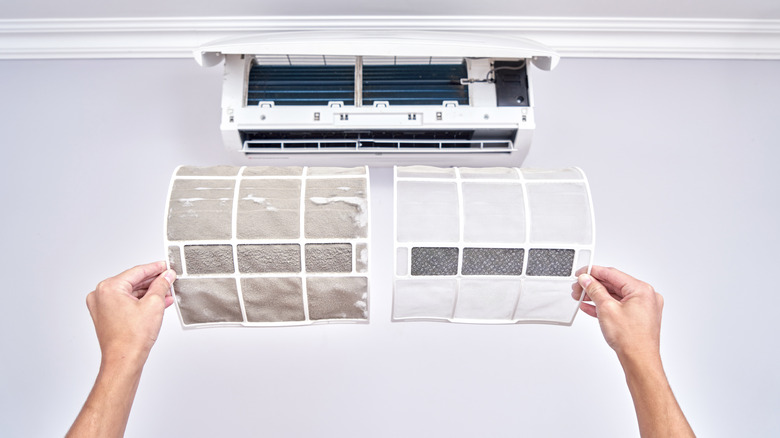
At any time of the year, one of the most useful tips to prolong the life of your HVAC system is to regularly change or clean the filter. Ideally, you should do it at least once every 90 days — at a minimum. That cadence shortens considerably in homes with pets or high amounts of dust. The same can be said if you or your family members have allergies, since you'll want to ensure the filter is always in ship-shape to provide the best air quality. The summer is also a tough time for air conditioning filters. That's because doors and windows are often left open, and for longer — especially if you and your family are constantly in and out of the garden during lazy summer days at home. This can lead to a dip in air quality, not to mention an air conditioning system that has to work harder and use more energy to cope with a clogged filter.
As for how regularly you should actually change it in the summer, it's hard to say exactly. Bearing in mind the 90-day rule, and that the timeframe shortens with extra stressors or with allergies, it could pay to inspect the filter once every 30 to 45 days. That doesn't strictly mean you have to change it, but if you find that it's clogged up, at least you won't have to wait another 60 or so days to remedy the problem. As for how to do it, that's best answered by your unit's manufacturer instructions. They'll be able to advise on the type of filter you need, as well as how to both access and replace the filter without causing damage to your system.
Look out for signs of mold on interior AC units
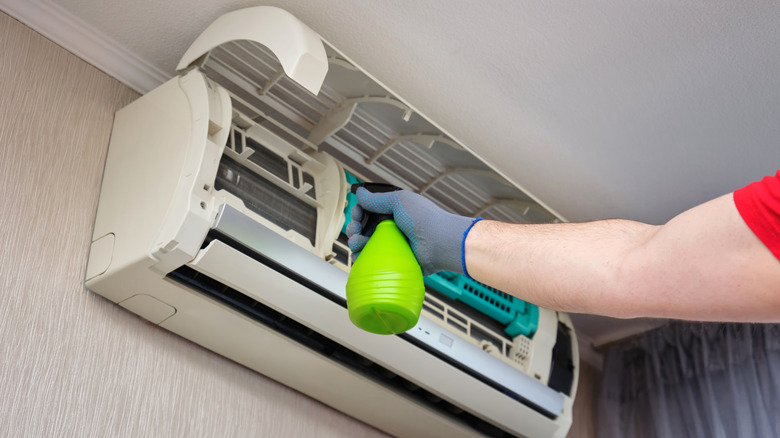
You might think that the outdoor unit of your AC system is the most prone to dirt and grime. However, it's important not to overlook your interior unit. One of the hidden downsides of air conditioning is that the units indoors can, over time, collect mold. This happens as the evaporator creates condensation when cooling the air in your home. When this moisture builds up, it creates the optimum conditions for mold growth. And if you start to smell a nasty moldy smell, then that's one of the most common air conditioning failures — one that you'll want to remedy as soon as possible.
In the summer, when your system is likely working overtime to keep you and your family cool, that moisture is all the more likely to appear. With this in mind, it pays to keep an eye on your indoor system. To make it easier to remember, check it at the same time as your filter, and if you notice any signs of mold, clean them as a matter of priority. The last thing you want is for your family to breathe mold spores. As for how to clean it, there are a number of DIY methods, but we recommend hiring a professional to clean it for you. This is especially true if you clean the visible stuff, but continue to smell mold when you switch the unit back on.
If you haven't already, check the drain line
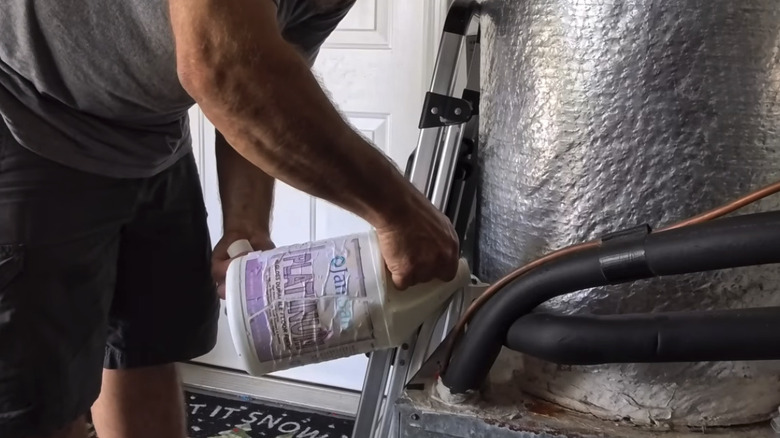
Another top tip for summer air conditioning cleaning is to ensure you check the drain line. It's generally good practice as springtime prep to ensure that your system is in fine fettle for the coming warmer months. But if you haven't done it yet and it's midsummer, it's even more worth doing. You can usually find the drain line access near the indoor unit, and you should be able to easily check to see if there's any grime or nasty build-up inside. And if you happen to find them, then you'll want to give the drain line a good flush to prevent your AC from shutting down.
Flushing this part of the system ensures that any nastiness that's built up inside is cleared. If you don't do it from time to time, then the line can become clogged, leading to performance issues and potentially even damage. As for how to flush it, you can use a mild cleaning mixture comprising 1 cup of bleach and 1 gallon of water, pouring it into the indoor access point. Alternatively, you can use a wet/dry vacuum to clear any clogs, suctioning it from the drain line exit, which is usually found near the outdoor unit. You may even want to try both, depending on the amount of bacteria and other detritus that needs to be dealt with.
Don't allow dirt to sit and bake in the sun
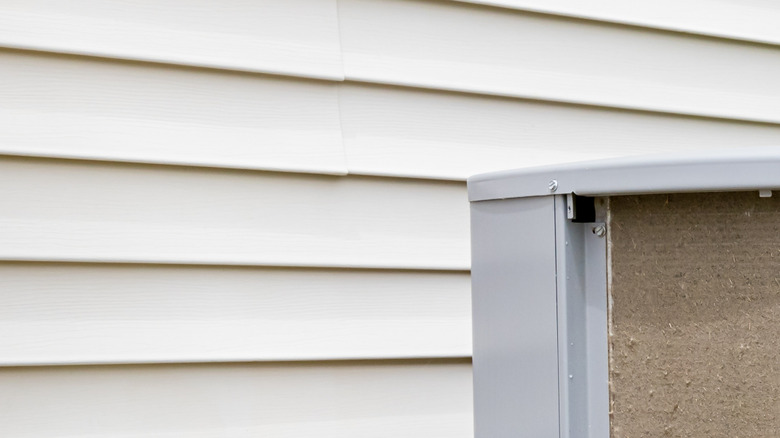
In the summer, even in dry conditions, air conditioning units can get coated in dirt and dust. And if you allow it to settle and become baked-on in the sunshine, you'll have a nightmare trying to get it off in the fall — or worse, next year. Dirt becomes much harder to remove once it's been baked like this, which in turn makes accidental damage during cleaning much more likely. It may also require a professional in order to clean it for you — an annoying cost when you could simply have cleaned it more regularly through the summer.
Again, like flushing the drain line, keeping on top of dirt can save problems down the line. By simply inspecting your unit regularly for build-up — including on the fins and coils — you can avoid the need to hire a professional to clean it. What's more, as you'll see in the next few sections, cleaning your air conditioning system needn't be overly complicated, either.
Clear loose dust from the evaporator coils with a soft vacuum brush
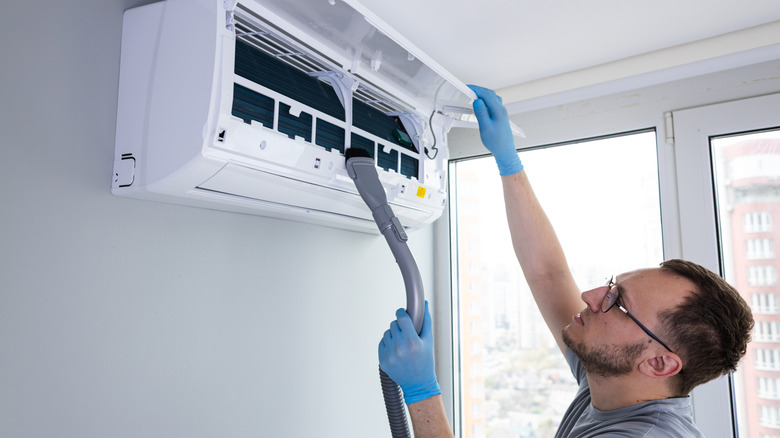
For air conditioners specifically, start by ensuring that your vacuum attachments are clean before using them on the unit. A dirty brush attachment can transfer dust, debris, and bacteria rather than removing it. Then use the vacuum brush to gently remove loose dust and debris from the fins and coils. Because these components are delicate and easily bent or damaged, it's important to clear away surface build-up carefully.
The clean, soft bristles of the vacuum brush will help to gently agitate the dust loose without putting undue pressure on these parts — and without adding more dirt into the mix. Paired with the suction power of a vacuum cleaner, you'll find that it's the most effective way to clear your unit of dust. You can use a standard brush by itself (ensuring, once again, that it's clean), but be careful: without the suction of your vacuum, it'll be easier to accidentally brush dust and dirt into the coils, instead of away from them.
Use a dedicated condenser coil cleaner
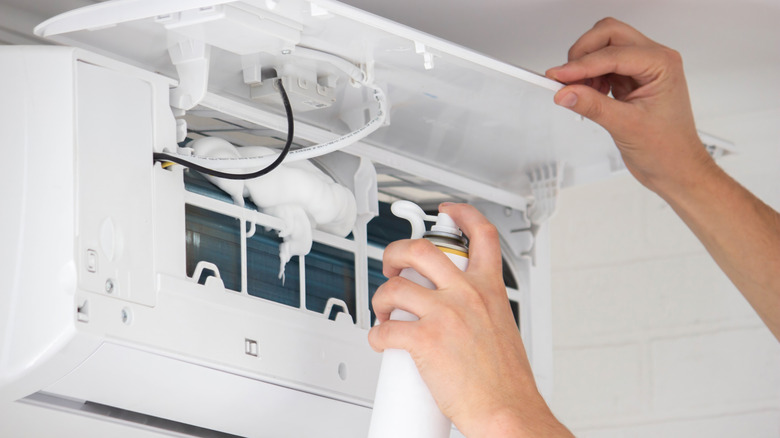
If you decide to enlist a technician to maintain and clean your AC unit, then this is likely what they'll use. Condenser coil cleaners are sprayed over the exterior fins of your unit, and work to break down heavy layers of dirt between the fins and around the coils. It's a good way to lower your AC's running costs. However, it's important to choose the right type of cleaner. For interior units, no-rinse cleaners are usually best, since it's impractical to hose anything down indoors. For outdoor units, you may need something more heavy-duty, and you'll more than likely need to rinse it off afterwards. The best bet is to consult your manufacturer's instructions for the best type of cleaner to use, and then follow the recommended product's instructions, or go straight to the professionals.
When you're rinsing your coils off (if required), it's best to spray outwardly to avoid pushing any loosened grime back inside the unit. To make life easier, remove the outer panels and fan from your unit first, remembering to turn the power off before you start. This will expose the fins and coils, as well as the interior of the unit, which will also allow you to vacuum the inside. With the panels removed, spray down the fins and coils and allow the spray to work its magic. Gently hose the inside of the unit walls to push the dirt out and away from your system.
Avoid using harsh chemicals on any part of your system
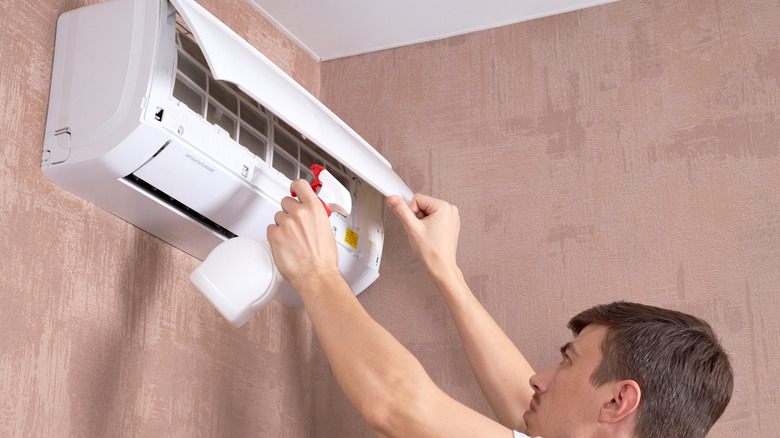
As with any delicate electrical system, it's always best to steer clear of using harsh chemicals to clean your AC unit. A diluted bleach solution can be used to flush the drain line, however, since bleach is corrosive on metals, it's best to stick to gentler cleaners elsewhere. Strong chemicals risk damaging fragile internal components, which can shorten the lifespan of your system and lead to costly repairs and replacements.
As for what to use, if you have a bottle handy, then you can use hydrogen peroxide to clean parts of your air conditioner. Like bleach, it'll destroy any bacterial build-up present. But if you stick to a 3% solution, you should avoid causing your system any damage. You can use peroxide to clear the drain line instead of bleach, and you can use it to spray down the areas of your indoor unit where air flows in and out. Just make sure that you allow it to dry before you switch the system back on. For your outdoor unit, as mentioned earlier, it's generally recommended to use a dedicated AC cleaning solution. These are designed to break down the layers of dirt and grime that build up on exterior units, while avoiding damage to any of the parts.
Never use a pressure washer
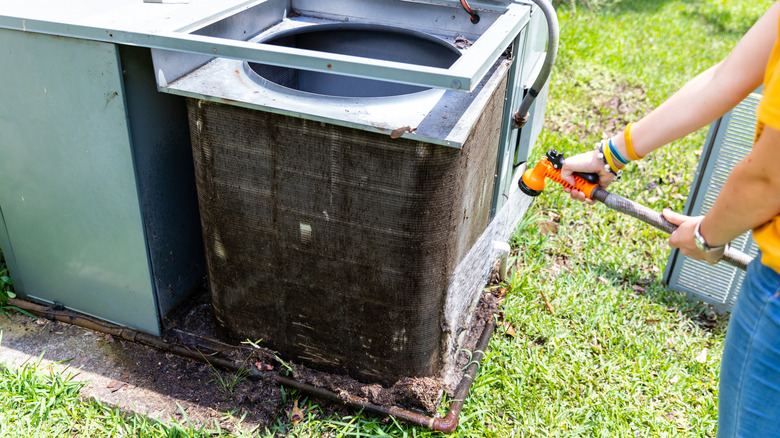
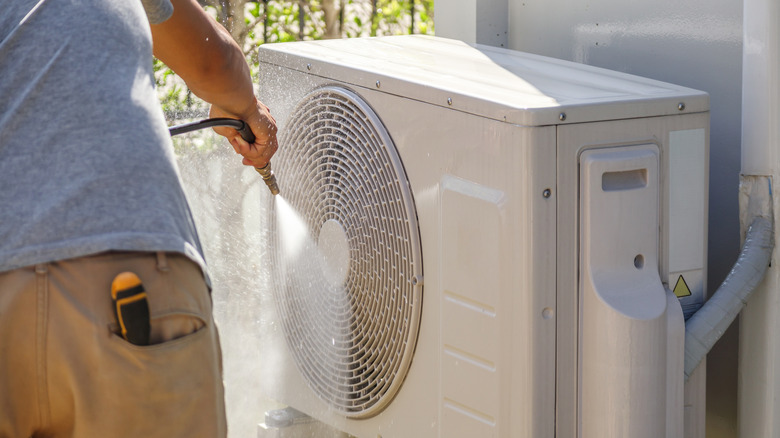
If, despite your best intentions, you left it too long between cleans, you may be faced with layers of baked-on dirt to deal with. This is frustrating, and you're unlikely to remove it with a simple vacuum and brush attachment. However, don't be tempted to break out the pressure washer. Yes, it'll make short work of the detritus that's built up on your unit. But it'll almost certainly bend the fins, too, which will have a negative impact on your system's performance.
More than that, pressure washing the outside of your unit risks forcing dirt further into the coils. If you do that, then you'll have serious difficulty trying to remove it. Instead, you're always better off using a dedicated AC cleaning solution to break down the grime, and then hose it off gently from the inside out. You may have to spend a few bucks to buy the cleaning fluid, but that's a small price to pay versus the cost of professional maintenance and repairs.
While you're cleaning, look out for bent fins
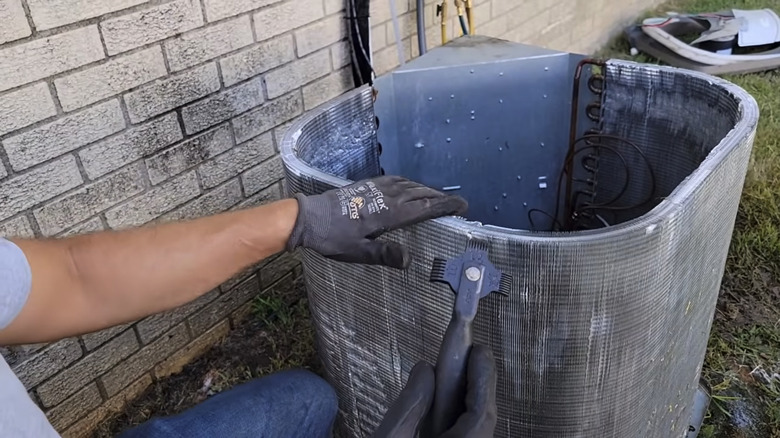
Pressure washing isn't the only cause for bent AC fins. Heavy weather, like hail, can cause them to become bent, as can impacts from flying debris during high winds. For this reason, inspecting your AC system should be a top priority when checking your home for damage after a storm. Even in the middle of summer, it's worth inspecting the fins while you're cleaning to check for bends. Even just a small fault can lead to restricted air flow, putting more pressure on your system and often leading to a dip in performance — not what you want during a heatwave!
To remedy any bent fins, straighten them out using a fin comb. You can buy these in different sizes, to suit the spacing between the fins on your specific system. You can also buy combs with various sizes in one handy tool, like this 4-in-1 Fin Straightening Tool from Malco. Whichever one you use, mix up a spray solution with dish soap and water, and use it sparingly to help lubricate the fins.
Call a professional if a deep clean (or fix) is required

Air conditioning systems are placed under a lot of pressure in the summer months to keep our homes — and their occupants — cool. This is why a regular cleaning regimen is so important, to keep the system working as required. However, if you're ever unsure about how to deep-clean your system, or it's gotten so dirty that you don't think you can handle the job yourself, it's best to hire professional help.
Tune-ups from an expert are a good idea from time to time anyway, to keep your system in good shape and ensure it's not working harder than it needs to. But with cleaning specifically in mind, the last thing that you want to do is shorten the lifespan of your air conditioner by either cleaning too hard or ignoring the problem. The cost to hire a professional may feel like a financial inconvenience, however, it'll cost you much less in the long run than, say, replacing the air conditioner entirely. Don't forget, either, that if there's a build-up of dirt — and you're running your AC constantly to stay cool — it can overload the system while also costing you more to run it.