

Attract Pollinators To Your Yard With A Drought-Tolerant Wildflower They Can't Resist
As top predators in many food webs, humans often lose sight of how we affect other players in the food chain. We overfish, overharvest, or introduce non-native species that disrupt balanced ecosystems, or participate in behaviors that contribute to pollution and climate change. On the flip side, we also can contribute to a strong food web in simple ways, like caring for pollinators. This can be as simple as planting viper's bugloss (Echium vulgare), a wildflower that pollinators love.
Though we often hear about ways to bring pollinators into your garden and yard, it's important to understand why. Pollinators are insects and animals, such as bees, butterflies, bats, birds, and other small mammals, that gather pollen and fertilize plants. In fact, these critters can be credited for one-third of the food we eat. Sadly, pollinators are struggling as climate change, chemicals, and disease are negatively impacting their habitats. By planting wildflowers like viper's bugloss that offer an abundance of nectar and pollen, we offer pollinators a food source that may otherwise be hard to find.
Viper's bugloss (also commonly known as blueweed, blue thistle, blue devil, or snake flower), has showy bluish-purple flowers with red stamens that appear atop stalks between May and September. Its funnel-shaped blooms protect its nectar and pollen from intense heat and moisture, making it an optimal flower for pollinators. Its later-blooming schedule also allows pollinators to stock up on food before winter, when food is more scarce.
Growing viper's bugloss in your garden
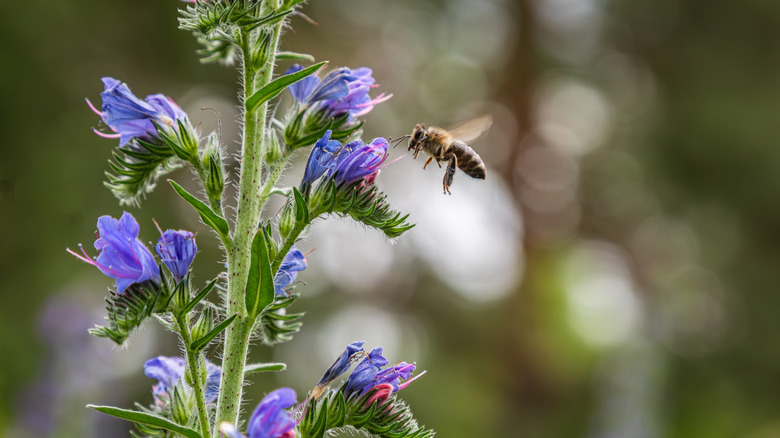
Not only is viper's bugloss a fantastic food source for pollinators, but it's easy for even the most novice of gardeners to grow. It is a low-maintenance plant that is tolerant of the roughest terrain, like dry, rocky soil. It is hardy to USDA Hardiness Zones 4 to 8, has an affinity for full sun, and has a low-growing habit, maxing out around 1-2.5 feet tall and a spread of 1-1.5 feet.
To attract pollinators, there are tricks to make it easier for these helpful creatures to find your garden. Plant the viper's bugloss in clusters, rather than nestling individual plants here and there. This allows insects to find the flowers and graze efficiently. Fun fact: Bees prefer yellow, blue, and purple flowers, so they will home in on a group of bluish-purple viper's bugloss. Consider starting a pollinator garden by adding other pollinator-attracting plants, particularly those that bloom at different times than the viper's bugloss, offering a year-round food source.
This wildflower can also self-seed liberally and aggressively, which is why it has been considered among the flowering blue weeds to avoid planting in your yard. It has also been labeled as invasive in states such as Washington, Oregon, Idaho, Montana, Utah, and West Virginia. To keep it contained, cut off the flower stalks after the blooming season, before seed pods form and mature. The plant is also toxic to humans and livestock if eaten, and its prickly hairs can cause skin irritation.