

Say Goodbye To Wood Mulch: The Permanent Alternative That Deters Weeds And Erosion

Are wood chips really the best type of mulch for your garden? When so many materials are available, defaulting to one of the most common options is easy, but it may not be ideal for your yard. While wood mulch is relatively cheap and easily accessible, it also has some distinct downsides. One of the main drawbacks is that it decomposes and needs to be replaced every year or two. This can add a lot of extra work — and expense — to your already full gardening plate. If you're searching for a longer-lasting solution, there's an alternative worth considering: lava rock.
Lava rock is heavier than wood chips, shredded bark, and other kinds of wood mulch, so it's more likely to stay put on windy days or during rainstorms. It's worth noting, however, that lava rock is lighter than most other types of stone and will shift more easily than heavier alternatives. Not only will this material keep your garden looking tidier, but it can also help control erosion.
Lava rock comes in an array of colors, including red, black, and brown, so you can choose the hue that best complements your existing landscaping. The material is also available in multiple sizes, ranging from tiny pebbles to large stones. Live in an arid area? You've probably heard about the xeriscaping trend and how it can help your garden in a drought. Porous lava rock is a useful mulch in these types of gardens — water passes straight through it rather than being absorbed or repelled. It provides good airflow, too, improving soil oxygenation.
Should you swap wood mulch for lava rocks? Not in every case
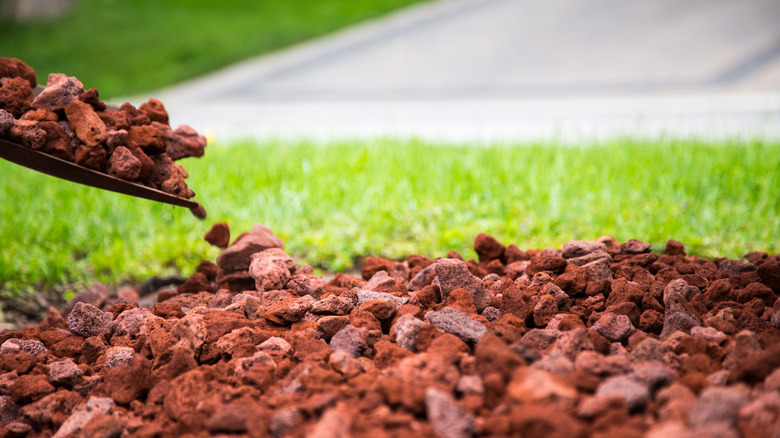
If you're having trouble deciding between rocks and mulch for your landscaping when finding the perfect landscaping for your taste, you're not alone. Despite all the benefits of lava rock, it's not without its downsides, especially when compared to an organic material like bark or wood chips. For starters, lava rock doesn't break down, so it adds minimal, if any, nutrients to your soil. Also, lava rock costs more upfront than most wood mulches — you can expect to pay between $50 and $180 per cubic yard for lava rock. That's significantly more than wood chips, bark, and other types of organic mulch, which range from $25 to $100 per cubic yard. However, as mentioned, lava rock is a highly durable material, so you won't have to replace it as often as wood mulch. This could save you money in the long run.
Laying down lava rock is a little more labor-intensive than spreading wood mulch over a yard. It's heavier to transport and it has sharp edges, so you need to wear heavy-duty gloves when handling it. You may also need to pin a layer of weed barrier under the stone to help keep weeds out of your garden or add edging to your beds to keep the rock in place. Finally, there are the aesthetics of your yard to consider, which are, of course, dictated predominantly by personal preference. If you have a rustic, traditional, or cottage garden, where natural materials rule the roost, then wood mulch is probably the better choice. If, however, you're cultivating a contemporary vibe in your garden or want to add a pop of color to your beds, lava rock could be a good option.