

The Discontinued Lenox Pattern From The '40s That Collectors Dream Of Finding Secondhand
Some Lenox china patterns are not worth buying unless you really like the design. One exception? Rare finds like Lenox Fountain. Made between 1926 and 1948, Lenox Fountain is one of the brand's most valuable patterns, and a complete place setting can be surprisingly difficult to track down.
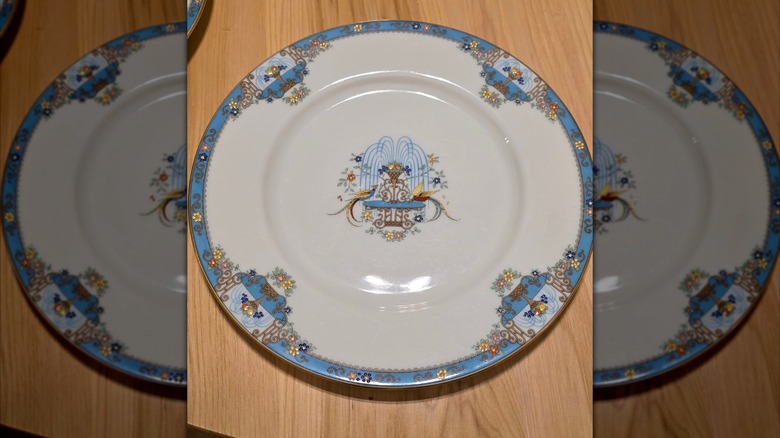
The Lenox Fountain pattern is striking with its turquoise border accented with gold, featuring a medallion in the center that shows a fountain surrounded by birds. Fountain was designed by Frank Graham Holmes, one of the most important designers in Lenox's history. Holmes helped give the company a distinctly American look at a time when European china dominated the market. Fountain's pattern was inspired by wrought iron gates Holmes saw during a trip to the 1925 Paris Exposition, which helps explain the pattern's unique combination of geometric lines, birds, and vivid turquoise.
Even a single piece is worth buying, especially if it's in good condition. A single Fountain dinner plate can fetch $99.95 at Replacements, a footed cup and saucer $69.95, a large berry bowl $399.95, and a rim soup bowl $119.95. As with other vintage china, condition can make a big difference in what a piece is worth, so look closely for chips, cracks, worn gold, and other damage before you buy. If you want a full set, prepare to pay; sellers ask $2,500 for a 115-piece set. That's a very different story from the Lenox pieces that most shoppers tend to skip over in favor of other china brands and their patterns.
What markings the Lenox Fountain pattern features
The value of Fountain makes it the kind of vintage china pattern you'll want to look out for when thrifting. The Lenox Fountain pattern is easy to remember but you should always flip the piece over and check the mark just to be sure. A few details can help narrow down a piece to the Fountain era. Lenox has used a green wreath around an "L" in its backstamps since about 1906, so look for this sign at the bottom, as well as the words "by Lenox" underneath. Lenox didn't switch from green to gold backstamps until 1953, and the "by Lenox" disappeared from the mark around the same time. Keep in mind that Lenox pieces made before the early 1930s generally won't say "Made in U.S.A." at all. So if you find the green wreath, the mark says "by Lenox," and the iconic design on the front, you probably have an authentic Fountain piece.
If you do find Lenox Fountain china, resist the temptation to clean it aggressively. Vintage china's gold decorations can be surprisingly delicate, and abrasive cleaners or dishwashers can damage the finish. The pieces should not be soaked in water, and you should never use paper towels to dry your fine china, either. For a piece that appears valuable, gentle hand-washing is the safer bet. Careful cleaning will ensure that your Lenox Fountain pieces stay in pristine condition.