

Check Your AC Unit For This Type Of Blockage As Summer Winds Down

As summer winds down, you will notice you aren't relying on your AC as much. Because of this, you can take the time to maintain your air conditioner to prepare for fall. That way, when you need it the following year, you just have to do some simple checks, and you're ready to go. This includes things like replacing your AC filter and looking for any obvious signs of damage. However, if you live in an area where cottonwood trees (Populus spp.) are common, you may need to inspect your AC at the end of summer for a blockage from the seeds around any openings, filters, and coils.
If you live somewhere near freshwater or wetlands, you have likely dealt with cottonwoods. There are several species found natively across the United States. They feature heart-shaped leaves and produce big, fluffy clumps of cotton-like material that holds the tree's seeds, hence where they get their name. These little tufts look nice while they are on the plant, but are annoying when they start to blow in the breeze, especially between May and July.
For those who have allergies, you likely already know they can be a nightmare. But what you may not realize is that these airborne clumps can also ruin your AC. They can easily cause clogs and blockages that you need to fix around the end of summer, so you don't damage your air conditioner by running it next year before fixing the problem.
Cottonwood seeds can cause serious damage to your AC
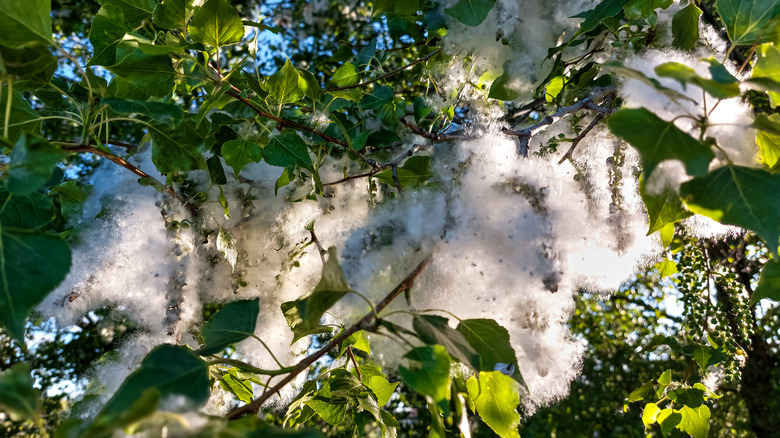
This cottonwood fluff can get into your AC unit and wreak havoc, especially if not cleaned out. The fibers cause clogs. "So the damage that can be caused by cottonwood is, typically, it creates high pressure, it can't get rid of its heat. Fan motor up top and the compressor motor down below will both work harder if the cottonwood seed plugs this thing up," said Chad Needham, who works with Standard Heating and Air, when speaking to WCCO. Over time, the blockage causes the machine to burn up, and eventually just stop working entirely. Before that happens, you may start to notice your utility bills increase as the AC unit struggles to get its job done. There might also be evidence of poor ventilation and air quality.
Cottonwood trees don't produce the same amount of seed fiber every year. Sometimes, there will be almost none, while in other years, the air is filled with these fluff balls floating in the breeze. Because of this, you may need to clean your AC out several times throughout the season. In some cases, it can be up to once a week, depending on your distance to the nearest cottonwood trees, which is why this is one tree you shouldn't be growing right next to your house. However, no matter how little fluff you see floating around, you want to check out your unit before you let it rest for the fall and winter.
Cleaning out the blockage in your AC caused by cottonwoods
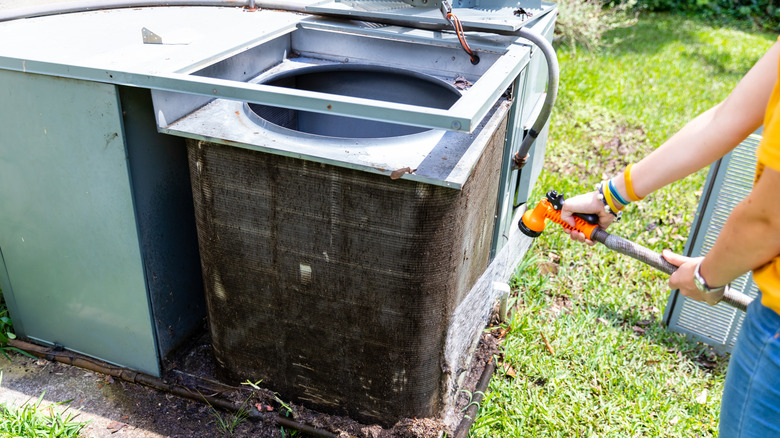
If you notice that your AC hasn't been making weird noises or not doing a great job of dropping the temperature in your home, consider calling in a professional to make sure they get all the fluff out of your unit and check that nothing else is wrong. If you're just wanting to do a bit of maintenance and clean it up before you retire it for the season, though, all you need is to get your hose, set it to a spray setting, and wash them away. Rinse it at a sharp downward angle so the seeds fall off your air conditioner and don't go deeper into the coils. While it is okay to hose down an AC unit, you need to make sure you are being gentle. "I don't want people using pressure washers, brushes, any of that stuff isn't helpful. Typical garden hose, just water. The goal is to get that down to the bottom and have the unit breathing," said Needham.
To prevent these seed fibers from damaging your AC unit in the future, take steps to keep it a little safer. A simple protective mesh screen around vents and your condenser or intake of your air conditioner can also help catch some of the fluff before it creates a blockage. You need to ensure the mesh is big enough to allow for clear airflow, though.