

The Collectible Cast Iron Dutch Oven You'd Be Lucky To Get Secondhand (It's So Valuable)

If you're an avid antiques collector or a home cook looking to snag a quality heirloom, you're always on the lookout for special items. There's a vintage cast-iron piece that you need to get your hands on. The Griswold Tite-Top Dutch Oven was produced between the 1920s and 1950s and goes for hundreds of dollars online. It all depends on the condition and rarity. The number 9 size is pretty common but still averages around $400. Scarce sizes like the No.12 sell for around $2,000. The size 13 Tite-Top Dutch oven seems to be a super rare vintage kitchen item, so it would be a thrifter's dream to find one at all. Needless to say, finding one for cheap at an estate sale or thrift store would be quite the feat. What makes them so valuable is their historical significance coupled with their long-lasting quality.
Cast-iron enthusiasts praise these antiques for their durability and cooking capabilities even after decades (or in some cases 100 years) of use. In fact, they're considered lighter and easier to handle compared to the cast-iron products of the 21st century. Then there's the fact that they were made by the Griswold Manufacturing Company starting in the late 1800s. Based in Erie Pennsylvania, the former home hardware-makers expanded to cast-iron kitchenware like waffle irons and kettles before finally crafting the iconic Dutch oven design in the 1880s. It could even be argued that early productions of the Tite-Top model are symbols of the American industrial revolution .
Tips for finding an authentic Griswold Tite-Top Dutch Oven
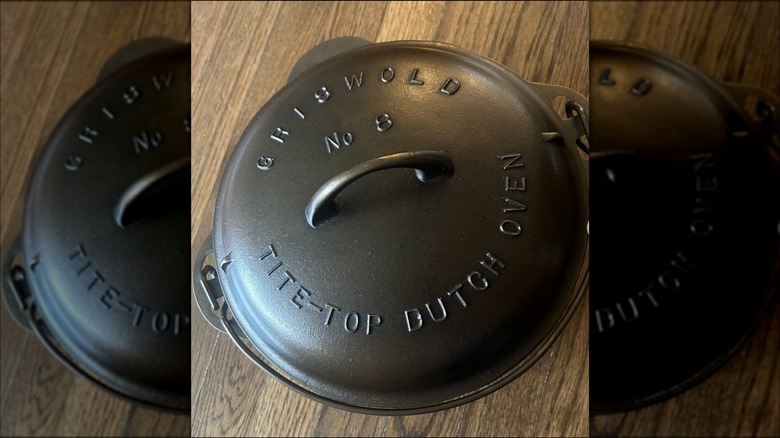
In order to spot the antique cast-iron Tite-Top Dutch Oven at an estate sale or thrift store, you first need to familiarize yourself with its appearance and general markings. This may also prove helpful when dealing with online sellers. The standard design features a pot with two side handles and a bail handle, plus a lid with a center pull handle. The lid should say "Griswold" on one side of the center handle and "Tite-Top Dutch Oven" on the other in raised letters. In the middle there should be a No. followed by a number to indicate its size in quarts. The underside of the lid and the bottom of the Dutch oven should have the Griswold cross logo in the center and "Erie PA" along with patent info and the product name. Some Dutch ovens come with trivets. The trivet should say "The Griswold MFG.CO. Erie.PA. U.S.A" on them along with a number that corresponds to the oven size. This indicates that they match with the cookware instead of being an add-on.
It's important to note that the use of the logo and markings on Griswold products changed throughout the decades. So you may be able to determine the era a Tite-Top Dutch oven is from based on the logo variation. Aside from authenticating the piece, you also need to consider its condition. If you just want to collect the oven as a display piece, general wear and tear might not matter. It could even add character. However, if you do plan to cook in this antique Dutch oven, make sure to evaluate its condition before you buy. Check inside the pot for pitting and make note of any cracks or dents in the metal.