

The Mess-Free Amazon Find To Replace Painter's Tape
We may receive a commission on purchases made from links.
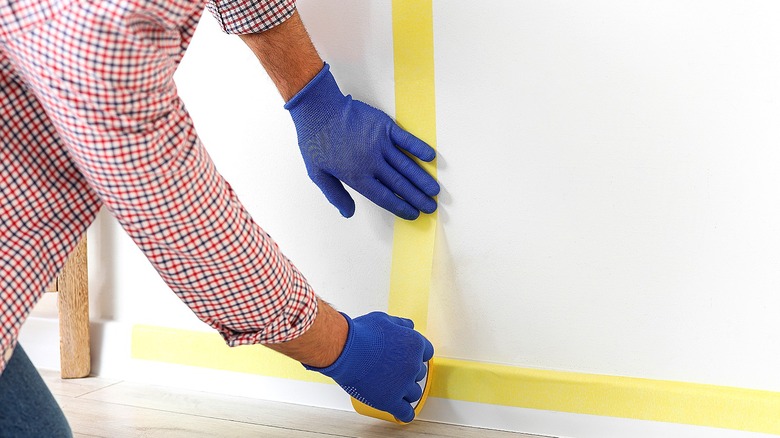
If you've ever done a painting job in your home, you likely already know that it involves more than sticking down a strip of painter's tape around the windows, cabinets, and baseboards. You also have to protect the larger surface next to it. Sure, you could just grab a roll of plastic sheeting and hold it against the tape, but doing so again and again for all your windows, door frames, and other objects can take a lot of time. Because of this, you might consider a product like the Tangibay Pre-Taped Masking Film, which combines painter's tape and a plastic drop sheet into one as a way to prevent paint messes.
The Tangibay masking film is available on Amazon for $9.29; a roll measures 44 inches by 66 feet. The tape is made from natural rubber, while the plastic film is made from high-density polyethylene. According to the manufacturer, the plastic film has a static-cling effect, allowing it to stick to flat surfaces without additional tape.
As of this writing, the product holds a 4.6/5 star rating from over 330 customers. While 76% of the reviewers give the masking film five stars, another 13% give it four. Four percent of reviews give the product one or two stars. One consistent compliment among reviewers is that the product saves time, both in application and clean up. That said, a few buyers said it was necessary for them to go over the tape with a stronger one. Said one three-star review, "Material is flimsy and not like paper. It worked for its purpose but had to have help from other tapes to keep it in place."
Things to check when using painter's tape
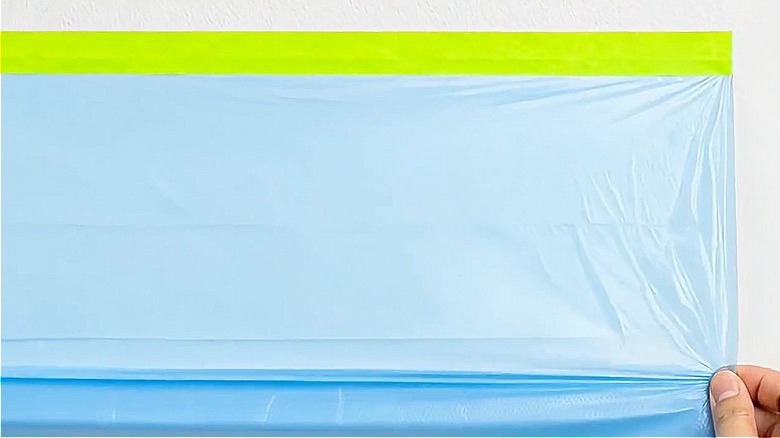
We all want to paint our homes like a professional, and because of this, we might turn to a product like the Tangibay pre-taped masking film. However, when using such products, it's important to keep in mind that one size doesn't fit every project. In the Tangibay masking film case, its 44-inch width, for example, might not be optimal if you're working with a narrow space; all that extra plastic may just get in the way. On the other hand, for covering larger surfaces, such as a full wall section, an appliance, or a car body panel, the wider option could very well provide you with better single-pass coverage. In other cases, you may need to fold or cut the film, or use multiple smaller pieces and overlap edges to get around corners, or work with tricky configurations.
No matter what size you use, though, it's also important to prepare a surface for the tape to stick better. If the surface is dusty, wet, or grimy, painter's tape in general won't stick well. That said, for any masking tape you use in painting, run a finger or putty knife along its taped edge to make sure it's fully attached. If the tape has any gaps, the paint could leak from there – creating a mess.
Lastly, wet or dry, when's the best time to remove painter's tape? It's when the paint is dry to the touch. When you go to remove the tape, though, just remember not to rush it. Doing so can put unnecessary stress on the fresh paint line — this again goes for any painter's tape, including a product like the Tangibay pre-taped masking film. Instead, once the paint has dried properly (but not fully hardened), slowly pull the tape back on itself at a 45-degree angle. (Also, learn how to keep painter's tape straight with a clever trick.)