

Goodbye Drawer Liners: The Clever And Free Hack To Replace Them
We may receive a commission on purchases made from links.
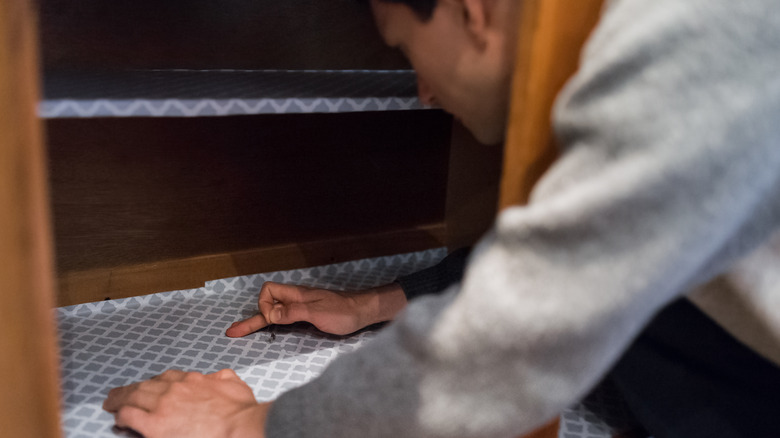
Drawer liners often get neglected because of their low visibility. Out of sight, out of mind: We typically only think of them when we're moving into a new space and encounter a bare, empty drawer or an old liner. While there are plenty of reputable shelf liners that protect your cabinets and drawers, you may prefer not to spend much (or any) money on a product that rarely gets seen. Instead, line drawers with free wallpaper samples for a budget-friendly and creative solution.
It's easy to wonder if liners are even necessary, since they're rarely the star of any room. However, a liner, which is easier to wipe down than a wooden drawer, keeps the drawer clean and protects it from scratches — two important qualities, particularly if you're renting and want to keep your space in stellar condition. Plus, drawer liners are for more than protecting shelves. Inserting a liner with a bit of texture and grip can keep contents in place.
Wallpaper companies often give out free samples to help potential customers with the decision-making process. Free samples vary in size, amount, and shipping costs. For example, Walls Republic gives three free samples, ranging in size from 8¼ by 11½ inches to 15½ by 21 inches, with a $29 shipping fee. Katie Kime offers three free samples in two sizes (10 by 8 inches and 24 by 24 inches), charging $4.99 for standard shipping. However, Farrow & Ball allows three free samples (the dimensions aren't specified, but they look to be around 8½ by 11 inches), with free delivery.
How to use a free wallpaper sample as a drawer liner
It's important to start with a clean drawer before putting down any type of liner, including wallpaper samples. Wipe away dust, food particles, and grime, especially anything that would prevent you from smoothing out the liner. Particularly dirty drawers can be cleaned with vinegar diluted with water (use a 1:1 ratio) or a small amount of dish soap. Make sure the drawers is completely dry before you proceed to avoid the likelihood of mold. For extra protection against moisture, you can add this overlooked scrap to your drawers to help fight mold.
Since you're working with limited supplies, be extra precise when measuring and cutting the wallpaper samples. One way to determine the measurement is to lay cardstock sheets down inside the drawer, taping them together to fit the exact dimensions. Then use the cardstock as a template to cut the wallpaper sample.
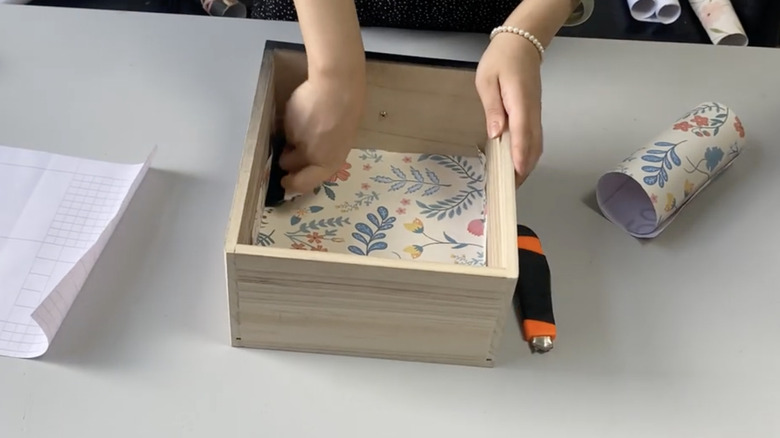
Next, know the difference between traditional and peel-and-stick wallpaper, as this will help you figure out what's needed to adhere the liner. Using a peel-and-stick version works best for this project if you want to keep it cost-free; these are available at both Walls Republic and Katie Kime. However, if you're working with traditional wallpaper that requires an adhesive, consider double-sided tape (best for easy removal) or PVA glue, like Lineco Neutral pH Adhesive, which is non-toxic, moisture-resistant, and bonds well with wooden drawers. Use a brayer or squeegee to assist with smoothing out bubbles and getting the paper into the corners.