

Skip Mums: These Fall-Blooming Flowers Will Thrive In Heavy Clay Soil Without Amendments

When autumn comes around, you're probably dreaming of all of those gorgeous fall-blooming flowers you could add to your garden. However, if you have heavy clay soil, you may assume your choices are limited to plantings such as mums unless you're willing to dig in compost or other amendments. While colorful blooms like chrysanthemums can struggle in dense clay, you don't have to give up on a showy fall display. Two native asters can handle heavy clay as-is, making them an easy alternative to mums: Calico asters (Symphyotrichum lateriflorum) and New England asters (Symphyotrichum novae-angliae) don't need you to amend your soil for them to flourish.
Both species are herbaceous perennials and native to the eastern half of North America, so they're well adapted to local growing conditions. They're hardy in USDA zones 4 through 8, and you can grow both in the same flower bed. New England asters create a dramatic backdrop, reaching 3 to 6 feet tall, while the shorter Calicos can fill the space in front of them. You may also need to provide these aster flowers with stakes, so they don't topple over in rainy or windy weather.
Calico asters reach a maximum height of 3 feet, so they're well suited to the front or middle of a border. Together, the two species also give you plenty of color to work with. Calicos come in yellow, purple, or white, while New England asters can be yellow, purple, or lavender. Cultivars and hybrids expand the palette even further, with shades of pink adding another option for a lively late-season display.
How to grow calico and New England asters in your clay soil
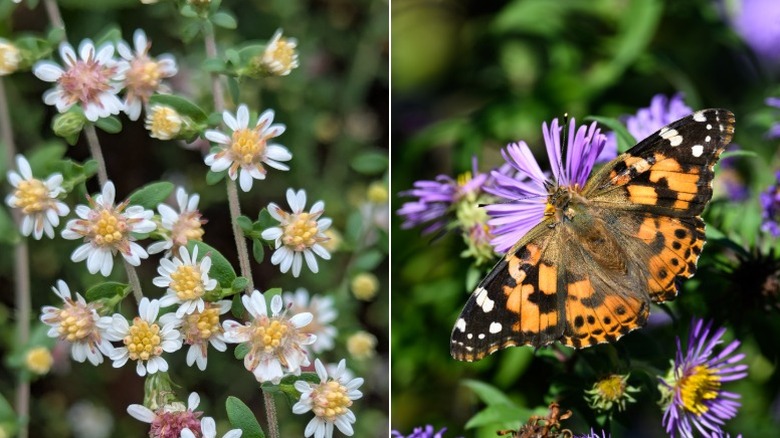
With their pretty, daisy-like flowers, these asters are among the many beautiful plants that will thrive in clay soil. Both species can be grown in full sun but can handle part shade. For the heaviest flowering, give them at least six hours of direct sunlight each day. If exposed to sun all day, it's best to keep the asters well watered. However, those plants that receive afternoon shade can handle a bit of dry soil. You should be able to enjoy the plentiful blooms all through fall, after which the plants will be covered with fluffy seed heads. You can leave these out over winter, as the birds will thank you for providing a food source.
Apart from adding some lovely color to your fall garden, these plants are also a valuable source of nectar in autumn, when all the summer bloomers have faded. They support a range of different specialized bees, as well as normal honey bees, hoverflies, moths, solitary wasps, and butterflies. You'll also find that both species are larval hosts for a wide range of butterflies and moths.
If you're looking for a plant with a slightly spicy fragrance, you might want to consider the aromatic aster (Symphyotrichum oblongifolium). It also grows in clay soil and blooms in the fall.