

Replace Your Old Medicine Cabinet: A Modern Alternative With Better Storage
We may receive a commission on purchases made from links.
You head to the bathroom and, while looking in the mirror, realize that your medicine cabinet has been there since your home was built, over 100 years ago ... and it looks like it. But before replacing it with a similar model, why not give your bathroom an upgrade with one of the best bathroom cabinets for storage and style? Enter bi-view mirrored medicine cabinets. These modern, two-door cabinet options open outward from the middle, giving you two mirrored doors instead of one. So you get two times the mirror surface and double the interior storage — all without it taking up half of your bathroom's wall.
These cabinets are great in smaller bathrooms where space is limited, or in full bathrooms shared by multiple people. In terms of sizing, it's best to have your medicine cabinet be narrower than your vanity, as it helps to create visual balance. If they're the same width, or if the medicine cabinet is wider than the vanity beneath, it can make the whole setup look a bit top-heavy. So if your vanity is roughly 30 by 48 inches, a bi-view medicine cabinet ranging from 24 to 36 inches should hit that sweet spot.
And these convenient cabinets aren't hard to find. For example, Lowe's has them starting as low as $45, and Home Depot has them for as low as $102. Amazon also has a couple of options that are $100 or under, such as this Réflexon 24x24 inch Bathroom Wall Cabinet for $50. So if you're looking for an easy way to clear some space on your vanity countertop to keep your bathroom clean and clutter-free, a bi-view medicine cabinet may be what you need.
Installing a bi-view surface-mount medicine cabinet
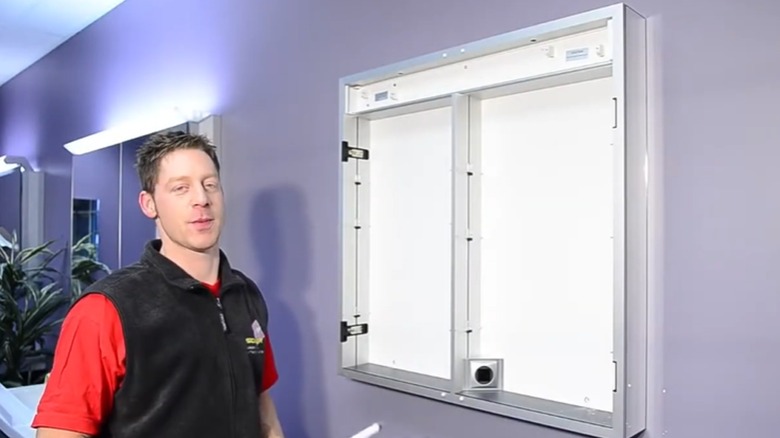
Bi-view cabinets are just one of the many items you can use to organize your bathroom. The open-shelf design lets you quickly scan for your favorite grooming products, and many come with modern features including built-in lighting, Bluetooth clocks, and anti-fog mirrors. Plus, you can install them yourself.
If you're concerned because you may have plumbing or wiring behind the cabinet, it's best to hire a professional, or at least consult one beforehand. But if you feel confident enough to tackle this on your own, you'll need a few tools, including an electric drill, a level, and a measuring tape. In some cases, you may also need a utility knife, a keyhole or reciprocating saw, and a stud finder. However, for surface-mount styles, you likely won't need any cutting tools as long as there are studs behind the wall to sufficiently anchor the new cabinet.
Start by locating the studs and using a pencil to mark the drill spots for the mounting hardware. To make this easy, many medicine cabinet hardware packs come with pre-drilled mounting strips. If yours does, measure the distance between these strips and center their placement on the wall. Next, transfer the drill spots you made so you know precisely where you need to secure the hardware.
It helps to have an assistant for this next step. Unscrew the cabinet door and have your assistant hold the cabinet while you secure it to the wall, driving the screws through the strips and into the studs. Once it's secure, reattach the mirror.
Installing a recessed bi-view mirror cabinet
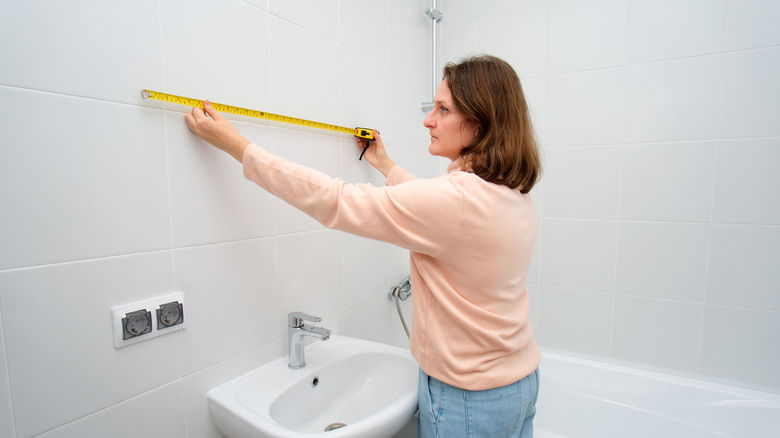
For recessed cabinets, installing bi-view cabinets often means cutting into the wall to make room for a wider new one. If this is the case, you'll need the same tools listed for the surface-mounted cabinet. To get it done, first, measure the cabinet's width and height, then compare it to the existing opening. This will let you know how much space is needed. Next, use a level to expand the current dimensions to the new, wider cabinet width and mark these lines on the wall.
Go over this area with your stud finder to mark the best drill spots. Score the new outline with a utility knife, then use a saw to cut through and remove this drywall piece. Now, you can accommodate the wider cabinet. If you hit a stud, you may need to cut it away and install a header onto the frame. Note that this requires a lot of precision in order to protect the wall's structural integrity. Essentially, it involves installing 2x4 blocking studs on either side of the frame and then securing the drywall edges to it. Given the precision needed here, you may want to call a contractor if you're not comfortable with this task or experience any issues.
Once the frame's secure, remove the cabinet door. Perform a quick fit test, sliding the cabinet into the space and using shims to adjust it if needed. Next, mark pilot holes on the wall for the new mounting hardware and secure the cabinet onto the wall. If needed, patch up, sand, and paint any surrounding drywall and then reattach the cabinet door. After installing your cabinet, you can finally reclaim those cluttered counters and give your personal products a proper, organized home.