

14 Modern Backyard Trends That'll Upgrade Your Pool Area
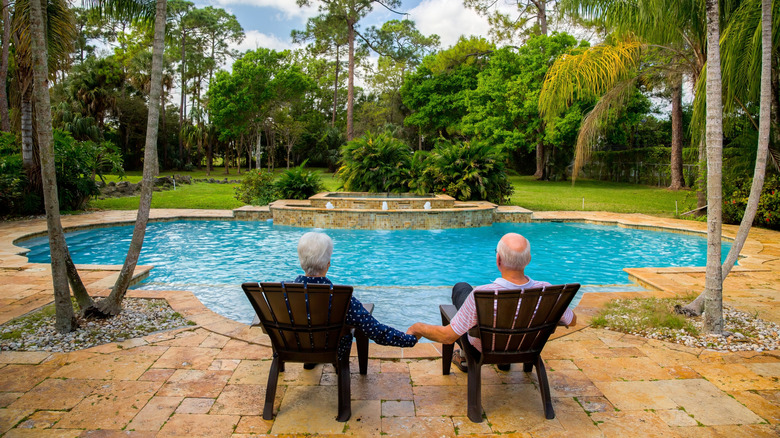
Your pool used to be judged largely on size and cleanliness, but these days, size isn't terribly relevant. Today, designing the perfect pool for your yard includes things like efficiency, environmental impact, and how the water is treated. There's also a focus on how the pool fits within the larger backyard system, whether there are extra facilities like lounging, shade, and lighting, and of course whether your pool is just a pool or a wellness retreat.
Modern backyard pool trends require even a small pool can look like a resort, rather than just a simple pool. It needs to provide a place to entertain, relax, practice self care, and exercise. It needs to fit into the backyard properly, so that it's a cohesive part of the whole outdoor living space. Things like sunshades, vanishing edges, and spas, as well as accessibility features like zero entry or beach entry, are all increasingly common and help take a pool from a merely functional pool to a backyard wellness spa and entertaining area.
Dark moody pool finishes are replacing classic blue
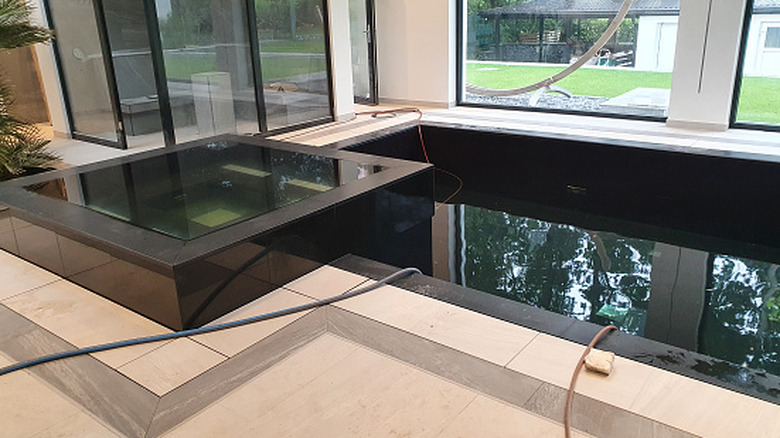
For decades, most pool finishes were a shade of blue or turquoise, usually fairly light in color. But light sky blue or bright turquoise is no longer the automatic choice. Charcoal, graphite, and black tones are increasingly common.
Aside from the fact that it creates a genuinely interesting look that's more like a hidden lagoon than a traditional backyard pool, it's also a functional choice. The darker finish absorbs more of the sun's energy than paler ones. This raises the water temperature over the course of the day and slows the cooling of the water in late afternoon and evening. While it might only raise the water's temperature a few degrees, this makes a big difference in unheated pools in terms of comfort. It also reduces energy usage in heated pools, because you don't have to run the heater as long to achieve a comfortable water temperature. But it's also worth noting that this dark plaster or dark pebble finish hides the pool floor, which makes it easier to misjudge depth and potentially harder to spot a struggling swimmer. It also makes it tougher to find that pair of goggles that you dropped. This kind of feature can definitely bring safety issues that need considering and addressing before you commit.
Sunshelves give swimmers a shallow lounging zone
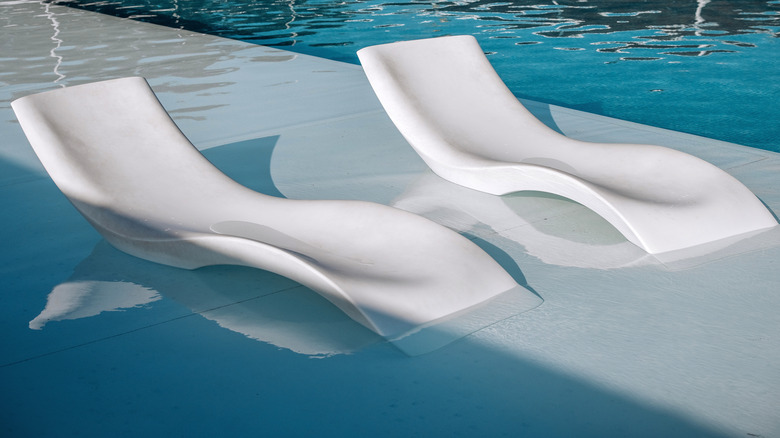
Sunshelves are sometimes called tanning shelves, and they're basically a broad, shallow ledge that sits just under the surface of the water. You can put a chair or a drink here and enjoy the cool water as you relax without being fully submerged. A sunshelf is typically around 9 inches deep, which is shallow enough that furniture doesn't float away, but deep enough that your feet get covered.
This super shallow zone makes a great safe splash spot for little kids, as well as a lounging spot for adults. It creates a safe zone without turning the whole thing into a wading pool. Installing a tanning ledge typically costs between $5,000 and $15,000 if you're retrofitting a sunshelf into an existing pool, because a prefabricated shell can't generally be modified in this way. A new area has to be dug out instead, which also increases the overall size of your pool. However, a tanning shelf won't add much to the cost of a new vinyl or fiberglass pool liner because it's just part of the form.
Clean rectangular shapes beat freeform designs
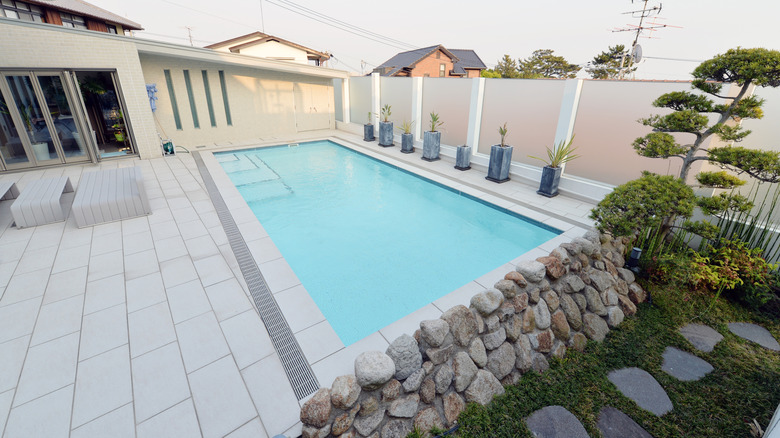
Freeform pools, with their soft kidney-bean-shaped curves, used to be hugely popular, and there are still plenty of them being built, but they aren't as desired as they once were. Modern backyard trends are gravitating toward straight lines and sharp corners, largely because a geometric pool, even if it's just a plain old rectangle, fits in better against a boxy, contemporary house. A rectangular pool is easier to fit into a smaller yard, while still maintaining plenty of outdoor living space too. L-shaped pools are also increasingly popular, as the shorter L zone can be used to create a shallower area with features like a sunshelf or a kids' play area, without sacrificing the lap swimming distance of the longer portion.
About 85% of new pool sales are for straight-edged or rectangular designs, as opposed to curves and free forms. Although there are lots of different pool shapes to consider, rectangular pools just fit into most yards better. They're also easier to cover and fence, and to build a deck or flooring around, so they're generally more cost-efficient at the build stage and for overall ongoing maintenance.
Vanishing edges turn the pool into a view
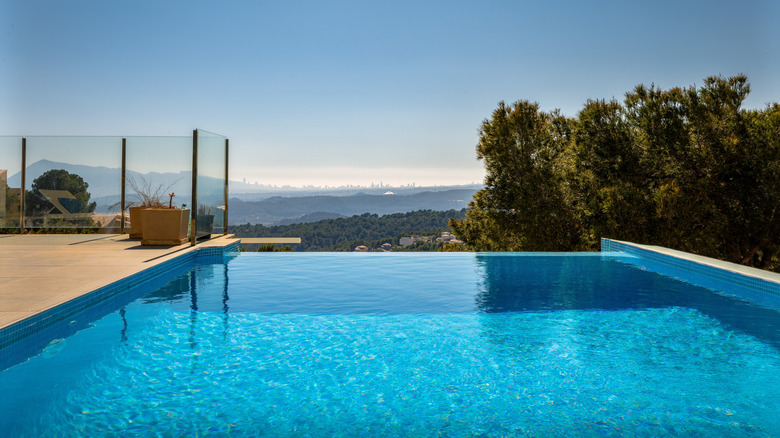
If you're lucky enough to have a sloping lot, a vanishing edge pool can really add a sense of wonder to your gardenscape. With the right installation, it appears that the water just seems to stop with nothing visible on the outer wall. It's constructed so that the far edge of the pool sits flush with the water surface, rather than rising above it like a standard pool wall. This means that when the pool is in use, a thin layer of water is constantly sheeting over that flush edge and it falls into a concealed basin, which feeds the water right back into the main pool. It creates an illusion of a vanishing edge. They may also be called infinity edge or negative edge pools. The trick is that the hidden catch basin mustn't be visible from the deck or the lounge chairs, otherwise the illusion is ruined.
Vanishing edge pools are expensive compared to the cost of a regular in-ground pool, with an average price point of $95,000, because you can't just use a standard factory-made liner. The construction of one of these pools, whether you're using a vinyl liner, concrete, or something else, is a more involved affair that requires specialist waterproofing and installation. If you're going to drop this much money on a pool, you need to make sure that you get the full effect of the illusion, which requires a sloping lot or an elevated position — and preferably, with the vanishing edge looking outward across a view, rather than just beside your regular plain old weathered wood fence.
Raised spas spill directly into the main pool
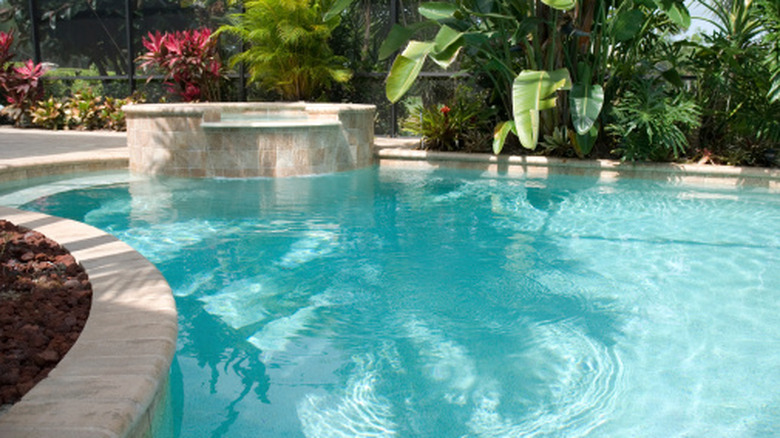
Because more and more people are treating their backyard as a wellness space and their pool plays a prominent part in that, they are choosing to build raised spas that spill directly into the main pool. As an added bonus, the spill creates a waterfall setup that you don't have to pay extra for. The other popular option is a level spa, which sits flush with the pool and provides easier back-and-forth access. There's also a perimeter spill spa, which is slightly less popular than the other two because of increased cost and setup, but is still a viable option. It uses the invisible edge, similar to the vanishing edge pool, to catch and recirculate the water.
One of the biggest benefits of having a raised spa is that it can maintain a warmer temperature than the rest of the pool. This minimizes how much energy you spend heating the whole thing, because you don't have to raise the pool temperature to match that of the spa. Plus, the spa stays hotter and more appropriate for soaking and wellness activities. Additionally, if you have a spa like this that shares equipment with the main pool, it will cost between $15,000 and $50,000 as an integrated add-on.
Large format pavers are replacing traditional pool decking
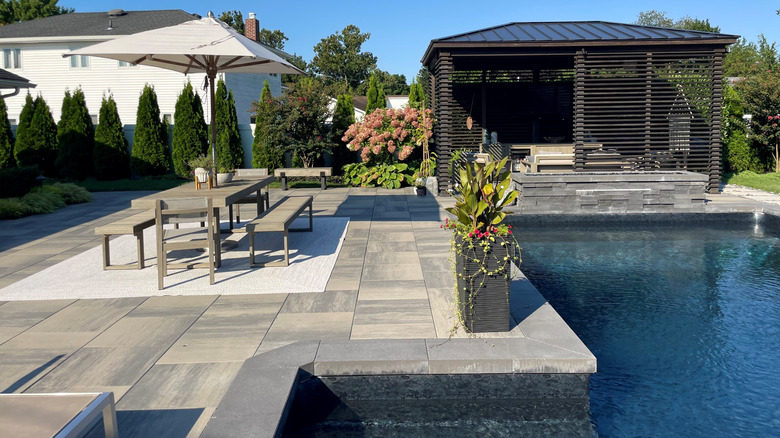
An increasingly popular bathroom trend has made its way outdoors to the pool, and that's large-format tiles. Or specifically, for a pool surround, large-format pavers. They've replaced the traditional wooden deck or small tiles that rely on lots of grout seams for grip. For a really contemporary look, homeowners are choosing oversized, naturally grippy stone slabs in place of more traditional options. There are fewer seams and therefore fewer places for grime to collect, making it easier to keep clean. Natural stone is high-traction, so it's safer than smoother porcelain. Unlike wood, natural stone lasts for centuries. It doesn't degrade or need constant treatment. Insects don't eat their way through it and, because there are fewer seams and joints, you'll find fewer weeds or ants popping up between them.
While large-format tiles cost more than wood decking initially, they save you time and money in terms of deck maintenance. The most important consideration is how slip-resistant a material is. Something like granite is a strong choice, as it's less slippery when wet and it stays relatively cool underfoot. It's also longer-lasting than something like concrete. Budget-wise, concrete pavers run about $5 to $15 per square foot installed. Natural stone varies from around $10 for sandstone up to $50 for granite, with popular mid-range choices like limestone and travertine typically landing between $15 and $30.
Fire features add drama after the sun goes down
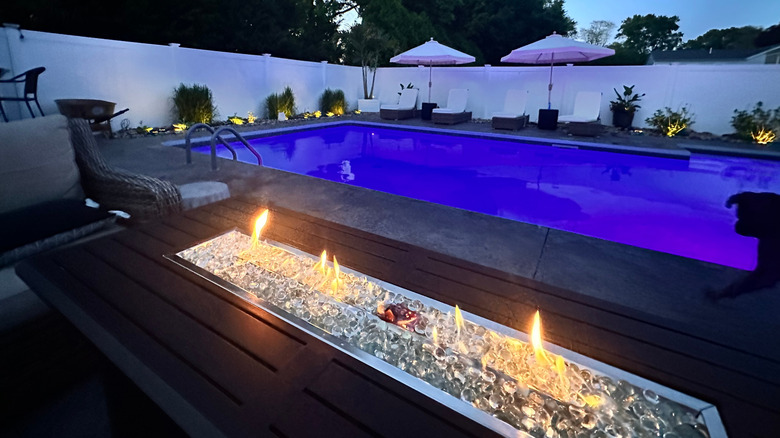
Fire and water can be truly stunning partners when the design is right. Plus, adding fire bowls or linear fire pits near the water helps extend the pool's use into the evenings. Even if you've already got lighting installed, a cozy glowing fire just adds an extra dimension of special.
Linear fire pits are low, long, and act as a focal point for a seating area close to the pool or as part of the pool complex. Raised fire bowls add more sculptural visual appeal. You can even make a fire bowl part of the pool's design, with options available that have a thin sheet of water cascading over the edge of the bowl's face, a little bit like a spillover spa cascading into the pool, but with fire. These kinds of fire features set close to a pool tend to be energy-efficient gas-fed models, as you wouldn't want wood-burning action near a pool or a deck. It's messy and potentially dangerous, because of stray embers that could burn feet if trodden on.
Zero-entry pools swap steps for a gradual slope
Universal accessibility is not really just a trend. It's fast becoming the norm, and rightfully so. As more and more people want to stay in their own homes for as long as possible, finding ways to make that a reality in their home's layout and function is essential. This should absolutely extend outdoors too. Old age and mobility issues shouldn't be a significant barrier to making the most out of indoor and outdoor living space.
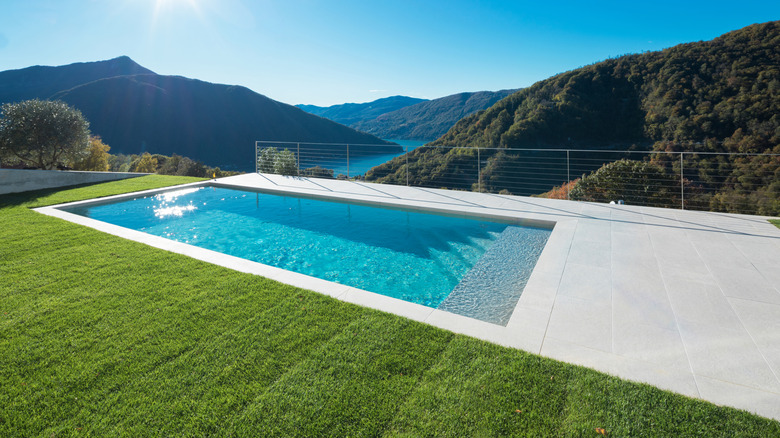
Traditionally, pools have steps or stairs that require significant mobility to use safely. A zero-entry pool, sometimes known as a beach entry, solves this problem. It's basically a gradual slope that starts at the deck level and has a gradual incline that you walk down to access the pool. The slope should, of course, be non-slip and you can add additional safety features like a handrail. The slope also serves as a shallow zone for kids to play safely without a hard drop-off. Of course if you have pets, they can also use the slope to get in and out of the pool safely. The only real drawback to a zero-entry pool is how much square footage it takes up. It's also not something that's easy to add in at a later date, so ideally it needs to be built into the pool from the planning stages to minimize cost.
App-controlled automation runs the whole pool
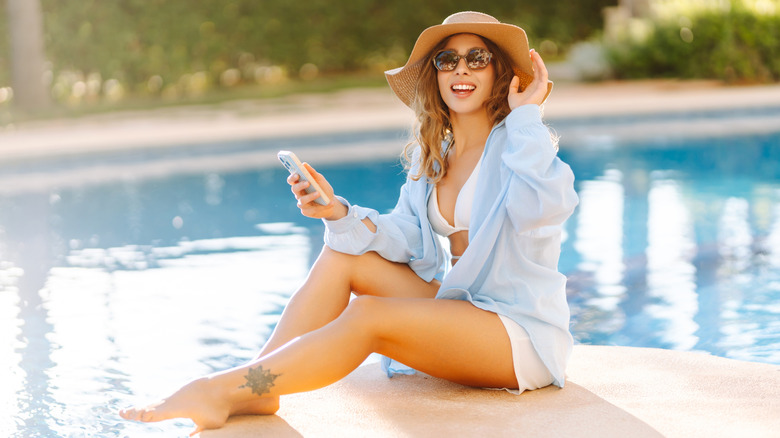
Whole-home automation can be a bit overkill. Nobody needs their toaster to be sending them notifications to their phone. Pool automation, on the other hand, can definitely make life easier. With the right setup with your phone, you can adjust lighting, perform water chemistry checks, set filtration schedules, and a whole bunch of other pool-related tasks. Some even let you control temperature, filtration, and pump speed.
App-controlled automation is genuinely useful. It can also help with repair costs, as catching issues like a stalled filter or a chemistry imbalance early helps you avert an expensive repair bill in favor of a quick, cheap DIY fix. Most major manufacturers now have their own automation systems with unique features. Some will notify you the moment something needs attention and others let you make adjustments to a variety of settings, including filtration and sanitization, as well as heating and lighting, from anywhere. Some will also let you use voice control to change settings.
Saltwater systems are becoming the default over chlorine
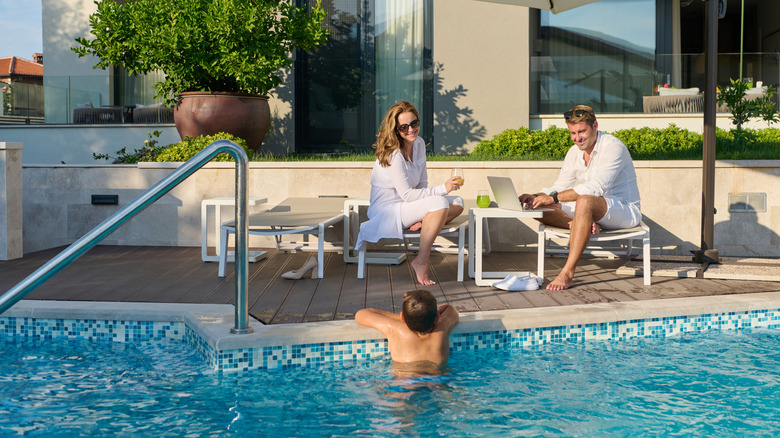
In an attempt to be greener and healthier, homeowners across the nation are switching from standard chlorine to saltwater systems. However, a saltwater pool doesn't entirely remove chlorine. There's still chlorine in the water. It's just that with saltwater chlorination, there's a salt cell that uses electrolysis, and this process generates chlorine from the salt dissolved in the pool water. While you don't make the same regular additions as with chlorine tablets or liquid chlorine, there is still chlorine present in the water.
Lots of people say they like the feel of saltwater. They say that the water is gentler than a heavily dosed chlorine pool and they don't get as many skin problems or stinging red eyes. Plus the process produces far fewer chloramines, so the water doesn't have that sharp chlorinated pool smell. Saltwater systems, however, are more expensive to set up than traditional chlorine ones. And you'll need to replace the generator every few years, so that is also an ongoing cost to consider.
If you have an existing chlorine pool, you can convert it to a saltwater system, which costs between $1,000 and $5,000, depending on what equipment you already have in place. There are also other alternative cleaners to reduce the amount of chlorine in your pool. These lower-chemical pool options include UV or ozone systems.
Narrow strips of turf are breaking up paved pool decks
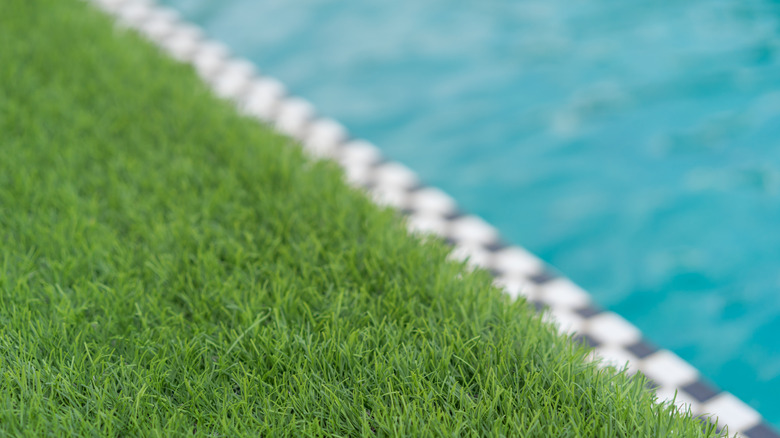
The unbroken field of pavers, poured concrete, and wooden decking is starting to feel rather dated. Newer trends involve using real or synthetic turf between hardscape sections. For homeowners who want to encourage pollinators to their yard, while still enjoying a fantastic outdoor pool space, it's possible to incorporate hardy low-maintenance ground covers in strips between pavers out of the immediate splash zone.
However, close to the pool, in the splash zones, artificial turf is often the more popular choice, especially with standard chlorine pool setups, because synthetic turf is more resistant to chlorine and other harsh pool chemicals. Real grass or ground covers can scorch, discolor, and die off when regularly exposed to the chemicals used to balance water in a traditional chlorine pool. Whether you choose artificial turf, real ground covers, or a mix of the two, it creates a really dramatic look and softens the appearance of the paved or decked area. This is because it breaks up the hardscape with greens and, in the case of real ground covers, lilacs, whites, and pinks that soften the whole thing.
Sunken lounges tuck dry seating inside the pool's footprint
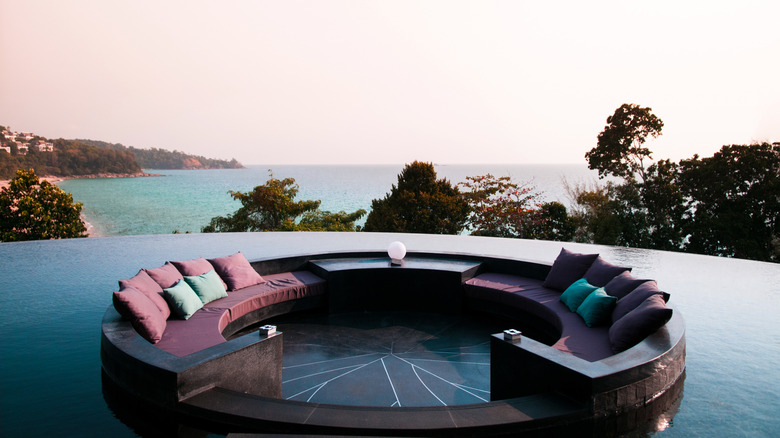
A sunken lounge is a seating nook that's part of the poolscape without technically being part of the pool. It's sunken into the pool area, often around a fire pit or fire table, and water generally surrounds the area on almost every side, with a short bridge or a few steps as the way in.
Some variants are partially submerged too, with seating set so that guests sit either knee- or waist-deep in water, rather than on fully dry ground. With the fully dry version users never get wet, even though they're surrounded by water. Although the sunken seating area is part of the pool complex, it's not technically inside the pool. This is a costly setup, however, as the dry pocket requires excavation and waterproofing below the pool's waterline, so it is generally not available as part of a standard shell pool design. Of course, it also requires additional space and universal accessibility is challenging.
Layered lighting extends the pool into the evening
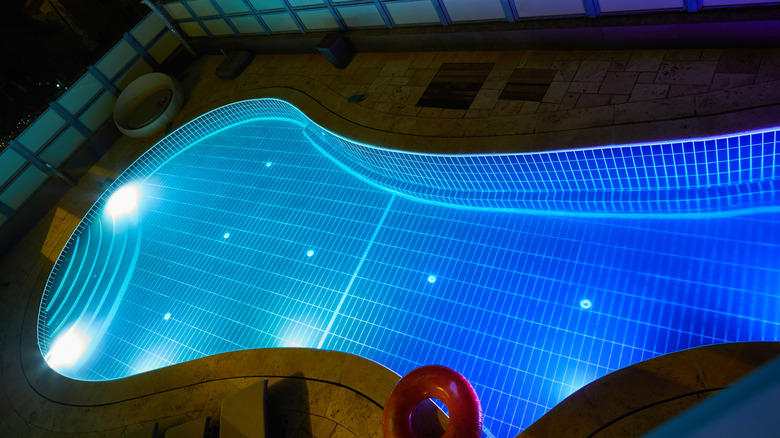
Gone are the days when one or two bright floodlights aimed vaguely at the water counted as sophisticated pool lighting. Thankfully. That's been replaced by more elegant lighting that usually incorporates a layered design. Underwater LED fixtures create a lot of drama, especially where the design incorporates color-shifting LEDs that cycle through a variety of colors or have changeable settings that you can alter via a connected app. Some are even fancy enough that you can set them to transition to the beat of music playing nearby or through built-in speakers. You can also get floating LED orbs that sit on the water's surface.
Deck-level or patio-level lighting also helps give a secondary layer that makes using the pool in the evening enjoyable and safe. Step lighting further improves safety by helping make sure people don't trip in the dark. Warm landscape lighting around plants, pathways, and pool edges, and on the walls, directed toward the pool, creates a welcoming and cozy atmosphere that's far more appealing than the old-school white floodlight that burns your eyes if you look directly at it.
Energy-efficient equipment is now the norm
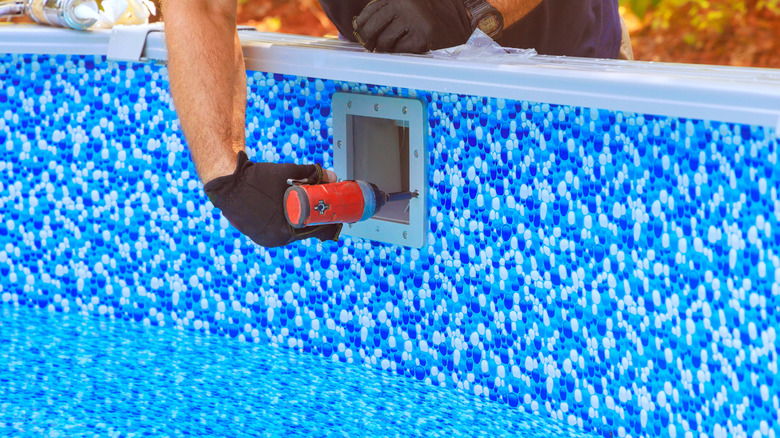
One of the biggest continuing trends is making backyard pools more sustainable. Every homeowner, even if they're not overly bothered by their carbon footprint, wants to minimize energy usage and their utility bills. Inefficient pools use a huge amount of energy, and therefore cost a great deal to run. Heating, filtration, and pumps all cost energy and money.
Replacing an older single-speed pool pump motor with a variable speed one saves about 70% electricity. Some people opt for solar to help maximize energy efficiency for their pool, while others stick with the most efficient electric, gas, or heat pump setup they can find. Other energy-efficient changes and upgrades include smart controls, pool covers, solar heating, and switching to LED lighting. Any small changes, like switching to efficient lighting, can have a substantial impact on annual running costs.