

Your Store-Bought Potted Petunias Will Look 10x Lusher With This Easy Step
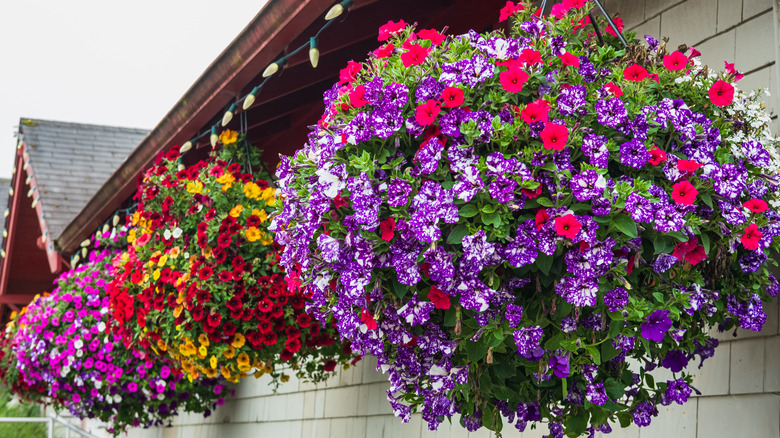
Petunias are undeniably pretty, but very greedy. Their relentless flowering means they feed and drink heavily, particularly in warm weather. Those big blousy store-bought pots bursting at the seams with colorful petunias can look wonderful when you bring them home and very quickly end up looking sad and miserable. I'm a master gardener with over two decades of professional experience, and I have to admit I'm not a fan of buying big plants crammed into small pots from the nursery. That's largely because they are often grown cheaply with only short-term appearance in mind rather than longevity and sustainability. Young petunias in appropriately sized pots just aren't as sexy as plants crammed into small pots that make the flower display look lush and full.
When you bring these plants home, they may start wilting in a couple of days, so you water them, but that doesn't really work. Then you think maybe they need a bit of fertilizer, so you add some feed, which also doesn't really work. hen you try watering again, but the petunias are still drooping, and you find that as much water as you're pouring in is running straight out of the bottom. The problem is that the cheap peat-based or coir-based potting medium your plant came with can quickly dry out and become hydrophobic, so instead of soaking the root ball, water passes straight through. There are quite a few ways to revive sad-looking petunias, but fixing watering issues is a great place to start.
How to rehydrate hydrophobic potting mix to help reinvigorate your petunias
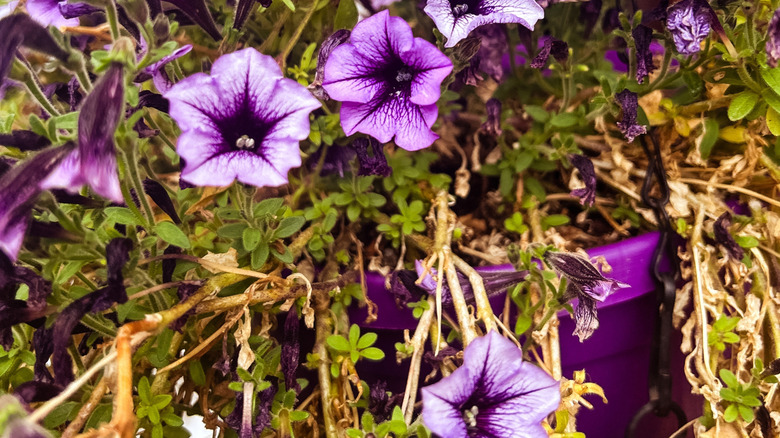
Once the potting medium in your petunia container has become hydrophobic, just emptying a watering can over the top isn't going to solve the problem. The soil is completely dry, so it's not absorbing the water that you're pouring in. The first thing to do to help alleviate this is to give it a proper soak. Take the nursery pot and place it inside another larger container. Fill that container approximately halfway to two-thirds up the sides of the nursery pot, then walk away and leave it. You're not going to cure the hydrophobia in just 10 minutes. Leave the pot to soak for at least a few hours.
You may find that if the pot is very dry, it will float, or you'll see streams of air bubbles rushing up. That's okay. If necessary, you can weigh the pot down with a couple of large pebbles to hold it against the base of the larger container. Letting the hydrophobic soil soak for a few hours helps to re-wet the potting medium and overcome the hydrophobia so that water is able to fully penetrate again. Once your growing medium is properly wet through, you need to open up a few new pathways through the potting mix. Use a knife, a screwdriver, or chopstick. Working carefully and gently, push it vertically into the growing medium in several places all around the outside, hopefully avoiding most of the root ball. This loosens up any compacted growing medium and helps water fully penetrate. Next you want to fill, but not overly compact, these holes with fresh, high-quality potting medium that's well-suited to water retention.
Repot your petunias for the very best results
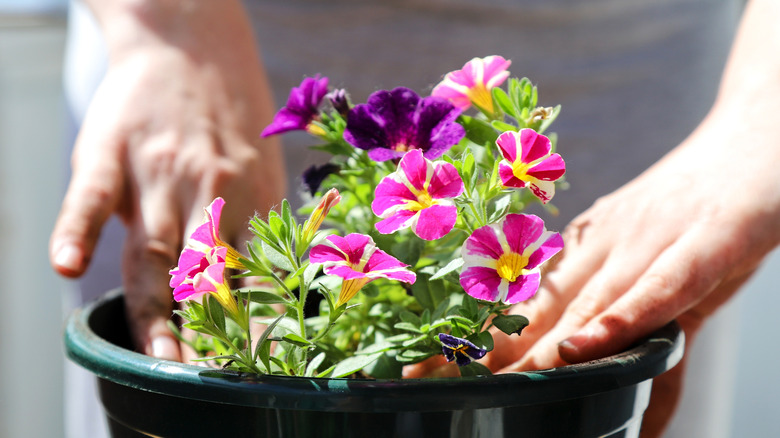
If you want your petunias to perform at their very best, then your best option is to repot them, preferably as soon as you get them home, and before they get too big. The majority of petunias sold in ready-to-go display containers at the nursery are overcrowded and in low-quality growing medium. Plus, it can be cheaper to buy smaller petunias in little plain plugs than to buy larger ones in fancier containers. I'd always recommend that you repot them into a roomier container and fill it with a high-quality potting mix. You can even make your own potting mix with just a few simple ingredients. Just remember that petunias are thirsty plants, so you need a high-quality mix that will retain plenty of moisture. Mixes containing coconut coir and vermiculite are particularly good for retaining moisture, and perlite is a useful addition because it creates air spaces around the roots to help limit compaction.
Start by removing the petunias from their pot and soaking them to remove as much soil from the root ball as possible without damaging the roots. Pre-moisten the new potting mix before adding your petunias. Add your petunias to the pot, fill around them with potting mix, and lightly tamp it down. Don't be tempted to fertilize, though, as the plants will need a few weeks to recover before they are ready for additional nutrition. Do, however, keep the soil evenly moist and avoid letting it dry out completely. Underwatering is a common mistake with petunias, and it can cause you to end up with the same hydrophobic problem that you are trying to avoid in the first place.