

Everyone Had Them In The '80s — Thrift Store Furniture Catches We're Dying To Find
We may receive a commission on purchases made from links.
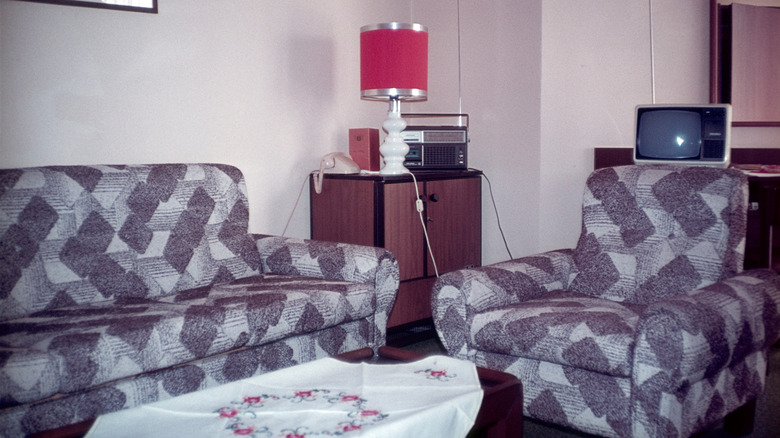
I grew up in the '80s and our house was most definitely not subtle. There was a ridiculous amount of brass, smoked glass, chrome, and mirrors on things that had no business being mirrored. Then there was the gigantic, hideous floral sofa set that was way too big for the room. It was a behemoth of a bright blue sofa with ugly brown and white flowers, and it had interchangeable covers that the whole family was forced to wrestle with for an entire day whenever wanted to change them. Sofa cover day was never fun.
And while some of this, like that awful sofa, is very dated and should stay lost to time, a great deal of '80s furniture, whether that's rattan, wicker, country-style furniture, things with frills, things with mirrors, or enough chintz to upholster half of Texas, is back and trending again. A lot of it, in the right space, actually looks pretty amazing. I'm an avid thrifter and it's great fun to see so much of what I grew up with once again back in the spotlight. Remember that this furniture, much like myself, is aging, so make sure you look beyond your initial excitement. Check for sturdiness, condition, and need for any repairs. Damaged veneer, a missing shelf, or badly cracked acrylic isn't always easily repairable and can ruin the look of a piece.
Brass-and-glass or chrome-and-glass coffee tables and dining sets
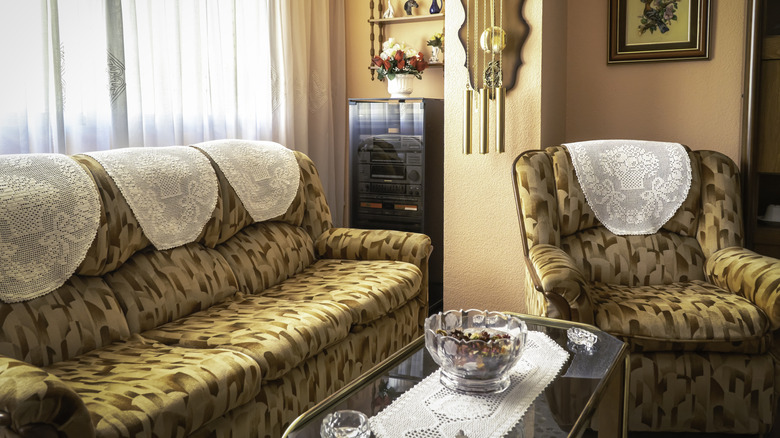
When I picture any smart living room from my '80s youth, there's more than a fair chance that something in it had a glass top and a shiny metal base. Everyone had glass tables in the '80s, with either a brass or chrome base. My parents were weirdly obsessed with brass, so anything with a metal accent was brass or brass-toned. My uncle, on the other hand, went the other way and chose chrome for everything in his house. Brass was wildly popular in '80s furniture and interiors, as was chrome, and you can find anything from restrained coffee tables to big curving dining sets with glass tops — as well as matching chairs with chrome or brass legs, and upholstered backs and seat pads. Used in moderation in the right setting, these coffee tables and dining sets can look surprisingly contemporary.
You will, however, have to check them over thoroughly. Pay close attention to corners and attachment points for chips and corrosion, and make sure that the glass is actually the right type for the base. With brass you should also expect some tarnish. Chrome doesn't tarnish in the same way, but it can pit or rust, so you may need to do a bit of restoration work if you want a true '80s piece.
Mirrored bedroom furnishings
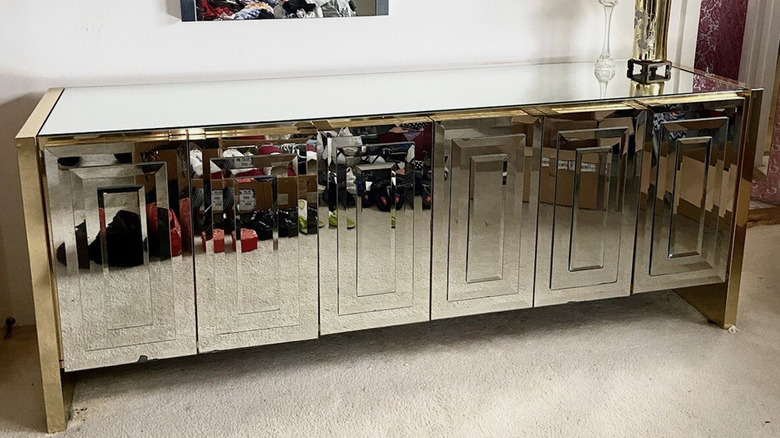
Mirrors played an absurdly big part in '80s interiors and it was about as subtle as shoulder pads. While it makes sense to have mirrors on dressers and nightstands, you could get entire bedroom groups clad in mirrored panels, including cabinets and even headboards. My older brother bought his first home in the latter half of this decade and he was a typical man of the time who wanted to be super cool. He had the latest of everything, and that included a very, very mirrored bedroom. It was weird, over the top, and just so '80s.
But mirrored '80s furniture, particularly from vintage brands like Ello, makes interesting design features today. Ello mirrored chests and credenzas, for example, are highly collectible. This brand also released a chrome and mirror platform bed, complete with a matching headboard and side tables that's still ultra-contemporary. But mirrored furniture is notoriously hard to repair invisibly, so its condition is super-important. You should expect some minor scratching or scuffing, and probably a ridiculous amount of fingerprints. What you don't want to see are cracked corners, chipped edges, widespread discoloration, or missing panels. If you're going to spend good money on an original mirrored piece of '80s furniture, make sure it's in good condition.
Lucite and acrylic furniture
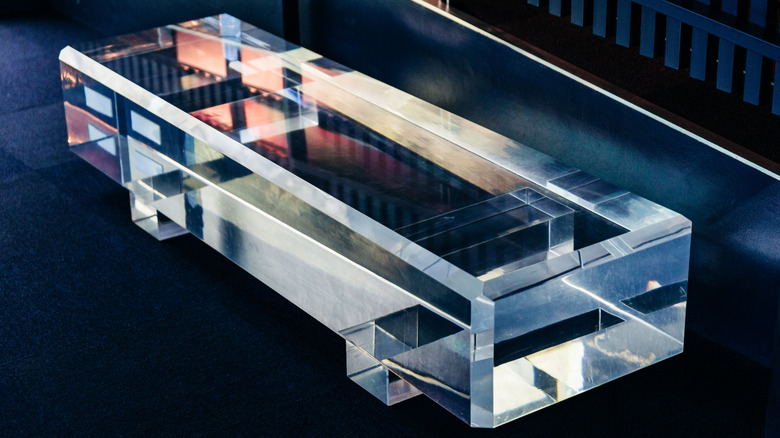
Back in the '80s, clear acrylic furniture seemed somehow wonderfully futuristic. Barely-there furniture was out of this world. Lucite and acrylic became the most recognizable materials in '80s interiors. Clear waterfall tables that bend gracefully toward the floor with barely visible joints were ultra-modern at the time, and today are wonderfully retro. You'd find tables, chairs, shelving, benches, and accessories of all kinds in this type of material, sometimes combined with brass or chrome.
While visually it was sort of barely there, most of these pieces were chunky, and if you stubbed your toe on one, you definitely knew it was there. A single good piece of vintage acrylic in a contemporary living space can work well and look delightfully vintage. But lucite and acrylic furniture, much like mirrored surfaces, are not easy to repair. If they have deep scratches, cloudy areas, or cracks around the joints, you probably want to look for a better piece. The same goes for any piece where there's obvious yellowing, as this is impossible to remove.
Curvy laminate and high-gloss tables
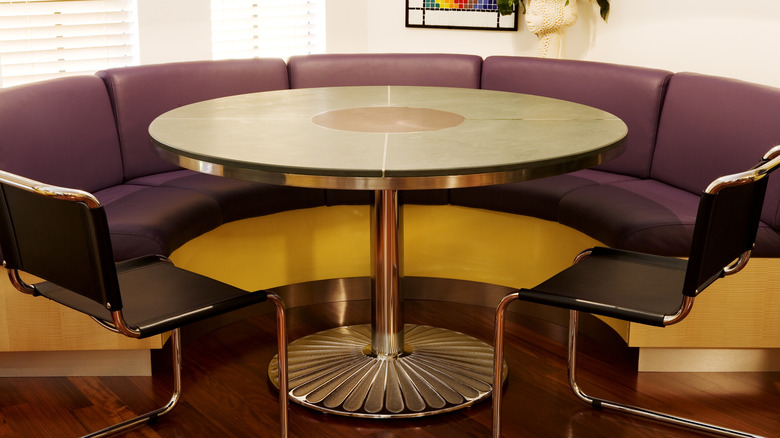
The postmodern designers of the '80s enjoyed playing with form, color, and finish, so you'll see a lot of strange chunky forms and interesting curves with laminate, chrome, or glossy lacquer finishes. There are still plenty of bulbous consoles, strangely rounded tables, pedestal bases, and stepped forms in bright colors or with shiny surfaces to be found at thrift stores across the country.
They work unexpectedly well in the contemporary living room, although do be aware that pedestal-based chairs are not necessarily the most stable thing to sit in. This type of furniture looks just as fantastically futuristic now as it did then, and when a single piece is the oddball in the room, it draws the eye and looks playful and uplifting. Some of the most sought-after pieces come from designers like Michael Graves, Vladimir Kagan, and Peter Shire. With laminate finishes, you need to look for lifting, swelling, and peeling, and check the edges and top surfaces for chips and bad paint jobs attempting to hide the damage.
Rattan and wicker seating
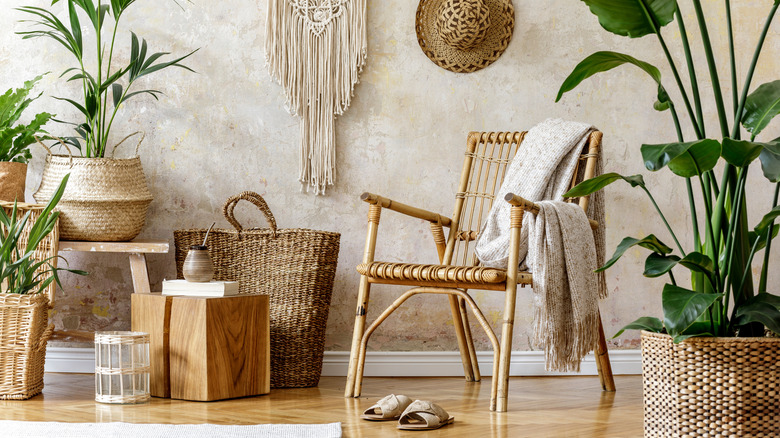
There was a big trend for rattan and wicker in the '80s, as well as for an indoor garden look in conservatories and sunrooms, with masses of greenery combined with rattan, bamboo, and wicker furniture. This was almost the complete opposite to the futuristic, shiny, chrome, smoked glass, and black laminate look. Yet, sometimes those two polar-opposite design trends would coexist within the same house, with the living room and bedroom sticking to the futuristic style, and the conservatory or sunroom receiving the indoor garden treatment.
A nice rattan or wicker chair from the '80s is a fabulous addition to your home, and you can often find them at thrift stores with ugly original cushions for just a few dollars. To make sure you're getting a true thrift store score with rattan furniture, check the condition of the frame and signs of excessive wear or rot. You can ditch the tired floral off-white seat or back cushion and add something new and modern — or perhaps you want to make your own. There was also an unfortunate trend of painting this furniture white or, like my grandmother, a weird dirty turquoise blue. If the paint is in good condition this can work, but you may need to consider stripping it down and painting it again in something that suits your home. Thankfully, repainting and minor repairs to rattan and wicker furniture is a relatively simple upcycling project.
Lighted glass display cabinets
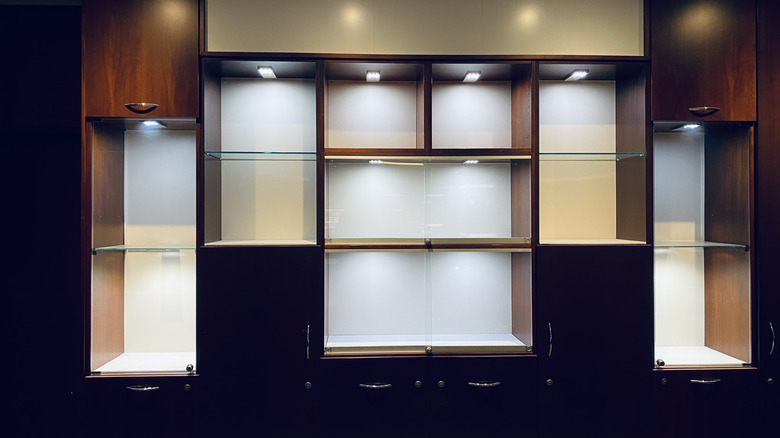
I'm sure just about every home in the '80s had at least one lighted display cabinet with glass fronts that were filled with things that children, under no circumstances, were allowed to touch. Most of us weren't even allowed to get too close to the glass doors. They were mostly wood, chrome, or brass and glass curio cabinets, to hold things like crystal glasses, little china animals, wedding gifts, or whatever else had been collected and deemed too important for an ordinary cupboard.
These often had mirrored backs and glass shelves as well as built-in lighting. Some, like Mastercraft units, were about as '80s glam as a storage cabinet could get, combining brass, glass, mirrors, curved doors, and integrated lighting. I'd love to find a chrome or brass vitrine by a designer like Mastercraft at the thrift store, as they are wonderfully over the top. If you're lucky enough to stumble across one at an affordable price and the lighting still works or can be replaced relatively easily, these make fantastic display units even now, as they draw the eye and make a real focal point of your most prized collectibles. For me that would probably be my geeky fantasy ornaments, fossils, and favorite books.
Entertainment centers and stereo cabinets
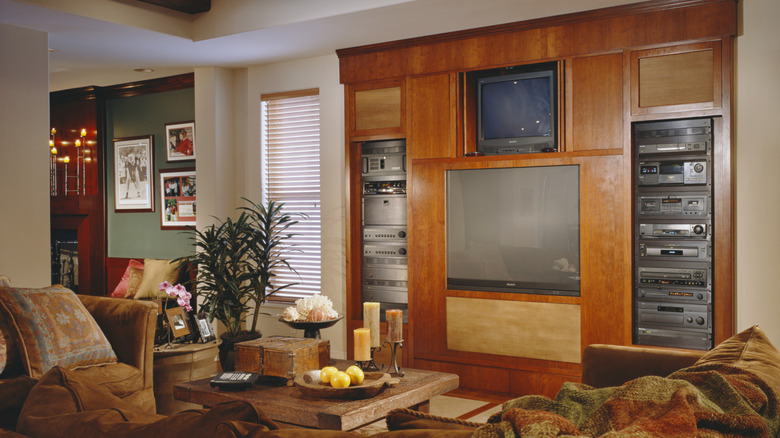
As with the lighted display cabinet, no '80s living room would be complete without a colossal entertainment center. These behemoths usually had cupboard doors that hid the whole thing away, and when you opened them, you would see a perfectly rectangular hole designed for a specific size of cathode ray television. Therefore, naturally, these cabinets were also deep to accommodate the huge back of televisions during this period. Televisions of the '80s were nothing like the sleek slimline screens with minimal edging you know today. They were enormous, incredibly heavy, and many still had buttons on the front for you to be able to change the channel, as not all of them had remotes yet. The entertainment center also played host to the VCR, stereo, cassette deck, LPs, and tapes too. Listening to music was also very different during the '80s.
Many pieces from this period are not easily repurposed because the way we access media has changed so dramatically. However, if you find a piece that you really love the look of, then there's no reason, for example, that a particular armoire-style entertainment center can't hide a modern TV, along with your smart home device, gaming console, and digital TV box. If you happen to have a taste for old-school entertainment in the form of DVDs or vinyl records, then a shallow hi-fi cabinet can make excellent storage, especially if you add a few extra shelves.
Oversized corner and sectional sofas
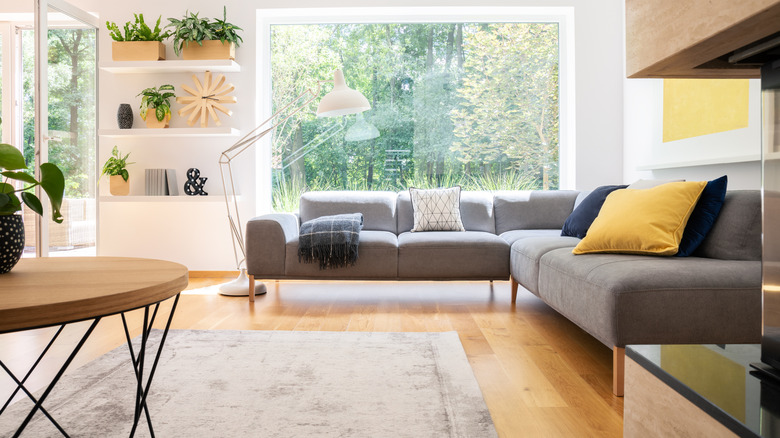
A furniture trend from the '80s that's making a comeback is oversized furniture. Big sectional and corner sofas were very much on trend during this decade. While some were beige, brown, and rather dull in shape, or hideously blue and floral (like my childhood nightmare), there are plenty of interesting ones filling thrift store floors. You can find fantastic post-modern designs with interesting curves, gloriously weird-ugly upholstery, and unusual angles. Their modular nature still makes them convenient to move and rearrange.
Some are rather enormous, but if you have the space for them, then they may well be worth the price tag. Don't be afraid of ugly fabric. If you love the shape, and the frame is in good condition, just replace the upholstery for a fraction of the cost of buying a brand new sectional sofa. You may even be able to upcycle it yourself and keep the frame exactly as it is, simply replacing the fabric with something more your style. And you could keep the '80s retro look by switching a hideous brown or floral for something bold like a black and white checker, and even add a few brightly colored accents.
Chintz sofas and skirted armchairs
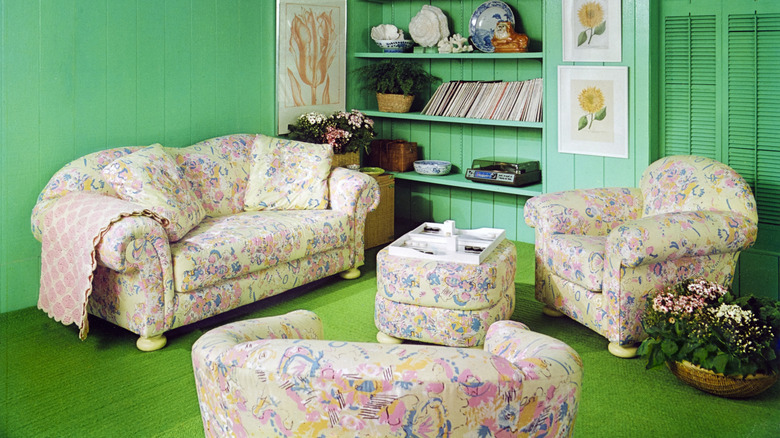
Not every '80s home embraced futurism. Plenty went the other way, with ruffles, frills, and an obscene amount of chintz, florals, skirts, tassels, and layers. Mario Buatta, for example, was a popular interior designer of the time, and he made chintz a signature of his English country interiors. He used so much of it that he became nicknamed the Prince of Chintz. While I am not a fan of chintz, ruffles, or skirts on chairs, there are plenty of people who still love the look, and there's usually an abundance to choose from at the thrift store. In fact, it was so popular that the '80s chintz sofa trend is making a comeback.
Don't be alarmed if you dislike the color or the print on the fabric, as you can change this without taking away the '80s vibe. You do, however, need to check the frame and the legs. If these are still in good condition, then you can reupholster it fairly easily. If you love the fabric, then check its condition. Look at the arms and the seat cushion to figure out how worn it is. Look at cushion seams and make sure you inspect areas that are hidden from sunlight to see just how much the fabric has actually faded.
Ornate brass beds
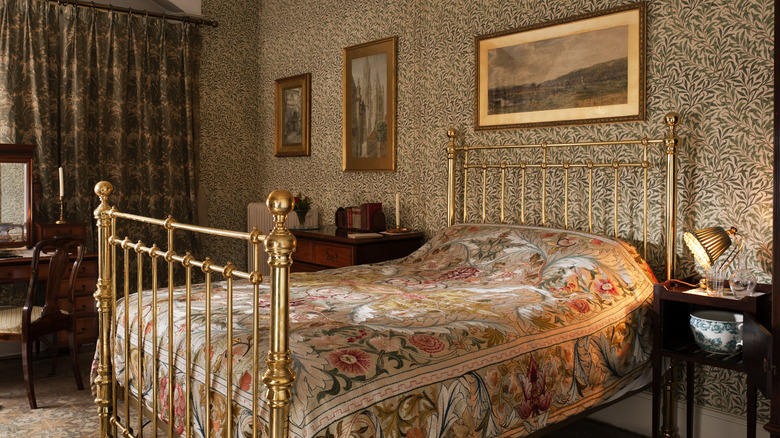
The brass bed revival during the '80s was particularly interesting because it was part of the restoration movement, with homeowners bringing back the Victorian grandeur of their homes or wanting the country living look. But, these beds also appeared in modern interiors. While you can get some huge ornate antique-looking brass beds from the '80s, you can also find stunningly futuristic ones, too, with matching brass canopies, headboards, and surrounds. For those who didn't want to go full brass everywhere, there are plenty of '80s bedsteads with white or dark iron frames with brass knobs, rails, and other accents.
These pop up pretty frequently at thrift stores, and if they're still in good condition, they probably have many decades of life left in them. Just make sure that it's all complete and still sturdy. Brass does tarnish over time, but most light surface tarnish can be removed pretty easily, so don't be too alarmed if the brass isn't all uniform in color.
French country bombe nightstands
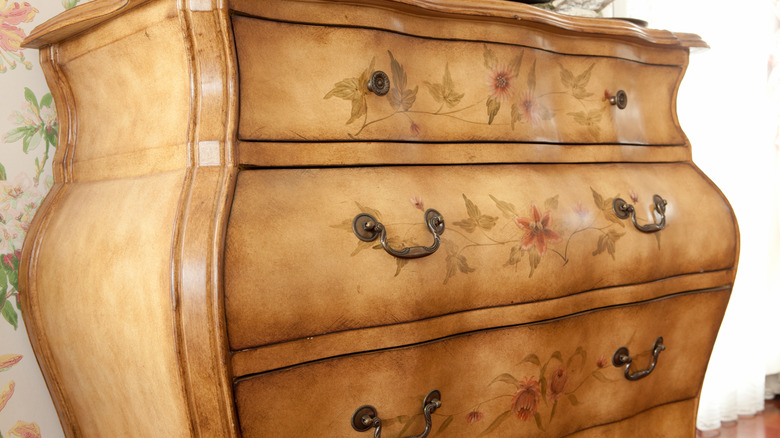
French-style bombe chests of drawers and nightstands have that bowed, swelling front and sides that make them seem like they came straight out of one of the bedrooms at Versailles. French country and French provincial furniture remained popular all through the '80s, with brands like Henredon making bombe nightstands in carved mahogany with ornate brass hardware.
Matching pairs of these pop up from time to time at thrift stores and they are functional and pretty. Even single ones, if you can get them cheap enough and in good condition, work well as hallway storage or for stashing all of your craft bits that don't have a proper home. You can find some beautifully made pieces with dovetail drawers, decorative hardware, and really lovely finishes. Usually, you can get them much cheaper than buying a chipboard flat pack that you have to spend hours trying to fit together yourself.
Magnussen Ponte tessellated stone tables
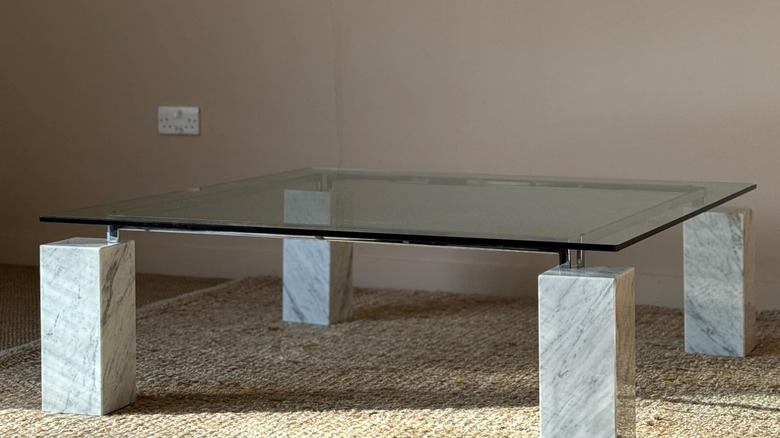
'80s design was very much about playing with materials and shapes, and that's exactly what Magnussen Ponte tessellated stone tables did. I adore these tables and would love to find one in the wild. Magnussen Ponte produced post-modern masterpieces using pale Mactan or fossil stone. Some of the best examples feature chunky geometric bases and are topped with glass. Some of these tables have rough-edged stone with smaller smooth stone balls supporting the glass tops, so they have a very distinctive architectural look.
Even if you can't find a Magnussen Ponte original, there are many other similar shapes and designs from this period that are equally as impressive. You do need to check the stone corners for chips and inspect the glass too, as it's difficult to repair and would need to be replaced if it's damaged. For those examples that are supported with stone balls, make sure they are all present, so that the top remains stable when you put something on it. Because these tables are so neutral in color, they work in pretty much any contemporary room, fitting into neutral minimalist spaces. They also work in bright, bold maximalist rooms, because they have such a unique shape and the color creates an interesting juxtaposition with the rest of a busy, colorful room.
Memphis-style furniture
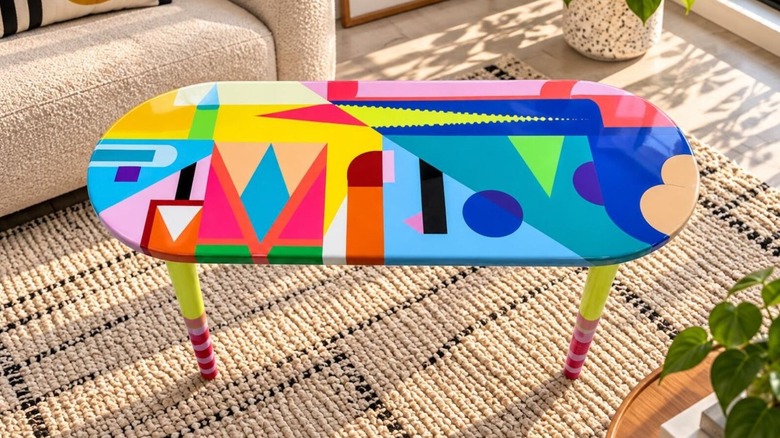
If there's one type of furniture that epitomizes the rule-breaking, boundary-pushing flavor of the '80s, it has to be Memphis-style furniture. These pieces were bright, bold, and startlingly different. They broke all of the design rules and really did play with shape and style. They featured bright colors, kitsch patterns, and used industrial materials, as well as acrylics and laminates — and they had wildly unconventional forms. This style of furniture also went against conventional design by mixing materials like wood and plastic laminate. Memphis-style furniture is a great way to bring the '80s retro aesthetic into your living space.
There were cabinets that also had curved arms that you could use for shelving on the outside, shelving units that were supported by colorful triangles, and weird wire lamps with odd little blue cupped feet. Most designs were slightly off-kilter or ever-so-mildly visually off-putting, while simultaneously being stunning. It would be an absolute dream to find an authentic Memphis Milano piece at the thrift store, though extraordinarily unlikely, but you may find some Memphis-inspired pieces that are still worth grabbing because they look so fantastic. The key tells are asymmetric shapes, squiggly prints, contrasting geometric blocks, bright, vibrant color, and an awkward or off-kilter appearance. There are a few Memphis-style furniture pieces that are firmly on my thrift store bucket list, because I love the flagrant rule-breaking and the interplay of color and shape.