

Not Hostas, Not Coral Bells: The Perennial Berry That's Great For Your Shaded Garden
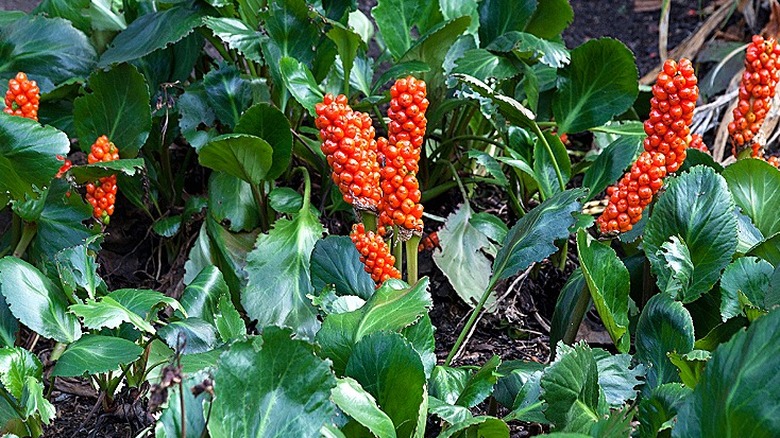
The lords-and-ladies (Arum maculatum) plant, also known as cuckoo-pint, is a true multi-season charmer. In the spring, it blooms dramatic spiked flowers to go along with its glossy, green leaves, followed by the development of berries that emerge fully as bright orange-red fruit in the fall. Best of all, this perennial is a shade-lover, adding drama from early spring all the way through "spooky season."
Soon after the arrow-shaped leaves arrive, flowers emerge in April and May bearing both male and female (or "lords and ladies") parts. Specifically, the "lord" is a fleshy, pale yellow/green spike with a purplish band, while the "lady" is the leaf-like hood surrounding it. Setting aside the slightly naughty names for the spathe and spadix, lords-and-ladies provides an undeniably striking sight in the spring. In the fall, the plant gets even more dramatic. After the lower leaves and the spadix drop off, the spiked part of the flower develops a column of red-orange berries that light up the autumnal forest.
The plant is reliably perennial in USDA hardiness zones 5 to 9. It grows up to 18 inches tall and 9 inches wide. Important to note, as ornamental as the berries of the cuckoo-pint may be, they're decidedly not for humans or pets. In fact, all parts of the lords-and-ladies plant are poisonous to ingest and can also cause contact dermatitis. That being said, when considering which berried plants to add to the garden to attract all the birds, you don't have to remove lords-and-ladies from the list as birds are unaffected by the poison.
Give lords-and-ladies shade and room to spread
The lords-and-ladies plant thrives best in partial shade. Spots to grow it in your garden include woodland areas, under shrubbery, or in other perennial beds that get no more than a few hours of sun each day. The soil for this plant should be moist and well-drained. Grow it either from seed, or from tubers or young plants offered through your garden center or an online nursery.
When placing lords-and-ladies plants, keep in mind that they spread fast, and so shouldn't be set too near more delicate plants; make sure to give these plants plenty of room to spread when you establish them. In addition, choose hardy companions that can hold their own, like daylilies and irises. Hostas is another; as a shade-loving plant, the cuckoo-pint is also among the best companion plants to grow alongside hostas. Ornamental perennials such as these can add interest during the dormant period between lords-and-ladies' flowering and berrying times.
Note that because it's hard to dig up the entire plant, a lords-and-ladies patch can be stubborn to eradicate. When digging it up, be sure to treat it like a weed and remove all pieces of the tuberous roots. Also, if you find you need to keep a patch under control, deadhead spent flowers to try and cut off self-seeding before it can get too far. But again, if you plant them, it's better to leave these mysterious beauties to unclaimed patches in a garden, where they can "lord" over all without fear of trampling less vigorous plants.