

Everyone Had It On Their Walls — Now It's The Vintage Halloween Decor We'd Be Thrilled To Find
We may receive a commission on purchases made from links.
Every year as summer departs, new Halloween decorations arrive, tempting us to add more new products to our seasonal stash. Sure, you could get that huge plastic skeleton that went viral to loom over your house, but who has room to store that for the rest of the year? Die-cut paper decorations actually let you bring the Halloween magic inside, plus they aren't a nightmare to store. Iconic party-supply brand Beistle is responsible for some of the most enduring and recognizable vintage Halloween decorations. These designs aren't only coveted thrift-store finds; they're still in production today.
Beistle is famous for die-cut paper wall decorations, made from the 1920s through the 1950s, as well as 3D honeycomb tissue paper shapes. From paper skeletons with moving joints to garlands of hissing black cats, Beistle's charmingly spooky Halloween imagery has been an inseparable part of the holiday since the company introduced its first seasonal decorations for Halloween 1921. In honor of the impact these designs had on how we celebrate Halloween, Beistle began reissuing reproductions of their vintage designs in 2012, with slightly different sizing and colors to differentiate them from the originals.
Even with reissued designs readily available, classic Beistle Halloween decorations can sell for hundreds of dollars. And depending on the style and rarity, collectors may pay even more. In 2025, a dancing cat die-cut from 1930, still in its original envelope, sold for more than $1,300 (via Halloween Collector). Fortunately for vintage shoppers, more common Beistle designs, like a jointed jack-o'-lantern and a cat with a crescent moon, can be found for less than $50.
How to spot vintage Beistle Halloween decorations
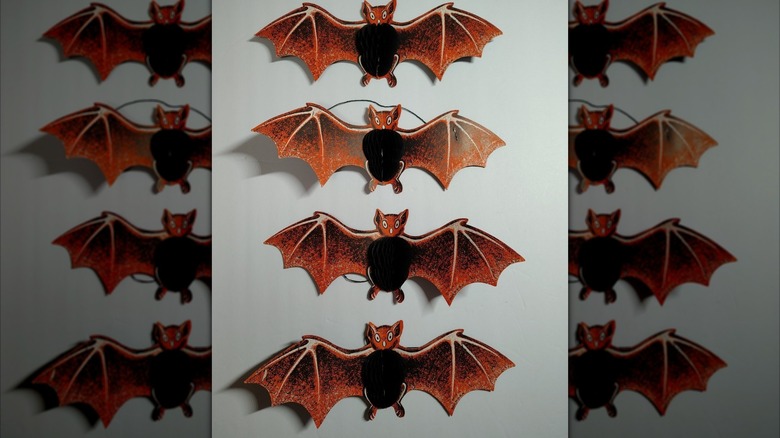
Beistle's die-cut wall decorations are valuable today because they were made in smaller quantities, and their paper construction made it challenging for them to survive to the present. Designs incorporating moving parts or folding paper are especially rare. If a die-cut survives in good condition, it can make for a stunning vintage Halloween decoration that's easy to find room for amid overcrowded storage boxes.
If you're decorating for Halloween with vintage-inspired items and trying to identify the provenance of some Beistle decorations, there are a few clues to look for. Beistle makes it easy to differentiate between their original vintage decorations and the 2012 reissues. The reproductions will have two copyright dates, one for the original design and one for the new version. Also, the name "H.E. Luhrs" on die-cut decorations is an indicator of vintage Beistle decorations, which were made during the 1940s and 50s when Luhrs was the company president.
Finally, there are some clues in the actual construction. Paper decorations from before the 1960s were often embossed, giving the design a subtle 3D quality. Then, in the 1980s, manufacturers started making double-sided paper decorations. You can sometimes identify older die-cuts if they are only printed on one side. They may even have marks left on the back from removing tape. Some rare 1930s die-cuts also have foil embossing, which can push their value past $100 each.