

Skip Pyrex: The European-Style Antique Dishware To Look For While Thrifting
You're likely to see Pyrex casserole dishes and mixing bowls mentioned in most ultimate guides to mid-century modern decor. They're undeniably fantastic thrift finds from the era. However, if you're more of a traditionalist, the minimalist printed patterns on the dishes might not be your cup of tea. Lovers of antique rather than vintage or retro tableware often like more ornate decorations, choosing pieces they imagine may have come from a Gilded Age manor or 18th-century palace. Staffordshire pottery fits the bill, and if you have a keen eye when thrifting, you might be able to nab some dishes for your collection, even here in the U.S.
Staffordshire in the West Midlands, England, is well-known for its beautiful countryside and historical buildings. But its biggest claim to fame began underground. Beneath the rolling hills are large amounts of white clay and coal, both of which were once necessary for producing high-quality pottery. While the region has hosted potteries for hundreds of years, things really started to take off in the 18th century when businesses began exporting local ceramics. Staffordshire quickly became synonymous with a distinctive style of pottery: clay with a slightly translucent sheen when fired, colorful, ornate hand-painted designs, and a clear glaze.
How to identify Staffordshire pottery
Staffordshire pottery wasn't produced by a single manufacturer, so there's no specific name or maker's mark to look out for. The term refers instead to pieces made in the area in the Staffordshire pottery style. There are clues you can use to determine whether you've found an authentic piece — the first is the material itself. Until the 18th century, China was the only country producing true porcelain tableware. The Staffordshire potteries helped change that.
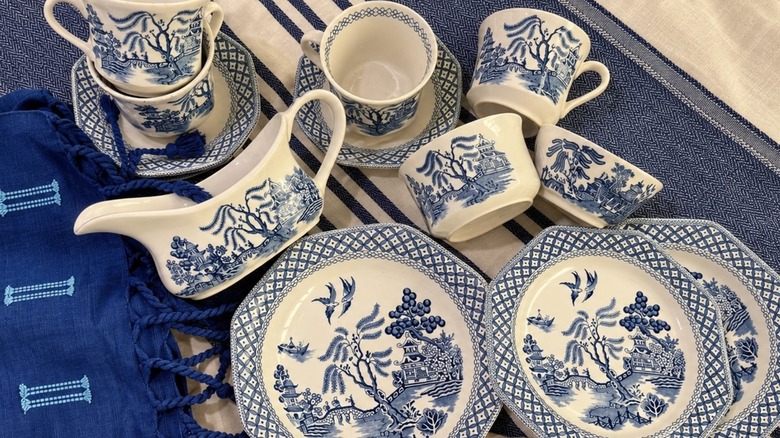
One clue to look for when identifying Staffordshire porcelain is translucency, as some pieces allow a little light to filter through. Some Staffordshire porcelain is bone china, which is made with bone ash as a key ingredient. Most Staffordshire porcelain tableware features blue-and-white decoration under clear glaze, but potteries in the region produced many other decorative styles and types of pottery. For example, Staffordshire potteries also made figurines. Check the decor section while thrifting if you're interested.
To authenticate your latest thrifting find, turn the piece over and look for a maker's mark on the base. This was — and still is — common practice for potters, and the marks often clearly state where the piece was made and by whom. Look for the word Staffordshire, a loosely tied knot symbol, or the names or initials of known manufacturers, such as Royal Doulton, Wedgwood, Wm. Adams & Co., and Royal Worcester. This is a non-exhaustive list, so don't be discouraged if you see a different mark. Instead, use it as a jumping-off point for research.
Is Staffordshire pottery valuable?

Because Staffordshire pottery has been produced for several centuries by multiple manufacturers, valuing pieces can be difficult. A rule of thumb when it comes to antiques is that older, rarer, and well-preserved pieces command higher prices. Porcelain is prone to breaking and chipping, so old wares in good condition can be more valuable. Pottery from manufacturers like Wedgwood, Minton, Doulton (or Royal Doulton), and Moorcroft can be sought after by collectors, with rare pieces selling for tens of thousands of dollars at auction. On eBay, more contemporary Staffordshire plates are listed for around $15, while complete sets and older pieces can run into the hundreds of dollars.
If you've run all the authenticity tests before buying an item at the thrift store and are convinced you've found valuable Staffordshire pottery, well done! Before taking it to the cash register, take a photo and run it through Google Lens to see if you can find similar items and their listed prices online. How much your find is worth on the secondhand market can be difficult to determine, given the huge range of prices for vintage and antique English pottery. However, online listings are a good jumping-off point for research. If you decide to buy the piece, don't stop there. Reach out to a few antiques experts. They may be able to help you learn more about your find, including its history and potential resale value.