

Here's A Potential Reason Your Yard Smells Like Burnt Rubber
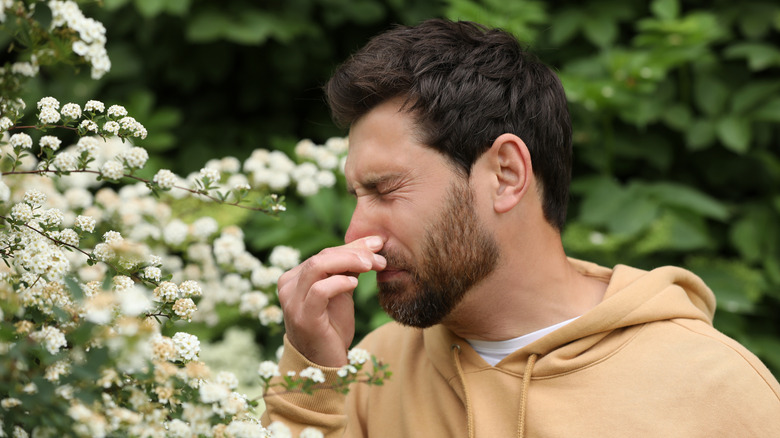
There are all sorts of memorable scents that tickle our nostrils when we're out in our yards — floral aromas, freshly cut grass, the smell of wood after it rains. And then there's that less pleasant but very distinctive odor of burnt rubber. Although it may smell like someone just squealed their car tires on your street, sometimes that weird aroma has an insect origin. If you're finding yourself asking, "Why does my yard smell?" – one of the reasons may be a stink bug that's in a huff.
Stink bugs, the tank-like insects that you might find indoors from time to time, produce an odd smell that some interpret as burnt rubber, others as skunky, and yet others as cilantro-like, or a mixture of those last two. (You can't blame us for assuming that the owners of those noses are cilantro haters.) Stink bugs release their scents as a spray of chemical compounds that can be propelled an astonishing several inches away from the insects. When we happen to be in the right place at the right time — or the wrong place at the wrong time, depending on how you feel about the odor — you might catch a whiff of eau de stink bug, which can smell distinctly unnatural.
Stink bug spray smells like burnt rubber as a protection
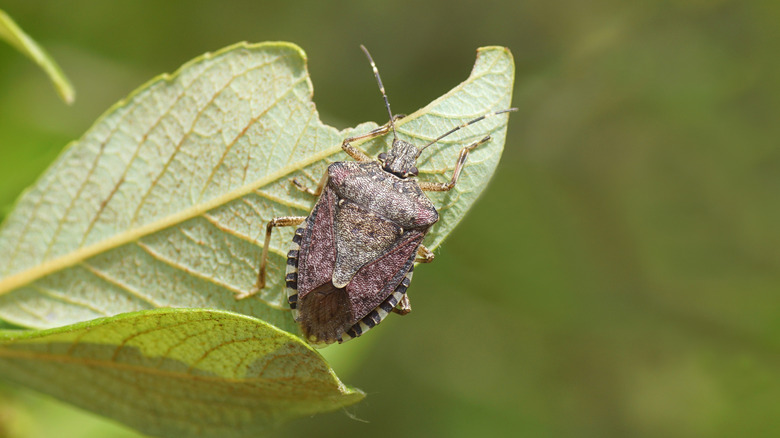
We can guess your next question — why on earth would bugs release such unpleasant scents? Unlike pinning down a precise description for this smell, the answer to that question is easy. Just like when skunks spray their foul odors, stink bug spray is a defense mechanism. It's a warning to anyone or anything that wants to mess with them to stay away. Stink bugs produce these burnt rubber smells when they perceive that they are in danger, such as when they are handled or crushed. If you had to worry about getting devoured by a larger creature, you might try the same tactic if you were able. And this strategy is certainly effective — predators such as birds and lizards will avoid eating stink bugs.
If you're wondering how to get rid of stink bugs because you have an infestation, pesticides aren't recommended — they won't solve the problem. One of the best ways to keep these bugs under control in your yard is to use biological controls, that's to say, encouraging the natural enemies of stink bugs, including praying mantises, spiders, and parisitoid wasps (mantises and wasps both love nectar-rich flowers). However, once you inspect your yard, you may discover that the stink bugs aren't the culprits, and that you're actually smelling the scent of a squash bug in your garden. It can be easy to confuse the two, both of which produce foul odors. You'll know you have a stink bug if it has a broader, more rounded body and is feeding on flowers or fruit in your garden — expect to find the narrower-bodied squash bugs on your squash plants. These pests are most effectively hand-removed, or targeted with diatomaceous earth.