

Not Straw Or Sawdust: The Best Type Of Mulch To Use Around Fruit Trees
We may receive a commission on purchases made from links.
There are plenty of fruit trees that will bring a bountiful harvest to your yard. Give them the best care, and they'll reward you with lots of delicious fruit for you and your family to enjoy. In addition to regular pruning, watering, and fertilizing, you also need to mulch the soil around the base of your trees. This reduces competition from weeds and prevents moisture loss. Using the right type of mulch material can also keep tree roots cooler in summer and provide nutrients as the mulch decomposes. Arguably, the best type of mulch to use around the base of fruit trees isn't straw or sawdust — it's wood chips that have come straight from an arborist's chipper truck.
While straw mulch is relatively inexpensive, it breaks down quickly, making it great for use in gardens that are regularly turned over, like your veggie patch. However, you need a longer-lasting mulch for fruit trees, which are permanent or semi-permanent features of a yard. Sawdust — on its own, without other amendments — can clump together and repel water rather than absorb it. Less water from rainfall or irrigation will get through to the soil and the tree's roots. On the other hand, freshly chipped branches from a living tree have loads of benefits as mulch. The differently sized branches decompose at diverse rates, providing nutrients to the soil and tree for longer.
Why freshly chipped wood mulch is good for fruit trees
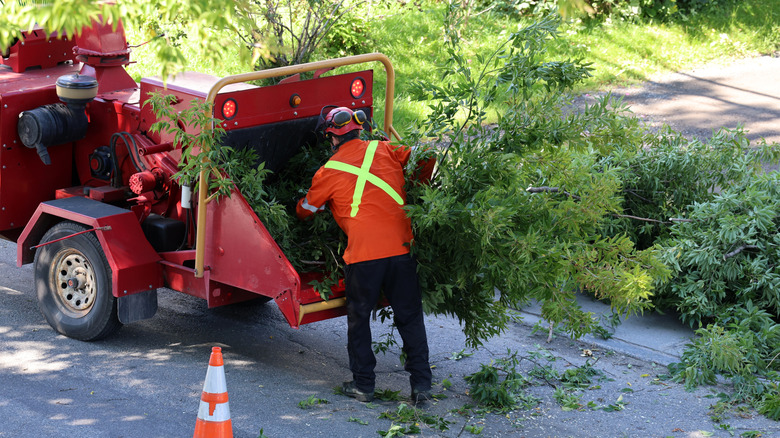
This type of mulch consists of the chipped branches and the tree's leaves. The minced-up foliage, in particular, breaks down quickly, providing a boost of nutrients that your fruit tree can start using immediately. Since the wood in the mulch — the chipped branches — has come from a recently living tree, they contain lots of healthy microbes that benefit the soil and your living, fruiting trees. It's probably better to think of this material as similar to the duff layer that accumulates around trees in a forest rather than a commercial mulch material.
If you know which of your neighbors is getting a tree trimmed soon, you might be able to score free mulch for your yard. Professional tree pruners or arborists typically run their tree trimmings through a wood chipper right away. They usually take the mulch away, but you could approach them and ask to take the mulch for your garden instead. They should give it to you for free — or at least at an affordable price. After all, you're saving them the hassle and cost of disposing of the mulch.
You could also call tree services in your area to ask if they can drop a load of chippings at your home after their next job. If you prefer technology-driven solutions, try the online service ChipDrop, which connects arborists with mulch to give away to gardeners who want it. Just be prepared to receive an entire dump truck's worth of wood chips (as much as 20 cubic yards) at one time. Some public utility agencies or transfer stations near you supply wood chips for free or at a low cost, too.
Repurpose your own tree trimmings as mulch for fruit trees
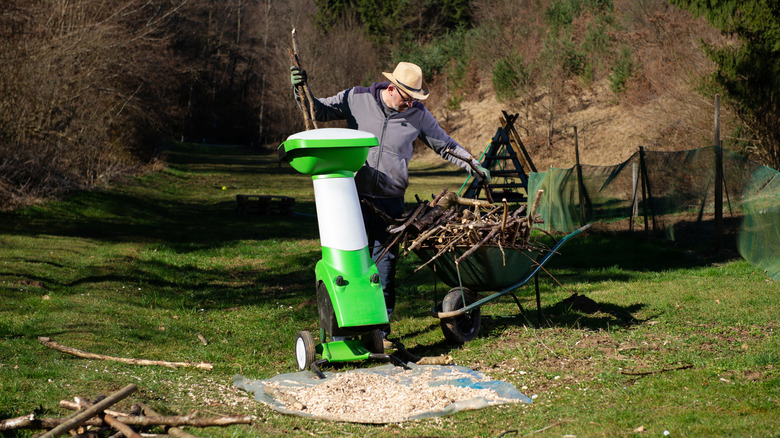
In an effort to provide your fruit trees with the right mulch and to prevent tree trimmings from going to the landfill, consider buying or renting a chipper to make ramial wood chips at home. What are ramial wood chips and how do you make them? They're exactly the type of mulch we've been discussing: fresh green branches that you've run through a wood chipper. Most fruit trees need regular pruning, so you might as well use the trimmings to provide nutrients to the tree they came from — or any other trees in your yard. You could add a layer of leaf litter under a layer of ramial wood chips for a mix of decomposition rates. A 50-liter Yeryork 15-Amp Electric Wood Chipper and Shredder will set you back about $130. (Note that you can't run leaves through this chipper.)
There are just a couple of things you need to be cautious about when using freshly chipped wood as mulch for fruit trees. Since fresh chips have not been composted, they will create heat as they decompose. If you layer the material too thickly, you risk it catching fire — between 2 and 3 inches deep is the limit, depending on how far the fruit trees are from built structures. Keep the mulch about 3 inches away from your tree's trunk to reduce fungal issues and stop the scion of a grafted tree from growing roots. Finally, fungi thrive in damp, decaying wood, so keep small children and pets away from the mulch to prevent possible ingestion of poisonous mushrooms.