

Man Transforms A Simple Log Into A Functional Hive For Mason Bees With A DIY
We may receive a commission on purchases made from links.
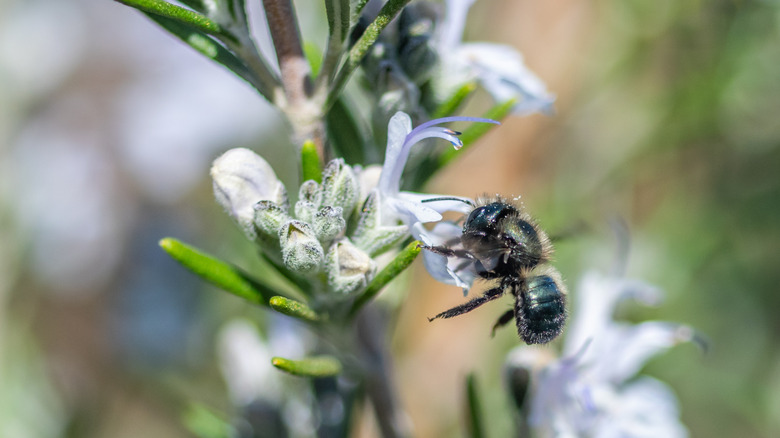
As a gardener, you know the importance of native bees to a thriving ecosystem. Of course, there are lots of bee species and each has its own nesting preferences. Take mason bees, for example. These gentle winged insects — that rarely sting, by the way — lay their eggs in holes. You can keep these bees in your yard by providing the simplest DIY house from bamboo sticks, dry plant stems, cardboard tubes — really, anything that's hollow and made of natural materials will do. TikToker JohnTed transformed a log he already had lying around into a suitable nesting spot for the mason bees in his backyard. He simply drilled some holes in one end of the log and mounted the log to the ceiling of his outdoor shed. It's something that basically anyone can do with an electric drill and the right-sized drill bit.
Are you wondering why you would want to attract mason bees to your garden? Importantly, they help to pollinate the blooms of your flowering and fruiting plants. They're fantastic pollinators — better, even, than honey bees. If you start digging into bee hotels and bee houses online, you'll find hundreds of DIY ideas, many featuring large tin cans or wooden frames stuffed with hollow tubes. They're all designed with mason bees and other species of hole-nesting solitary bees in mind. Making your own hotel to keep these productive bees in your garden is truly easy. If you don't have a log in your backyard, you can get a three-pack of kiln-dried Wilson White Birch Pillars for about $37. Make sure whatever log you use is in its natural condition and not treated with chemicals, and that it's longer than your drill bit. You'll also need an electric drill fitted with a ¼-inch drill bit for wood.
How to turn a log into a nesting site for mason bees
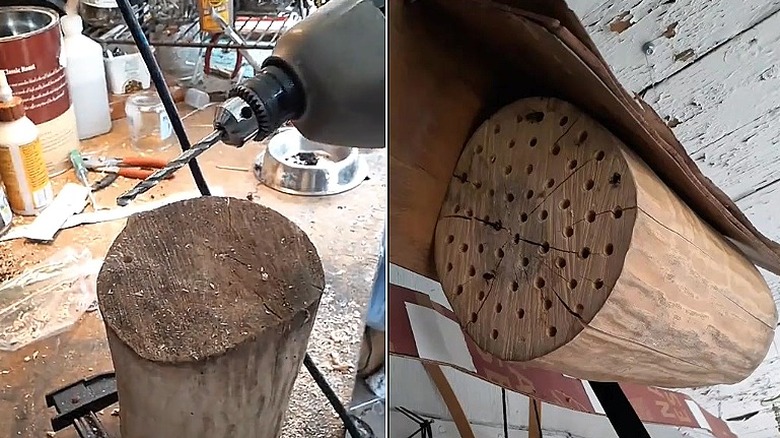
Secure the log in a vice with he end you're drilling facing upward. Start drilling holes as deep as the drill bit, leaving enough wood at the end of the log to protect the eggs and larvae. You can drill as many holes as will comfortably fit in the log without being too close together. There should be a ½-inch hole-free border around the edge of the log and the same distance between each hole throughout the log. Nesting mason bees, it turns out, aren't super neighborly. Plus, the border of wood around the outside of the log helps insulate the bees and their offspring from extreme temperatures. If the log you've chosen is quite long, you might even have enough room to drill holes in both ends, as long as the holes don't join in the middle.
@johnted69 I've been making "bee hotels" for mason bees. #savethebees #savethebees🐝 #DIY
Once you're done drilling, tap the log on your work surface to remove any sawdust from the holes. Mount the log to a sheltered spot in your backyard where mason bees are likely to find it, such as under the eaves of a porch or patio. It should be about 6 to 7 feet above the ground in a south-facing spot that gets warmed by the sun in winter but not in summer. Depending on the diameter of your log, these Jugghome Adjustable Sign Mounting Brackets might do the trick. You can attach them to a wall or the ceiling. Want to make your garden even more attractive to these highly beneficial insects? Plant this fall-blooming, fragrant flower in late summer to give bees a cold-weather habitat: aromatic aster (Symphyotrichum oblongifolium). It has hollow flower stems the provide natural nesting sites if your log is fully occupied.