

Why Does My Grass Look Gray And Torn?

If you want a front yard that your neighborhood envies, your grass should be lush, smooth, and green. Unfortunately, that isn't always as easy as it seems. Even if you've done seemingly everything to keep your lawn healthy and green — regular mowing, fertilization, watering, aeration, overseeding — things can still start to look dull. The reason it's fading, despite your best efforts, doesn't usually have anything to do with your routine. It's often your dull mower blade.
When you cut your grass with a dull blade, you're essentially ripping it apart rather than slicing cleanly through. Grass that has been cut or ripped unevenly is more prone to disease and drought while it recovers, which could leave you with much bigger problems than a little dullness down the line. These problems include diseases like rust and dollar spot. Your lawn may also experience jagged edges on individual blades, an overall gray appearance, and dead patches. Graying in grass can be due to gray leaf spot, a fungal infection, but if it's coupled with torn edges, it's pretty cut-and-dry that the mower is the problem.
It's easy to overlook this lawn mower maintenance task, but if you get on a regular schedule of sharpening your blade, your lawn will thank you. As a general rule of thumb, sharpening should be done after around 25 hours of use, translating to about twice per season for most users.
How to sharpen your lawn mower blade to prevent torn, gray grass
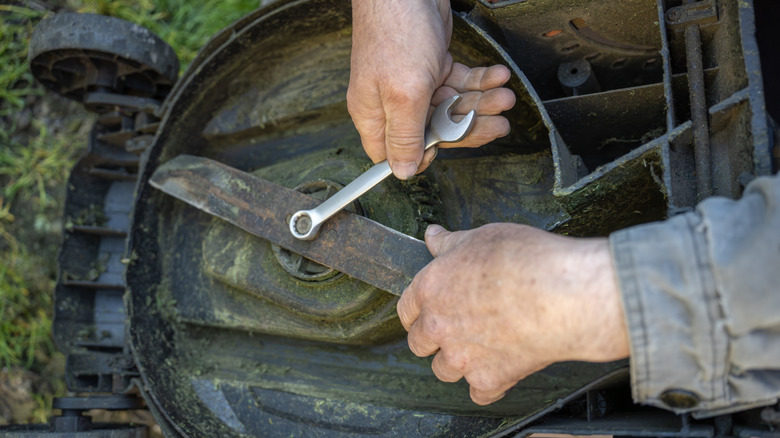
If it's time to sharpen your lawn mower blade, you have a few options. A hand file will be the least expensive, but most labor-intensive approach. An angle grinder or specialized blade sharpener will speed up the process, but will require an additional purchase if you don't already have the necessary tools. For all three methods, you'll also need some basic tools and a bit of safety gear, including a clamp, safety glasses, work gloves, a socket wrench, a balancing tool, and hearing protection for an angle grinder or specialized sharpener.
You'll begin by disconnecting the spark plug before securing the blade with a clamp and removing it with a socket wrench. Siphoning out fuel from a gas mower before tipping it to remove its blade can prevent leaks. Always tilt your mower so the carburetor and air filter are facing up.
When the blade is out, mark the bottom or top with spray paint or tape so you can later reinstall correctly. With your safety gear on, all you'll need to do from there is use your tool of choice to drag against the blade at the original angle, sloughing off thin layers of metal and eventually achieving a sharper surface. After you're done sharpening, you should also make sure that the job is even — if more metal has been removed on one side, your blade could be unbalanced. Check this by balancing the blade on a screwdriver, then correct the heavier side with some small adjustments to ensure a clean cut down the line.
If you're tired of spending time sharpening lawn mower blades yourself, give your local Ace Hardware a call to see if a pro will do it for you. Many stores offer this as a service at an affordable price.