

Which Household Slug Remedies Are Safe To Use Around Vegetables?
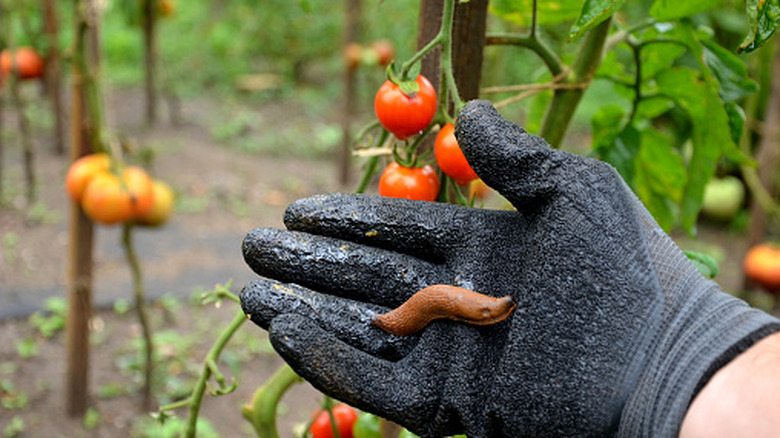
If there's one household slug killer that most of us have heard of, it's salt. And it's certainly not a myth that salt kills slugs! But too much salt can also harm your growing vegetables. Even some other tried-and-true methods, such as coffee sprays, require a bit of caution. Fortunately, there are plenty of ways to get rid of slugs naturally that use non-toxic substances but that don't hurt growing plants, including diatomaceous earth, beer, trap crops, and copper.
Like salt, diatomaceous earth deters slugs. Yet the powdery substance works because it is made from ground fossils that prick slugs' exteriors, rather than because it dries out their bodies as salt does. Another famous slug ender is the beer trap. Slugs are drawn to the yeast-smelling liquid, then drown in it. It's most effective when you bury a shallow container at soil level, with a bit of distance from your vulnerable plants.
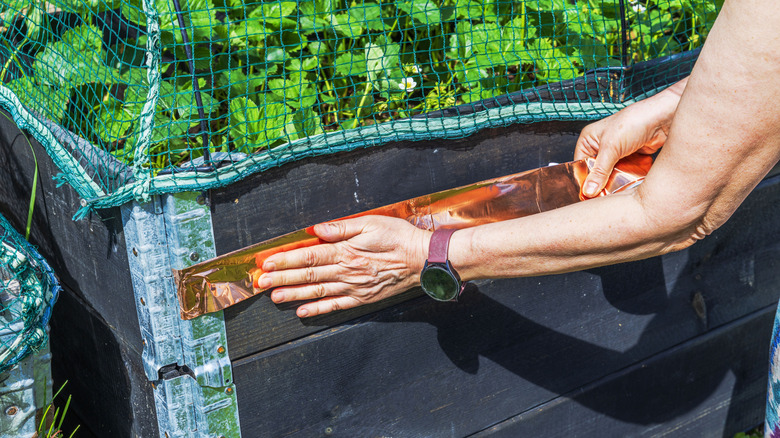
Natural borders around vegetable beds can also protect plants from slugs, although in two very different ways. Marigolds provide a "trap crop" when planted near veggies. You can then pick the slugs from the marigolds and dispose of them. Copper bands or copper wires can also be wrapped around whole beds or individual, vulnerable plants. While the metal is harmless to plants and larger animals, it "shocks" and redirects the slugs.
Why salt hurts plants, and more safe methods for slug removal
In general, salt is an efficient slug killer. The mineral's sodium content works quickly by drying out slugs' outer layer, killing them within minutes. But while this is an efficient way to reduce slug populations in your vegetable garden, it can also wreak havoc on the plants themselves. Excess amounts of salt can harm both above-ground plant parts such as leaves and stems, as well as the below-ground root system. Eventually, the plants' growth can be stunted, or worse.
Side effects such as these make it extra important to find ways to say goodbye to slugs with organic methods that are also plant-friendly. It's important to use restraint instead of going all-in on certain pest control substances. A foliar spray or soil drench of coffee, for example, can be an effective, natural slug poison. But dilute it with water, because watering your plants with straight coffee is a recipe for disaster. Use a strength of about 50% liquid coffee for a soil drench, and 10% liquid coffee for leaf spray. Watch vegetables closely to make sure they don't show signs of leaf burn.
Of course, the most hands-on, cost-free method is simply to pick slugs off plants. The best time for this is after dark or before sunrise. Shine a light on the undersides of leaves to find the slimy pests, then drop them in a bucket of soapy water. If you'd rather utilize the power of darkness without actually going out at night, consider setting boards around your vegetable patch. Every morning, turn the boards over to catch and dispose of the moisture-loving critters.