

The Fertilizing Technique That Can Take Your Hanging Planters From Blah To Gorgeous
We may receive a commission on purchases made from links.
Shopping centers and main streets are often adorned with hanging baskets full of flowering annuals. How do they keep them looking so lush when you struggle to get yours to thrive or bloom abundantly? Flowering plants growing in public places — whether that's in hanging planters, in containers, or in the ground — are attended by dedicated staff. But you don't need to hire a professional gardener to achieve the same results. With one special trick, you can transform your blah hanging planters into colorful displays your neighbors will envy.
You need to work on your fertilization technique, which involves feeding your flowering plants in baskets with the right dilution of Jack's Classic Petunia Feed (or a similar water-soluble fertilizer) throughout the growing season. Despite the name, Jack's Classic Petunia Feed isn't just for petunias. You can use it on any iron-dependent annuals commonly grown in hanging baskets, such as calibrachoa, bacopa, and verbena. If you want to keep your hanging baskets looking full and beautiful all season, you need to feed your plants regularly. Regular application is especially important if you're watering daily — say, during the hottest parts of summer.
Jack's Classic Petunia Feed has an NPK ratio of 20-6-22: 20% nitrogen, 6% phosphate, and 22% potash by weight. Plants that get too much phosphorus will become leggy, so low-phosphorus fertilizers keep plants compact. Jack's also contains three forms of iron and extra magnesium that keep leaves green and stems strong. Don't apply this fertilizer to plants prone to iron toxicity, like American marigolds, impatiens, and zonal geraniums. If you have these plants in your hanging baskets, use a fertilizer with an NPK ratio of 1:2:1.
Using Jack's Classic Petunia Feed in hanging baskets of flowering annuals
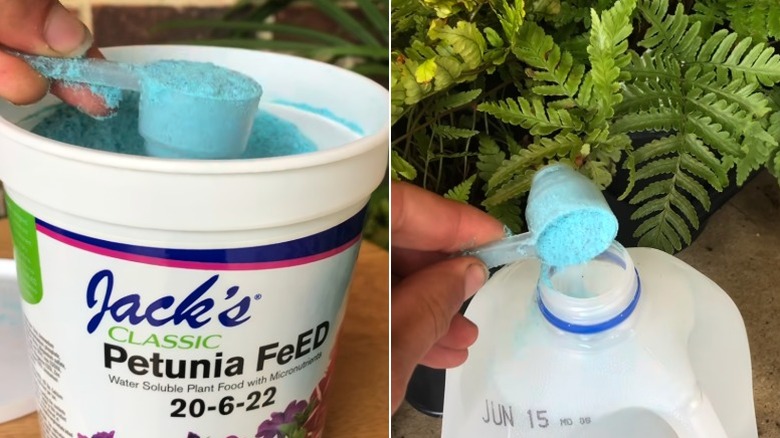
Mix 1 tablespoon of Jack's Classic Petunia Feed in 1 gallon of water and pour ½ gallon onto the soil of each hanging basket once a week. You can also use the solution as a foliar feed; you spray it on the leaves of a plant instead of pouring it around the base. If your area experiences hot summers, you may water more often than once a week. Because watering washes nutrients from the soil, you may need to fertilize twice a week. In that case, dilute 1 teaspoon of Jack's Classic Petunia Feed in 1 gallon of water instead of 1 tablespoon.
Moisten the soil in your hanging baskets before applying fertilizer. Dry soil separates from the sides of the container, creating a gap for the diluted fertilizer to escape. What a waste! If the soil is extremely dry, submerge the entire hanging planter in a large tub full of water and skip fertilizing until the plants inside no longer look stressed. If you want to avoid this problem in the future, you can simplify plant care with a highly-rated self-watering hanging planter from Amazon.
Something else to watch for is the soil inside your hanging baskets getting contaminated with soluble salts from the fertilizer. This can damage the roots of the flowering annuals growing in the planter. A brown or white crust on top of the soil or around the rim of the planter is a key sign of soluble salt buildup. You can also conduct a soil test to confirm if soluble salts are a problem. Either way, the fix is to flush the soil with water to wash the salts away. Your hanging basket flowers will look perfect on your porch once again.