

Everyone Owned It In The '50s — Now It's The Unique Milk Glass Jar Set We Want As Table Decor
We may receive a commission on purchases made from links.
Milk glass has undeniable vintage charm. While it was first developed sometime around the 16th century in Italy, this opaque white glass has had serious stylistic staying power. It saw a boom in popularity in the Victorian era as an alternative to expensive porcelain, then yet another boost from around the 1940s to the 1970s. Because of this, it's common to come across mid-century modern lampshades, vases, and decorative objects made of this material. If you happen upon Griffith's milk glass spice jars, you've truly hit the jackpot.
While most of us don't put much thought into our collections of seasonings beyond finding ways to store spices without cluttering the kitchen, these stylish jars can change all that. With their milk glass construction, squared off shape, and graphic labels that nod to the trends of the time, it's safe to say that they're a far cry from the bland plastic packaging of today. Griffith's spice jars were originally developed as a promotional tactic in the 1930s, during a time where many households had to cut back and reduce their spending on non-essential items. As a way to inject a bit of affordable luxury into consumer's daily routines, the company began selling its spices in sets that were pretty enough to be displayed. It's safe to say this was successful — the promotion ran for two decades, and the spice jars saw plenty of different iterations throughout the years. While they might have been a commonplace item then, they're a great find today, whether you're planning to resell for a profit, create a collection of your own, or simply add a vintage touch to your kitchen.
How to identify Griffith's spice jars
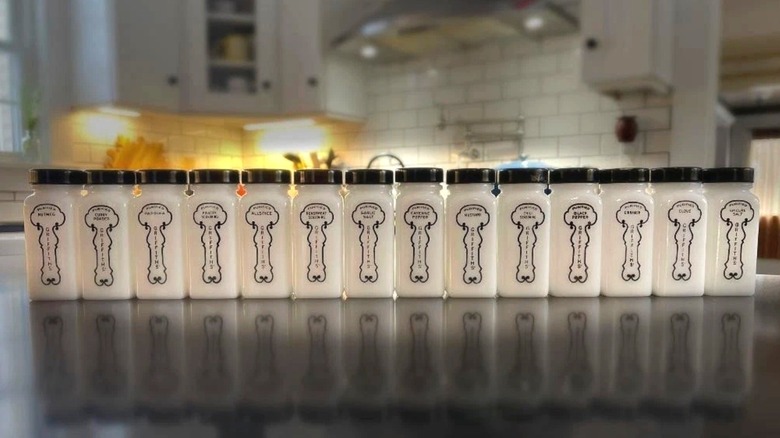
While Griffith's spice jars saw a few minor changes throughout the years, their general shape remained the same, making them fairly easy to spot from a distance. They are pretty close to the standard size of a spice jar today, and though they usually come in that quintessential white milk glass, there was also some occasional experimentation with a cocoa brown color, and lid colors can be found across just about the entire spectrum — pink, yellow, green, red, turquoise, black — you name it.
While the shape is often enough to make identification easy, the labels are what really gives it away. Regardless of the era in which the jar was produced, the label includes some arrangement of "Griffith's," "purified," and the name of the spice. The "purified" distinction refers to the company's special method of sanitizing and preserving the spices before distribution. Unfortunately, it can be a challenge to find earlier sets with intact labels — earlier iterations of the jars used paper labels with a distinctly Art Deco look, but later jars evolved to include a printed-on logo with more flourishes. The backs of the jars also featured instructions for how to use the included spices, a helpful addition for home cooks who found themselves stumped on how to incorporate then-unfamiliar flavors.
If you're an especially lucky thrifter, you also might be able to find an original spice rack. Because these spices were sold in sets of ranging from eight to 24, they came with their own storage method. These varied significantly throughout the years, but metal, plastic, and wood racks were all common depending on the era.
How to style — or sell — Griffith's spice jars
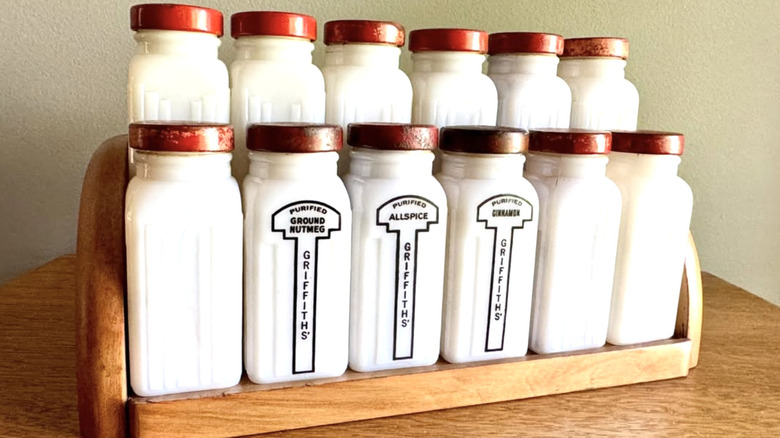
If you happened upon a set of Griffith's milk glass spice jars but you don't exactly have the space in your kitchen at the moment, you're in luck — there are plenty of collectors out there, along with shoppers who are looking for replacement pieces. Full sets in good condition, complete with the rack, will score you the largest payday — around $100 seems to be the going rate, but particularly rare sets that check these boxes can be priced up into the 200s or even 300s. Smaller collections, those with missing pieces, or collections where the labels have worn off will typically fall into the $50 range. Even individual jars can sell, usually for between $5 and $10.
If you decide to keep your spice jars, on the other hand, there are plenty of ways to put them to use in your home. While you certainly can use them for their original purpose, this comes with a risk — glassware items produced before the '70s could still contain lead, so unless you've done some testing, it's best to proceed with caution. Instead, consider styling your spice jars on their rack as a decorative accent in your kitchen. They can even be used to store small, non-food items, like buttons in a craft studio or hardware in a workshop. Regardless of your chosen use, they're sure to be a conversation starter, both for nostalgic visitors who remember seeing these jars in their own kitchens growing up and house guests who simply appreciate vintage design.