

Skip The Basic Concrete Blocks: The Natural Stone For Retaining Walls That Adds A Rustic Touch
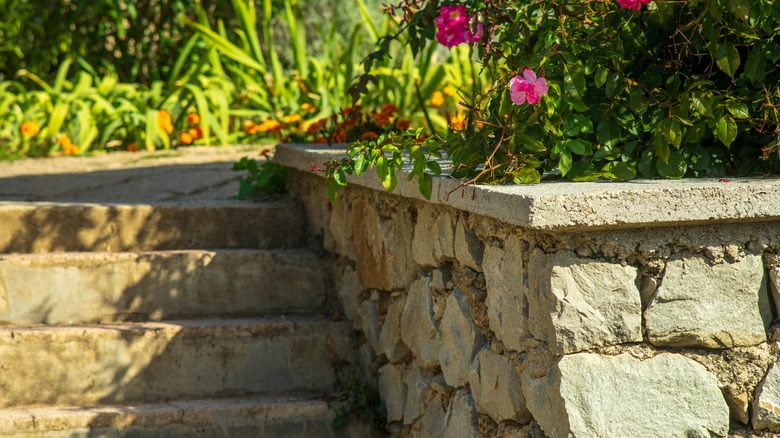
For the moment, leave aside all the important do's and don'ts of building a retaining wall, and consider one of the most important questions: what do you want it to look like? Stacking up concrete blocks will certainly result in a wall, but is it one you want to look at for the next several years? There are multiple stone options on the market for building a retaining wall, each offering its own structural benefits and aesthetic properties. For a wall that's contemporary without feeling cold, take a look at bluestone, which can fit a variety of design styles depending on how it's cut.
In the United States, "bluestone" is a term applied to an abundant type of strong, dense, durable sandstone found in Pennsylvania and New York. Bluestone gets its name from its blue-gray coloration, the result of mineral sediments that lacked oxygen in rivers around 370 million years ago. Due to its formation, bluestone splits into precise, complementary layers, which made it a popular choice for sidewalks and paving stones as early as the 1800s. Today, the fine-grained stone can be used in everything from eco-friendly patio alternatives to stairs and retaining walls. While bluestone is most popular in the Northeast, where it's quarried, today it's shipped all over the country.
What to know about choosing bluestone for your retaining wall
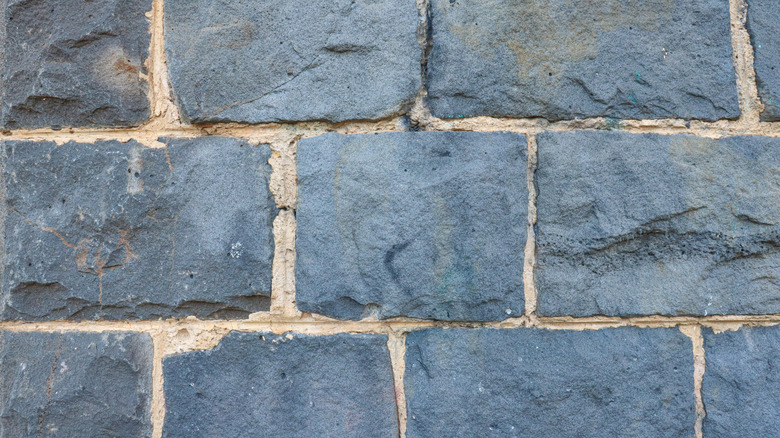
Despite its name, bluestone can be found in a range of hues, including green, brown, and purple tones. It's classified into various color ranges, so when you order bluestone, you're guaranteed to get stones in hues that coordinate with each other. Bluestone is a good choice for mortared retaining walls, but it can also be used in dry-stacked walls thanks to its flatter faces. Bluestone cleaves easily into layers, and today's machine technology allows for even more precise cutting and smoothing. It can be polished for a contemporary sleek look or left unfinished for a more rustic appearance.
As you shop for bluestone, you may spot a few unfamiliar technical terms. For instance, tumbled bluestone is created when a machine smooths its sharp edges. Thermal bluestone is soaked in water, then fire-treated for a smoother texture and appearance. Dimensional bluestone has been cut into evenly shaped, thick squares or rectangles with no sharp edges.
Bluestone's density makes it a weather-resistant stone landscaping idea that requires little upkeep. However, if your retaining wall is in a shady area or under trees, it can accumulate plant matter, like leaves, which can result in moss and stains. Sweep off the wall regularly and clean it with mild dish soap or a diluted bleach solution to maintain its appearance.