

Give This Garden Vegetable A Boost With Rice Water Fertilizer
We may receive a commission on purchases made from links.
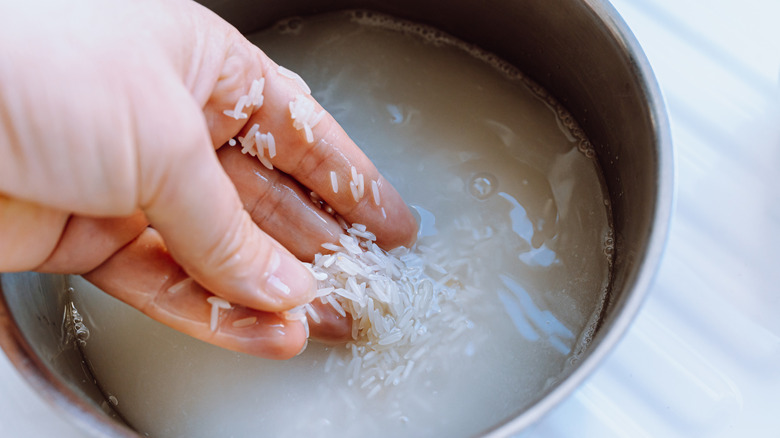
Washing your rice before cooking is a sure-fire way to get a fluffier final product, but if you're letting the water run down the drain, you're wasting liquid gold. The murky, starchy water doesn't look all that impressive, but it has a long history of use as a hair treatment, skin cleanser, and natural cleaning ingredient. It's also often used as a plant fertilizer, and out in the garden, it's been scientifically proven to bolster the health of eggplant crops.
Washing rice is impactful because it's milled — it goes thorough a lengthy, multi-step process to become the clean, edible, and debris-free final product that we then cook and enjoy. This process also leaves the rice grains coated in a layer of starch. Washing eliminates this starch (in addition to some of the microplastics and arsenic that might have hitched a ride), and the resulting water is a slurry of carbohydrates, vitamins, and minerals like potassium, iron, magnesium, and phosphorus that help to give plants an added boost.
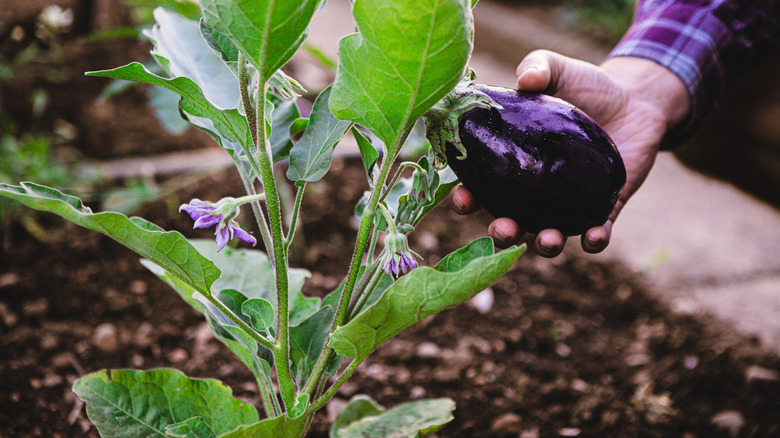
There are plenty of plants that love rice water fertilizer, but in a 2023 study published in the Indonesian Journal of Innovation Studies, its direct impacts on eggplant crops were proven. While the treatment didn't result in any measurable difference in the overall yield or height of the plants, the harvested fruits were heavier and the plants had longer roots and a greater number of leaves. Rice water shouldn't be seen as a cure-all for poor soils that need serious amendment, but it can be a valuable add-on to your existing gardening routine that helps to put a common waste product to good use.
How to use rice water on your eggplants
Rather than washing your rice in a strainer directly over your sink's drain, use a bowl to collect the by-product — picking up something like this two-layer Paoli Stainless Steel Fine Mesh Colander Set can make the process even easier. Once you have your rice water, simply water your plants with it. You don't have to get particularly scientific here, though you can add an extra step if you're interested in boosting the fertilizing power of rice water.
According to a 2021 study published in Agronomy, allowing rice water to ferment led to increased levels of several beneficial nutrients like nitrogen, potassium, and phosphorus. Thankfully, you don't have to wait long for this process to take place. After collecting your rice water, pour it in a glass and cover it with a cloth. Let it sit for around three days at room temperature, then store it in the refrigerator until you're ready to use it. Unlike fresh rice water, this fermented mixture should be diluted with an equal amount of water before applying it to your plants.
While it might be tempting to load up your eggplant crop with rice water daily, this isn't the best idea. Make sure to only fertilize every few weeks during the active growing season. Keep in mind that rice water is acidic — while eggplants do prefer soil on this side of the spectrum, overuse could throw your garden out of the ideal 5.8 to 6.5 pH range. You should also give your plants a break if the soil is becoming too wet, you're noticing unpleasant odors, or you've seen an increase in pest activity.