

Change Up Your Typical Mums For A Pretty Fall Flower That Thrives In Shaded Beds

Everyone knows that mums are the classic fall plant (you're probably already seeing your neighbors' porches adorned with them), and for good reason. Their flowers love the darkness that becomes more prevalent in the fall season. But they aren't the only ones that can bring a pop of color into the shadier, sometimes drearier days. If you want to switch things up and trade in your basic mums, we have something for you to try: the Japanese anemones (Anemone × hybrida).
Japanese anemones are unique in that, while they are perennials, they do well in the shade. In fact, they quite prefer it. When in bloom, their adorable little flowers spring high up above their bushy, dark green leaf base. The foliage only sits about 12 to 18 inches above ground, but the flowers shoot up on 3 to 4 feet stems, creating quite the show. Varieties like 'Andrea Atkinson' have stark white flower petals, while others like 'September Charm' have shimmery pink flowers. These colorful flowers make the perfect fall alternative and have been known to stick around even through the early frosty days of the season.
Because they like to spread out, Japanese anemones are a great, easy-care option to use as ground cover in your shady beds or yard. Plus, butterflies and bees love them, so they'll keep your garden full of pollinators through the fall. And a fun fact for our plant-history lovers: although these plants are a hybrid of several species native to China, the name Japanese anemones came about because early plant notations were found from a specimen located in Japan.
How to cultivate thriving Japanese anemones for beautiful fall flowers
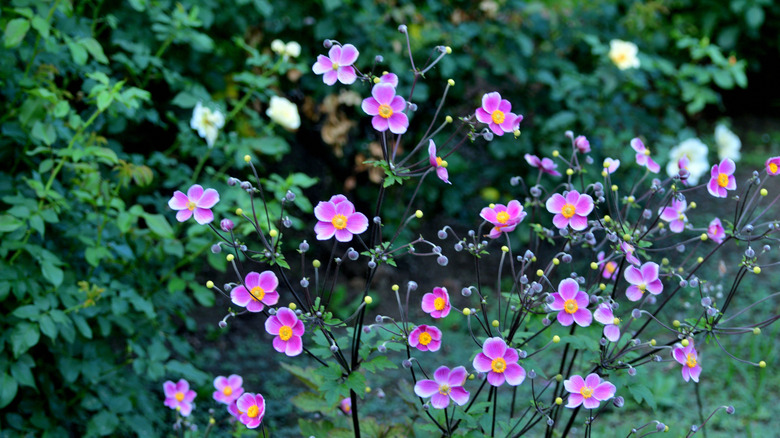
Yes, Japanese anemones are the stunning alternative to mums to grow in your garden. But there are a few things to note before clearing out your local nursery of their entire stock. First, these herbaceous perennials are hardy in USDA Zones 4a through 8b. So make sure you're within an appropriate zone if you want your flowers to thrive. Another thing to consider is that they love to spread, which runs the risk of them bullying all your other perennials. Start them where they'll have plenty of space to stretch those legs, so to speak. Once you've got that sorted out, you can get to work because fall is a great time to plant them.
Japanese anemones love a soil that is just the right amount of moist. To strike that balance, ensure that you're planting them in rich, well-draining soil, which can be supported by amending the soil with compost. Space them out evenly with about 2 feet in between and then top it off with mulch. During the first year, while the plant is getting established and growing, you'll need to pay attention to its watering needs. The goal is to maintain a consistent moisture level in the soil. You'll know it needs to be watered when the soil begins to feel dry to the touch when you place a finger down into the ground. Once your Japanese anemones are off and running, you can allow them to spread as much as you'd like. To keep them reigned in a bit, you can thin out any dense growth every 1 to 2 years.