

The Ancient European Tool That Makes Garden Bed Prep Easy
We may receive a commission on purchases made from links.
Sometimes, simpler is better when it comes to working in the garden. Large-scale, technologically advanced tools are fantastic for industrial applications, but when it comes to home gardens intended to feed a family or effortlessly fill your yard with color, cultures of the past had already developed many of the tools and techniques you need to get the job done. One fantastic example of a tool that has stood the test of time is the sarculum, a garden hoe that was commonly used in ancient Rome. Nowadays, it's more commonly known as a swan neck hoe.
There are quite a few types of garden hoes and they all differ, each with its own design. This design is set apart by its curved neck that allows the user to drag the tool nearly parallel to the ground while standing — if the handle is long enough, that is. Discomfort breeds innovation — after all, it's not hard to imagine an ancient farmer, frustrated by the consistent back pain they experienced from preparing their fields, deciding to create a tool that would solve the problem.
The sarculum is widely considered the first tool that was developed purely for agricultural purposes, and the design is just as useful today as it was 2,000 years ago. Swan neck hoes can come with different heads that make them better for certain uses, but they're generally used for removing weeds and disturbing surface soil in order to prepare garden beds for cultivation. By learning to properly use one, you can minimize the amount of effort required to prepare your garden for planting — and, more than likely, save yourself some back pain.
How to use a swan neck hoe to prepare your garden beds
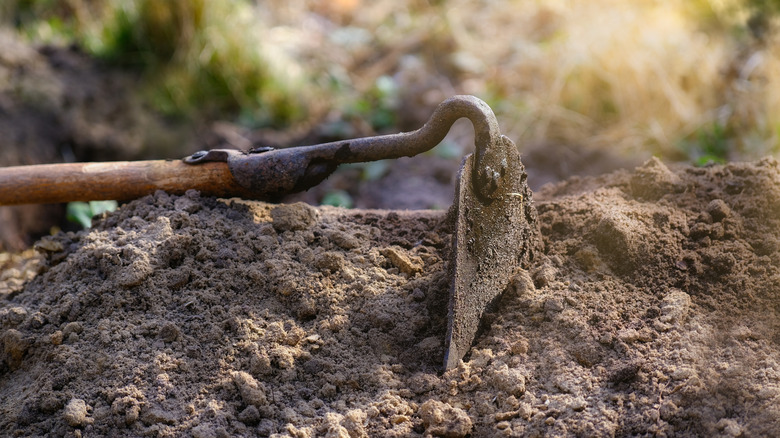
Before you get to work, you'll want to find a swan neck hoe that's well-equipped for the job you're trying to accomplish. Because of the design of the neck, these hoes are most often used for more surface-level tasks. The blade should run along the ground rather than being plunged directly into it, keeping cuts shallow. Choose a hoe with a long handle, like this DeWit 52-Inch Ash Hardwood Handle Garden Hoe, to minimize back pain. Hand-held versions with short handles are also available, but you'll lose out on some of the benefits of the long-handled tool.
Be sure to choose a tool with a sturdy handle, a comfort grip if desired, and a durable steel blade. Carbon steel is fantastic if you're looking for sharpness, but you'll need to be sure to clean and disinfect your gardening tool regularly to prevent rusting. Stainless steel, on the other hand, may be harder to sharpen but is more resistant to corrosion.
To properly use your tool, grip the handle with two hands while standing. Place it so the blade forms a shallow angle to the ground, then use a pulling motion to disrupt the top layer of the soil or remove the weeds in the garden bed. This tool isn't as aggressive as a full-blown tiller, but it's a fantastic option for getting under the roots of weeds and removing them in their entirety. While it might not be all that technologically advanced, there are good reasons why this style of tool has been a gardening essential for thousands of years.