

How Do The Amish Keep Weeds Out Of The Garden? (It's Not Landscape Fabric)
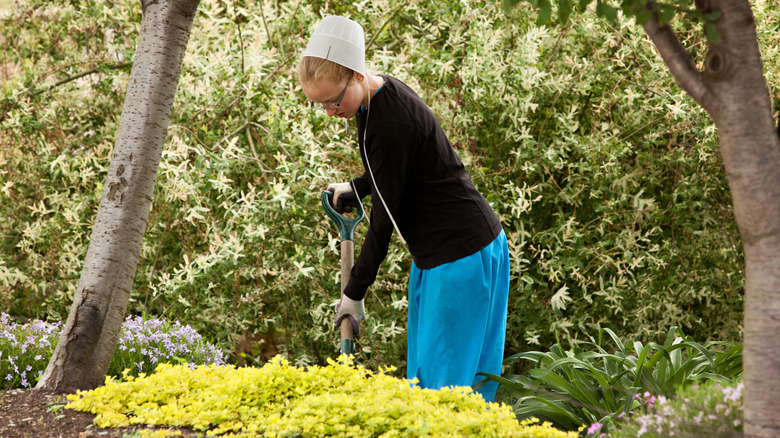
If there's one thing that unites the famously independent rural dwellers with us non-Amish gardeners, it's that we all have to deal with our fair share of weeds. And not surprisingly, the Amish community doesn't take this challenge lightly. After all, Amish farmers rely heavily on the crops they raise for both food and livelihood. When it comes to gardening, the Amish have centuries of know-how on which to draw. Mulching, foot-stomping, and soil amending are just a few of the traditional Amish methods for weed control.
In a letter written to Modern Farmer, an Amish organic gardener enclosed a 45-page handwritten how-to document, providing a fascinating glimpse into how modern Amish communities deal with age-old gardening woes. For one, the manuscript mentions using alfalfa hay, which is often recommended as one of the best ingredients for a DIY mulch. The author of the document, Joni Miller, wrote, "Mulching with straw suppresses weeds. Greenhouse tomato growers are using rich alfalfa hay. Weeds are prevented [with alfalfa hay], but the main benefit is that the decomposing alfalfa feeds the vegetables with high-quality nutrients." In fact, alfalfa differs from straw in that, unlike the carbon that straw contributes to the soil as it decomposes, alfalfa hay provides much-needed nitrogen.
Stomping is a time-saving method used by Amish communities. While moving between rows of planted crops, the farmers will simply stomp on unwanted vegetation that's growing in between. They save their hand-pulling for weeds that are growing closer to the actual crops, as they pose more of a threat. In this way, between-row weeds get trampled on regularly enough that they can't grow large enough to reach the crops, and the nearby nutrient-robbing weeds can be removed with more precision and efficiency.
The Amish may combine old wisdom with some new tech
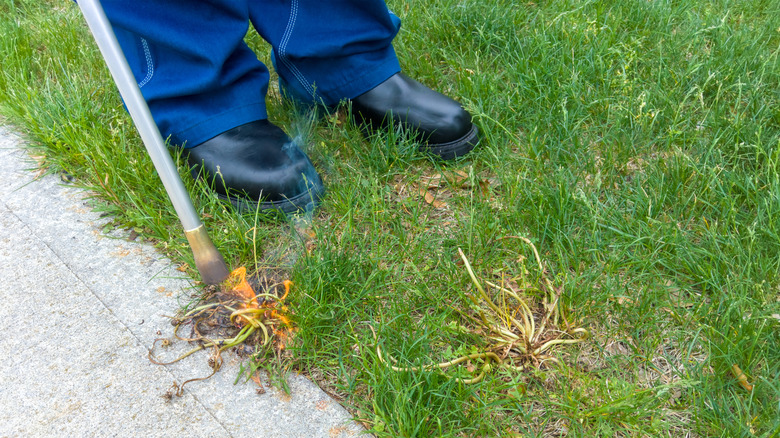
Of course, there are many subgroups of Amish culture, and rules about modern technology can vary between them. According to the document authored by Joni Miller, one weed control item in some Amish barns is the propane flame weeder, used to tackle out-of-control infestations. The flame wilts the weeds, creating a "fried green manure mulch mat" that blocks out new weed growth.
Interestingly, Miller also writes that Amish farmers may also use black plastic sheeting to kill weeds, which can be both laid and taken up by a working horse team. In order to keep within the organic guidelines that their buyers expect, Miller notes that the plastic mulch must be removed between uses, rather than allowed to break down in the soil. As maintaining natural soil is paramount to many Amish farmers, this could be a reason for some to avoid landscaping fabric, which degrades over time.
Historic Amish gardening practices aren't going anywhere
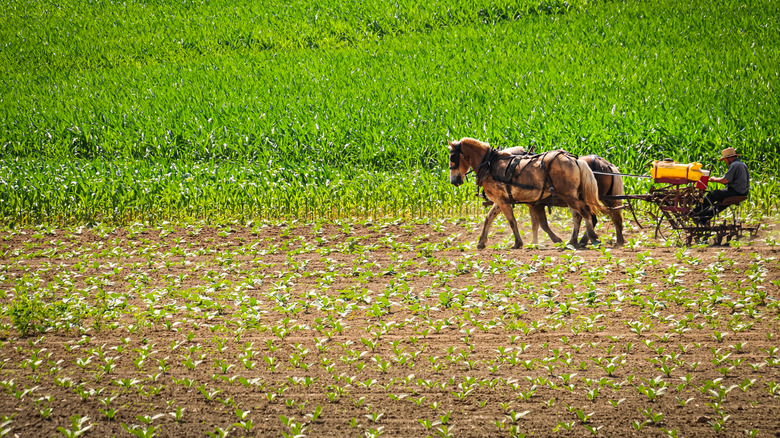
Just because a few more contemporary tools may be used in some Amish gardens doesn't mean that safe, natural weed control is a thing of the past. Joni Miller describes one method to prevent weed seed germination using "heat units" to decide when to attack the soil after planting. Per the letter, heat units are calculated by averaging the day's high and low temperatures (counting anything above 90 degrees Fahrenheit as 90 and anything below 50 degrees Fahrenheit as 50), then subtracting 50. According to the theory, weed seeds germinate once the accumulated total reaches about 60 heat units, so it's key to hoe the fields before then. Planting slightly later than conventional neighbors also helps; the soil is warmer, so crops sprout faster and stay ahead of weeds instead of competing with well-established ones.
Keeping to old-fashioned ways to amend the soil without contributing to weed population explosions is also important. "Reading soils by their weeds is an art!" Miller wrote. She notes that too high a magnesium level, for example, tends to result in grassy weeds, while a proliferation of dandelions indicates poor soil. In this way, the Amish not only know how to balance soil nutrients to manage weed growth, but also how to make corrections based on the weeds that do sprout up.