

How To Warm Up Your Attic With An Easy To Install Solution

Your home attic can be useful for more than just storage. With a little work, you can turn a boring attic into a hidden reading nook, an extra bedroom for guests, or a fun hang-out space. One of the major things to consider when finishing your attic is how to keep it at a comfortable temperature. Even a well-insulated attic can get uncomfortably cold in the winter, so you'll need a good (and safe) heating solution, and arguably the easiest and most economical one is a portable space heater.
Most home attics aren't huge spaces and don't require a powerful heater to keep warm. Since we're talking about electric heaters, you'll want to consider wattage when choosing the best space heater for your attic. An easy way to calculate this is to look at the square footage, then multiply that by 10 to figure out how many watts your heater should deliver. For example, you'll want at least a 1,000-watt space heater for a 100-square-foot attic.
This calculation is for finished spaces with proper insulation, however. An unfinished attic with poor (or no) insulation will require a more powerful heater. This is a good reason to insulate your attic if you haven't already. Also note that a low-quality or old space heater can be dangerous, so make sure whichever space heater you choose has safety features like overheat and tip-over protection. These automatically power off the heater if it gets too warm or is knocked over.
Portable space heaters may not be ideal for large attics
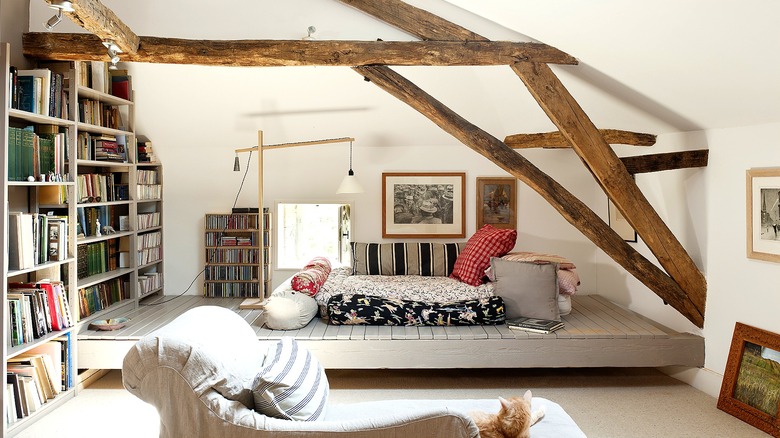
Electric space heaters are great for warming smaller attics. Their portability also means you can move them to heat specific areas as needed. However, they may not be sufficient for a large or finished attic. A space heater that's too small will be energy-inefficient. You'll have to constantly run it just to keep the room warm, and it'll be the reason why your energy bills skyrocket during winter.
That doesn't mean you need to extend your central heating system into your attic, which can be costly (especially if it requires upgrading your existing furnace). A wall-mounted heater can be an energy-efficient alternative. While not as portable as a space heater, it is still easy to install yourself. Another option is a ductless mini-split heat pump. This is a little more complex to set up but offers added versatility because it doubles as an air conditioning unit that can keep your attic cool in the summer, so you can have a comfortable temperature year-round.
You can heat an unfinished attic with a space heater, with some caveats
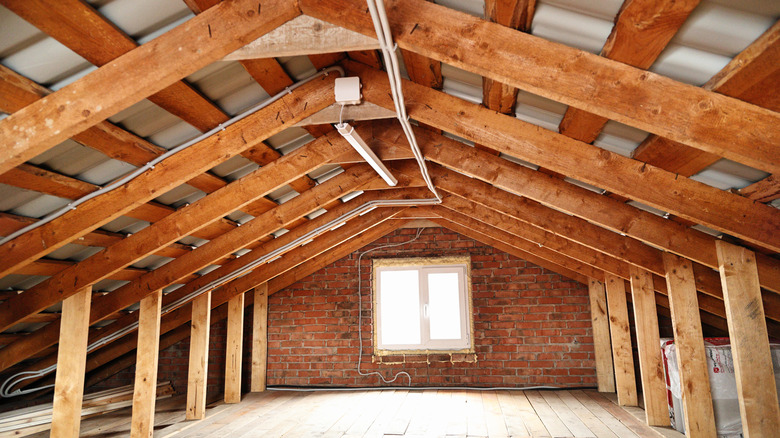
How effectively your heater warms your attic depends on how well-insulated the space is. A finished attic will retain heat better than an unfinished one. You may want to convert your unfinished attic into usable space, such as a small work area. Or maybe you just don't want the expense and hassle of finishing the whole space. A portable electric heater can work here, but there are a couple of things to consider.
The first is power. Portable space heaters aren't designed to keep a room warm all day long, and an unfinished attic will lose heat quickly. Since the "10 watts per square foot" rule applies only to finished, insulated spaces, you'll want to increase that wattage by about 30 percent, aiming for 12 to 15 watts per square foot for an uninsulated space. This depends on your needs, however. You may not need a more powerful unit if you only want to heat a small area in your attic, such as your workbench.
The second consideration is safety. Clear a safe perimeter around your space heater, keeping it away from any liquids and anything that could catch fire. Extension cords can also create a fire hazard, so plug your space heater directly into the power outlet. Also, make sure the outlets in your attic can handle the electrical load. Running a space heater on an old or overloaded circuit can trip the breaker. And finally, never leave a space heater unattended. Turn it off and unplug it before you leave the attic.