

Why Do Lawn Mower Blades Spin Counterclockwise?
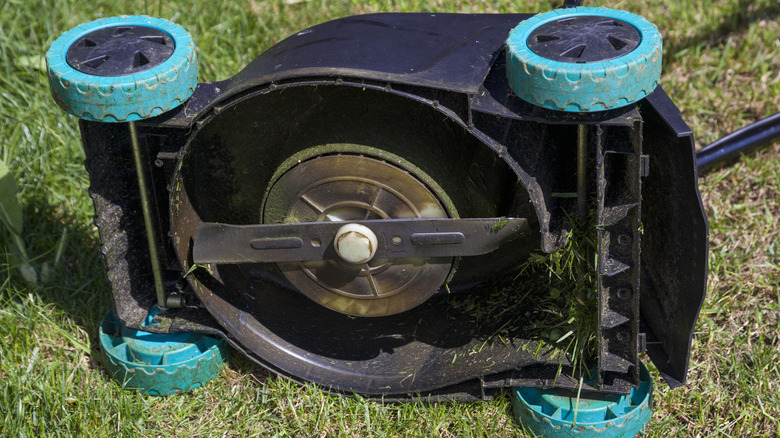
From chopping tall grass to watering your grass, understanding lawn mower basics is one part of keeping your turf healthy. And knowing how to prevent grass from sticking to your lawn mower's bagging chute can also make collecting clippings easier. But if you have ever wondered why lawn mower clippings always discharge out the right side of the deck, the reason is related to the direction in which the blade spins. Lawn mower blades have a specific rotation to provide the best cut and keep you from getting injured. Most push-type mowers have blades that rotate counterclockwise when viewed from below, and this is not a random design choice.
On a very basic level, lawn mower blades are designed to rotate counterclockwise because that's the direction the engine turns. Vertical-shaft small engines are standardized to rotate counterclockwise — this keeps them consistent across manufacturers. The blade is directly bolted to the engine crankshaft, so it makes sense that it spins in the exact same rotation. Working together in the same spin direction, the engine and the blades provide the upward suction needed to pull the grass straight up to get a clean cut.
Since the blades follow the same direction as the engine, it's only logical to wonder why the engine turns counterclockwise. A few factors went into the decision to standardize vertical-shaft engines in lawn mowers, with a major one being preventing the blade bolt from loosening during operation. Most push mowers use standard right-hand thread bolts, which tighten to the right. Because of how rotational torque acts on the bolt head, the engine's counterclockwise spin ensures that operating resistance continuously pushes against the bolt in a way that keeps it firmly secured to the crankshaft. Essentially, the rotation helps prevent the bolt from loosening. If the rotation were reversed without changing the bolt thread, hitting thick turf or a hidden stick could cause the mounting bolt to back out, creating a major safety hazard.
How counterclockwise rotation creates the perfect cut

When you look at a lawn mower in action, it's easy to think of the blade as just a pair of spinning scissors. However, the counterclockwise rotation of the blade does far more than just chop off grass tips — it acts as an aerodynamic vacuum system engineered to give your lawn a clean, even finish. As the blade spins counterclockwise at almost 3,000 RPM, the raised fins on the trailing edge act like fan blades, creating a powerful low-pressure area or vacuum underneath the deck. This sucks the bent and flattened grass blades up and into a vertical position just milliseconds before they are met by the precision-ground leading edge of the blade.
Because the blade rotates counterclockwise with the engine, it cleanly and precisely snips the grass like a pair of scissors to avoid ragged edges and browning. Meanwhile, this rotation creates an airflow that lifts the grass clippings into the interior of the deck, where they are easily ejected out the right side by a discharge chute. This prevents clumping under the deck and reduces how often you need to pause to clean your lawn mower deck, leaving a nicely trimmed lawn.
If this process is disturbed, like if you install a lawn mower blade upside down, the entire system is thrown out of balance. Instead of lifting grass to get a precise cut, an inverted blade pushes air downward, flattening the turf and bashing it with the dull trailing edge. This tears the grass rather than slicing it, leaving behind frayed, white-tipped blades that quickly turn brown and invite lawn disease.