

How To Stop Bermudagrass From Ruining Your Flower Beds
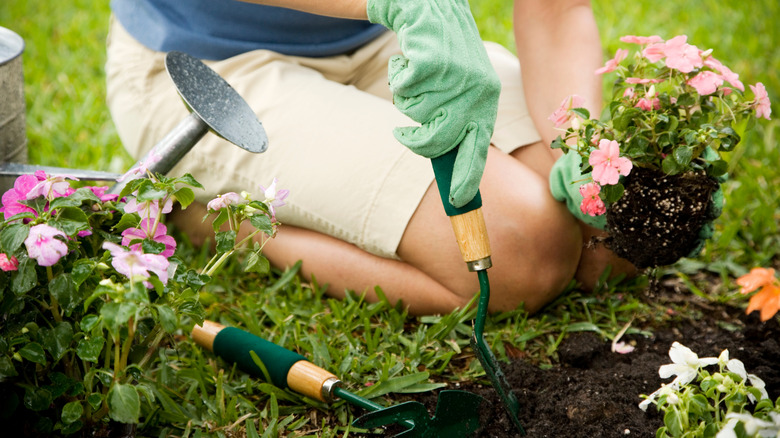
Bermudagrass (cynodon dactylon) was once hailed as an ideal turfgrass, due to its ability to thrive in any number of conditions. Yet that very tenacity is why modern homeowners now consider it one of the top grasses that should be avoided. These days, Bermudagrass is often treated as more weed than grass because of the shoots and rhizomes that have a way of quickly finding their way into your flower beds. So, taking a layered approach, literally, may yield the best results for you in stopping them from taking over your flower beds.
Start by mowing the Bermudagrass as close to the ground as you can get it. After that, put about ½ inch of compost on the ground, which will help get the decomposition process going. Next, lay down flattened cardboard, making sure to overlap each piece by about 6 inches. Staples designed to affix sod to soil can help secure the cardboard. Once that's done, use a hose to completely dampen the cardboard layers. Finish with a few inches of mulch on top. If any Bermudagrass seeds find their way into the mulch, remove those seedlings promptly.
If you'd rather not have a permanent wide border around your flower beds, consider temporary solarization measures to kill the Bermudagrass. Use clear polyurethane sheeting as a kind of flat "greenhouse" that uses the sun's rays to kill existing plants and seeds. After mowing Bermudagrass, lay the plastic so that it covers not just the unwanted turf, but also areas extending 2 feet on all sides, wherever practical. Leave the UV sheeting in place for at least four weeks, preferably during the hottest part of the summer.
Use a multi-pronged approach to eradicate Bermudagrass
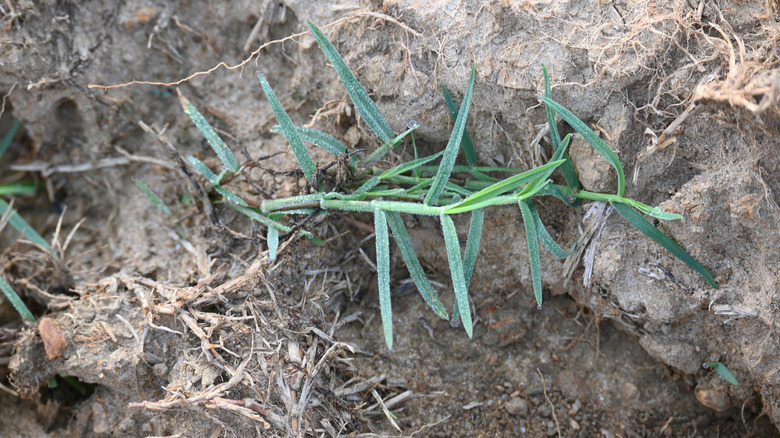
If it's impractical to devote a wide border of mulched or solarized areas around your flower beds, work to make the Bermudagrass itself feel unwelcome. Deprive the tough turf of the sun and moisture it needs to thrive. Start by establishing taller ornamentals and shrubs to shade out the area between the beds and the grass in the areas where it is most pernicious.
To deprive the weedy grass of the moisture it craves, make sure it's out of your watering zones. Set up soaker hoses or watering systems that dampen garden beds but not the nearby grass. And then, during periods of low rainfall, hoe or till the dry, grassy margins to bring Bermudagrass runners to the surface where they will be desiccated. This is an effective way to get rid of grass in your flower beds that only needs doing a few times a season.
Commercial products can also help support your other methods for dealing with the persistent problem. They work best on contact with living grass itself, rather than on the dormant lawn before it re-emerges in the spring. If you're looking for effective all natural weed killers to combat Bermudagrass, consider sprays containing vinegar. These can at least temporarily combat the problem. Other naturally derived products that may be effective are citrus oils, fatty acids, and clove oils. Always follow package directions carefully, even with non-toxic products.