

Cheaper Than Plywood: The Material To Use For Backyard Shed Walls & Roofs
We may receive a commission on purchases made from links.
If you've got the right skill set, building your own backyard shed can save you a fair bit of money compared with buying a ready-made one. However if you're not careful, by the time you've bought the lumber, roofing, siding, and all the other materials, you can quickly surpass the cost of a ready-made shed or DIY shed kit. While you obviously don't want to build something that's going to fall apart in a couple of years, you also don't want to spend more than you need to either, particularly when some of the less expensive materials can do the job just as well as the fancier, more costly ones.
One of the main places that offers the best opportunity for savings on the cost of materials is the sheathing, which is the layer of structural panels that covers the shed's framework and provides a solid base for siding and roofing. Plywood is one of the most common choices, but there is a cheaper alternative that's just as suitable for shed walls and roofs, and that's oriented strand board (OSB). It's widely used in residential construction but does have some limitations for use in outdoor projects like sheds. However, if used properly and in the right circumstances, it will do a perfectly adequate job as sheathing for your shed walls and roof. OSB is a great choice of material if you're trying to DIY a budget-friendly shed without breaking the bank.
Why OSB is a good choice for shed walls and roofs
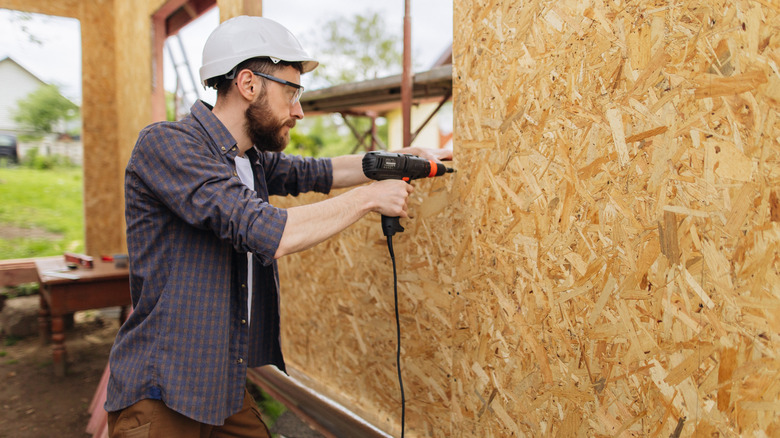
OSB is basically thin strands of wood arranged in layers and bonded with resin, then compressed into rigid panels. The end result is a rather unattractive rough patchwork, but as you're planning to cover the panels with siding or roofing, how they look doesn't really matter. What's more important is that OSB is a structural material that performs comparably to plywood when you use panels that are appropriately rated for the job.
OSB generally costs less than comparable plywood, which adds up to a decent saving when you're buying enough sheets to cover an entire shed. To give you an idea of the savings, Home Depot lists a 4-by-8-foot sheet of 7/16-inch OSB sheathing for $13.63, while a comparable-sized ¹⁵⁄₃₂-inch Plytanium plywood sheathing panel costs $27.81. That's a saving of $14.18 per sheet, or roughly 51%, although the plywood is slightly thicker and has a higher span rating, so make sure whichever panel you choose is suitable for your shed's framing.
It's also available in standard 4-by-8-foot panels so it's easy to work with. You can design your shed around these standard size sheet panels to help reduce offcuts and unnecessary expenses. For walls, OSB provides a layer of solid sheathing over the studs. On the roof it is ideal for the decking that supports your eventual roofing system. You'll need to check the panel's span rating against your framing spacing and the loads it needs to support. This is a particularly important DIY shed-building tip for roofs that need properly rated sheathing to handle the expected loads, including snow, if you live in an area where that's a concern.
Considerations when using OSB for a backyard shed
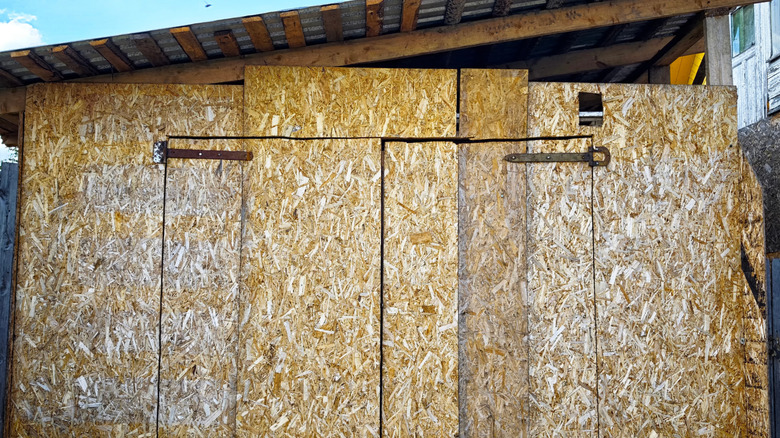
Although the adhesives used in the production of OSB are moisture-resistant, ordinary OSB sheathing is not waterproof. Prolonged exposure to moisture can cause the edges to swell and the surface to deteriorate rapidly. You'll commonly see panels rated as Exposure 1, which means that they can tolerate limited moisture during construction before being properly protected. That's not the same as being suitable for permanent outdoor exposure. Even exterior-grade plywood, which generally copes better with repeated wetting and drying, shouldn't be exposed indefinitely either.
If you're planning shed walls and roofing using OSB, you will need a suitable weather-resistant barrier and exterior siding to keep the rain off. On the roof, you'll have to install appropriate underlayment and finish it with shingles or another compatible roofing material. To maximize the lifespan of your OSB panels, don't leave them exposed to the weather any longer than necessary. Get the barrier in place as soon as possible after installation.
Check the manufacturer's directions and see how much of a gap you need to leave between panels. Generally speaking as a general rule, that is a ⅛-inch gap. This space gives the wood room to expand with changes in moisture levels without worrying about buckling. Make sure your shed has a good guttering and drainage system set up and that the OSB sheathing stays clear of any ground moisture. OSB is a good place to save money on a DIY shed, but only if you don't cut corners on keeping it properly dry.